

What Employers Are Actually Saying
Every month, Challenger, Gray & Christmas, a real firm that has tracked U.S. layoffs for years, asks companies why they cut jobs. In 2026, one answer took the top spot for the first time ever: AI.
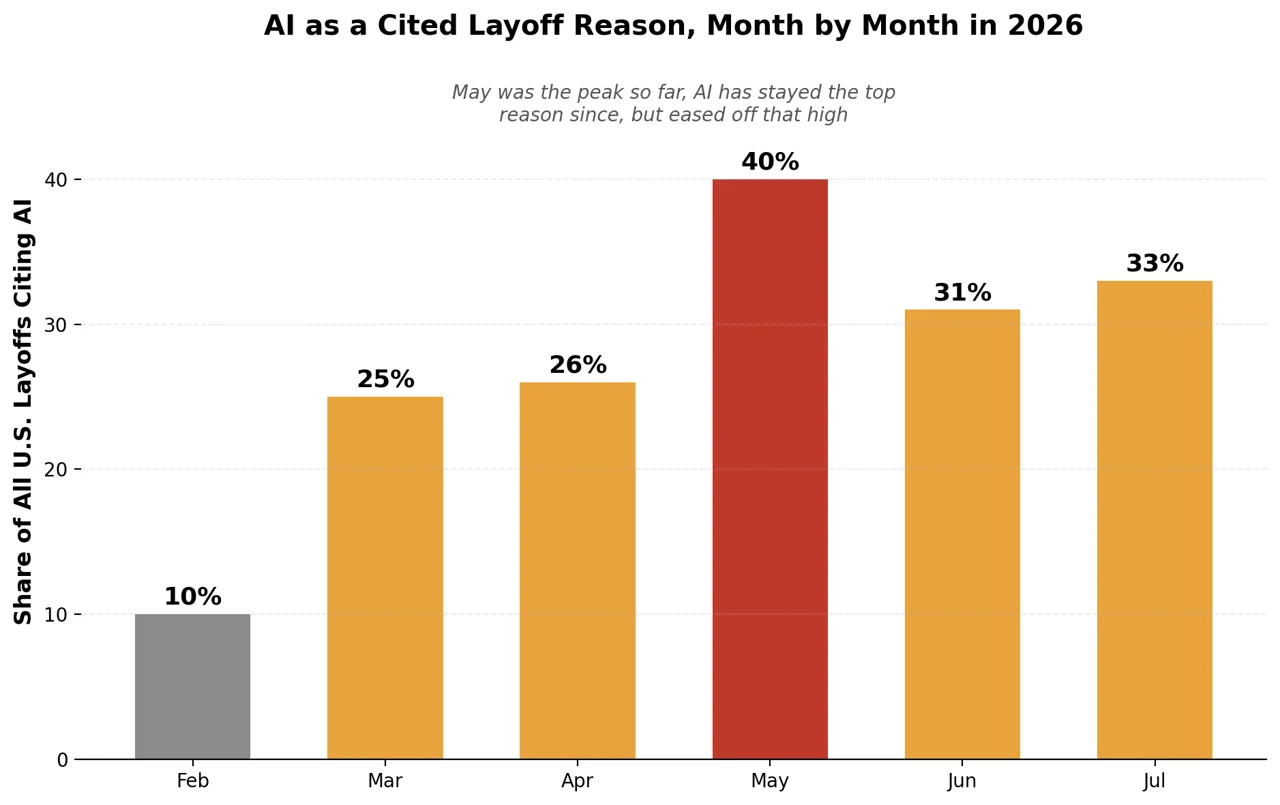
Here's how it actually played out, month by month, and it's not a simple straight line up:
- February - AI was blamed for 10% of that month's job cuts
- March - AI became the number one reason for the first time, 25% of cuts
- April - AI stayed in first place, 26% of cuts
- May - AI hit its highest point so far, 40% of all cuts that month. By now, AI had already been blamed for more 2026 layoffs (87,714) than in all of 2025 combined (54,836)
- June - AI dropped a bit from its May peak to 31% of cuts, but was still the top reason for the fourth month in a row
- July -`x AI stayed the top reason for a fifth month straight, about a third of that month's cuts. For the year so far, that's 112,713 job cuts blamed on AI, about 24% of everything
So the pattern isn't "AI keeps rising forever." It spiked hard in May, eased off a bit, and then settled in as the steady, most common reason companies give.
Here's the part most headlines skip. By July, total U.S. layoffs actually hit their lowest point in two years, and hiring was up 25% compared to last year. Andy Challenger, who runs the firm that tracks this data, said it simply: AI is changing the job market, but "it is not dismantling it."
So both things are true at once: AI really is the top reason companies give for cutting jobs right now, and the job market overall isn't falling apart. Since this firm started tracking AI as a specific reason back in 2023, it's now been blamed for 184,538 job cuts total, and more than 60% of that entire three-year total happened in 2026 alone.
One honest caveat worth knowing: even Challenger itself has flagged that what actually counts as an "AI-attributed" layoff isn't always clear-cut. In its July report, the firm noted an example of a company citing new software that may or may not run on AI, illustrating that these numbers depend partly on how a company chooses to describe its own layoffs, not a strict, independently verified test applied to every case. That doesn't make the trend fake, it just means the exact monthly percentages are closer to a well-tracked estimate than a perfectly precise count.
The Bigger Picture: Jobs Lost vs. Jobs Gained
Zooming out from month-to-month numbers, the biggest long-term study on this comes from the World Economic Forum's Future of Jobs Report 2025. It's one of the most serious studies out there, based on employers representing over 14 million workers worldwide.
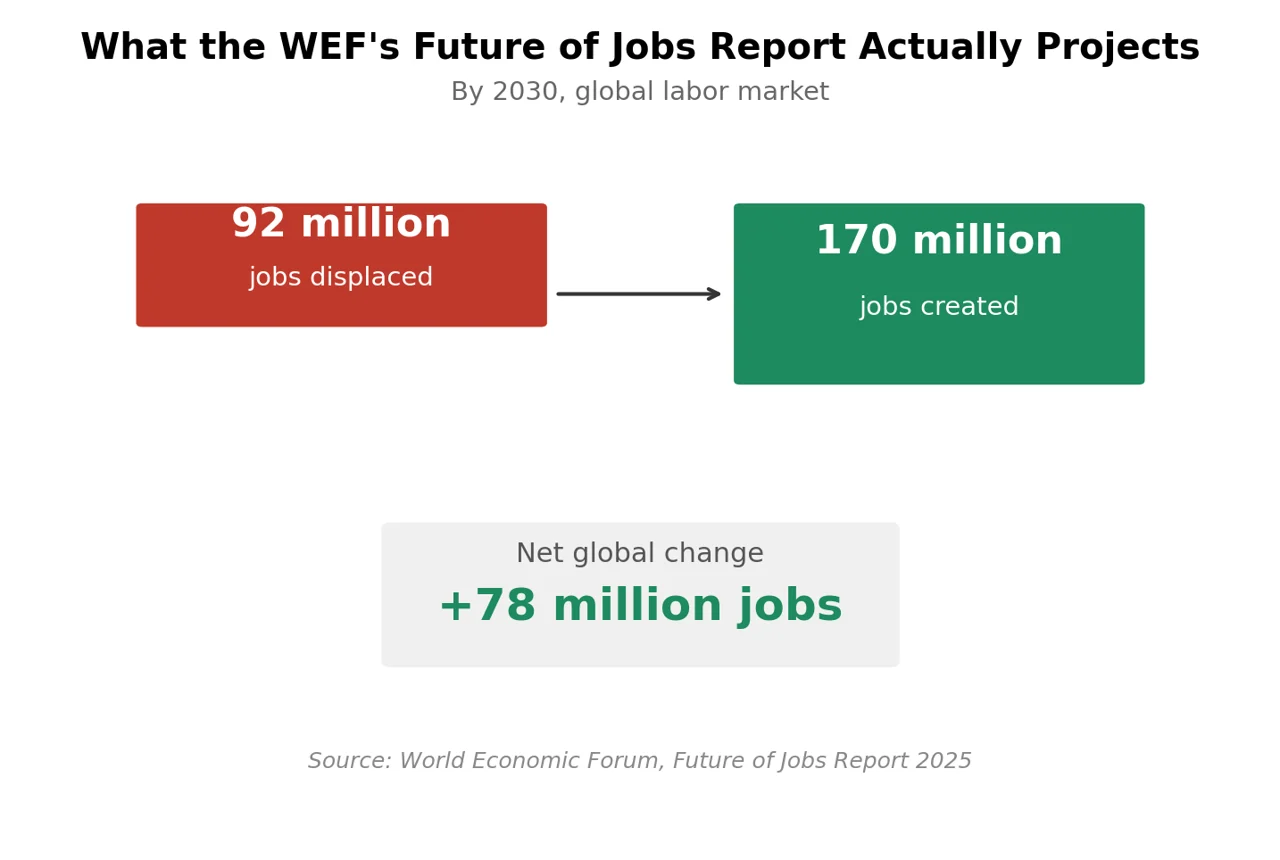
The Forum's own main finding isn't "AI destroys jobs." It's a simple before-and-after: by 2030, about 92 million jobs are expected to disappear because of AI and other changes, but about 170 million new jobs are expected to show up. That works out to roughly 78 million more jobs overall, worldwide.
That doesn't mean nobody loses their job. It means the pain isn't spread evenly, some jobs and industries shrink while new kinds of jobs grow somewhere else, rather than the whole job market simply getting smaller.
Why It Feels Bigger Than the Numbers Show
If AI layoffs are still a smaller slice of total layoffs, why does it feel like such a huge deal everywhere? Two real numbers explain that gap.
A lot more people are using AI at work than are losing their jobs to it. Anthropic's own research, based on real Claude usage, found that about 49% of jobs already use AI for at least a quarter of their daily tasks. That covers around 375 million workers worldwide, about 14% of the whole global workforce. Most of those people still have their jobs, this is a measure of how much AI gets used, not how many jobs disappeared. But it explains why AI feels like it's everywhere, even for people nowhere near a layoff.
Meanwhile, a more careful look at real layoffs tells a smaller story. Researchers at Oxford studying 2025 layoffs found that AI was only named as a factor in a little under 1 in 20 of them. That's real, but a lot smaller than the scariest headlines suggest.
Which Jobs Are Actually Most at Risk
The same tracking firm's industry data shows the pain isn't spread evenly:
- Tech has been hit hardest all year, about 31% of all 2026 job cuts, up 67% from last year
- Transportation had the biggest jump of any industry, up 303% from last year, now the second-most-cut industry overall
- Healthcare is up a smaller 6% from last year
- Media, on the other hand, is actually down 55% from last year, proof that not every industry is moving the same direction
Beyond industry, the type of work matters most. Across many different studies, one pattern keeps showing up: routine, predictable, rule-based work, like data entry, basic customer support, and standard paperwork, is far more at risk than work that needs judgment, human connection, or physical presence.
That last point shows up directly in the hiring data too. Even as tech layoffs climbed through 2026, Challenger's July report noted that hiring demand was actually growing fastest in aerospace, energy, and manufacturing, hands-on, physical, floor-based work. It's a real-world example of the same pattern: the jobs hardest to automate right now are also the ones companies are still actively hiring for.
So What Should You Actually Do?
- Don't panic, but don't ignore it either. AI-driven job cuts are real and growing, this isn't just a scary headline
- Look at what your job actually involves. If most of your day is repetitive, rule-based tasks, that's the highest-risk category right now
- Learning to use AI well is becoming a real skill. Since it's already touching almost half of all jobs in some way, knowing how to work with it, not just worrying about it, is a genuine advantage
- The overall job market isn't collapsing, so this isn't a reason to make big, panicked decisions, just a reason to pay attention to where your specific role sits
The Bottom Line
The honest answer to "will AI replace your job" isn't a simple yes or no. It depends heavily on what your job actually involves, and right now the data shows real change without the job market falling apart. AI becoming the top reason for layoffs in 2026 is genuinely true, not made up. So is the fact that hiring is still growing at the same time. Both are real. The real story sits somewhere between "robots are taking every job" and "there's nothing to worry about," and the actual numbers are the best way to figure out which one applies to you.
Based on Challenger, Gray & Christmas's monthly U.S. job cut reports through 2026, the World Economic Forum's Future of Jobs Report 2025, Anthropic's Economic Index, and Oxford research on 2025 layoffs. Layoff data updates every month, check Challenger's own reports for the latest numbers.