

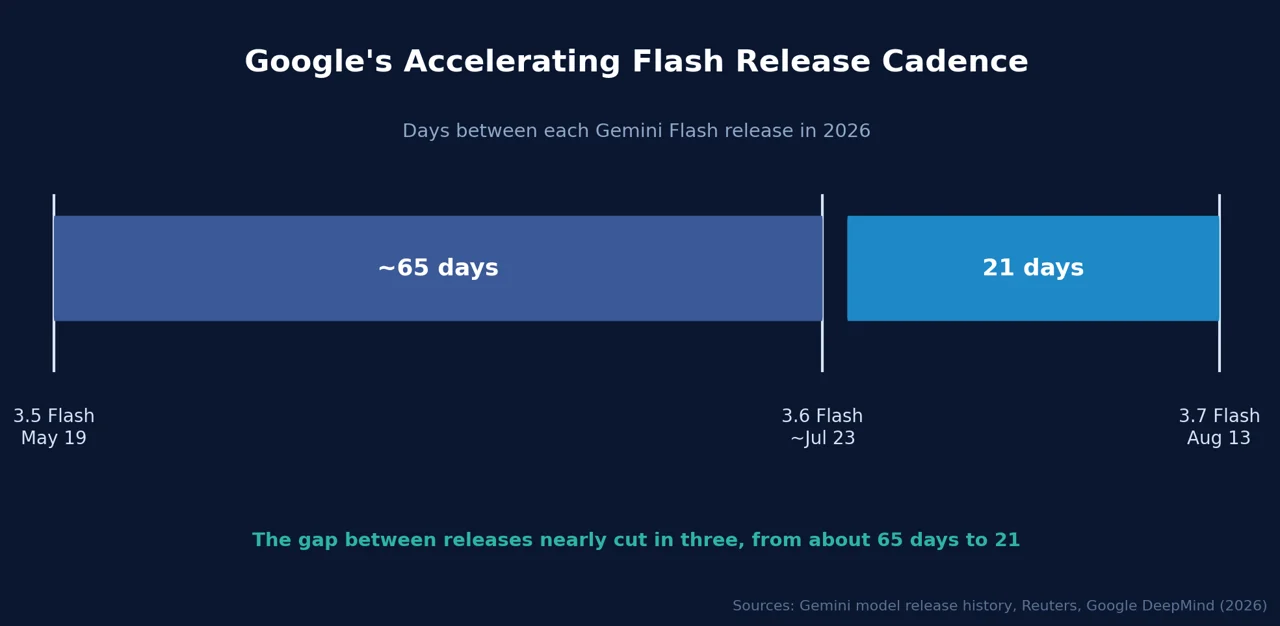
Three weeks. That's how long Google waited between Gemini 3.6 Flash and its successor, an unusually fast turnaround even by 2026's standards. Gemini 3.7 Flash landed and the pitch isn't a bigger model, it's a sharper one, with real gains in coding and document work, a price cut to match, and a leadership change happening quietly in the background.
Quick Answer
- Gemini 3.7 Flash launched August 13, 2026, just three weeks after Gemini 3.6 Flash
- It's a refinement, not a new pretraining run, Google's own model card describes it as algorithmic improvements to the existing reasoning foundation
- Real gains concentrate in coding, document-heavy work, and web development
- Price dropped to $0.75 per million input tokens and $3.75 per million output tokens, half the original 3.6 Flash rate, though this is introductory pricing that rises on January 1, 2027
- It now powers Gemini Spark, Google's AI agent for Pro and Ultra subscribers, live in more than 160 countries starting the same day
- Google DeepMind is undergoing a leadership transition at the same time, with Koray Kavukcuoglu reported to be replacing Demis Hassabis
What Actually Changed
Where It Leads
| Benchmark | What It Measures | 3.6 Flash | 3.7 Flash |
|---|---|---|---|
| FrontierCode 1.1 Main | Production code quality | 34.4% | 43.6% |
| DeepSWE v1.1 | Long-horizon software engineering | 49.0% | 65.3% |
| WebDev Arena (Elo) | Web app generation quality | 1538 | 1588 |
| GDP.pdf | Complex document comprehension | 22.0% | 34.0% |
| AutomationBench | Enterprise workflow automation | 17.0% | 30.4% |
| Harvey LAB-AA | Complex legal workflows | N/A | 90.7% |
| LVBench | Long video understanding | N/A | 85.4% |
| GDM-MRCR v2 | Long-context retrieval (128k / 1M) | N/A | 97.0% / 62.5% |
The AutomationBench jump is the one worth sitting with. At 30.4%, 3.7 Flash now leads both Claude Sonnet 5 (10.7%) and GPT-5.6 Terra (23.6%) on Google's own enterprise workflow benchmark, a category that matters more for actual business use than most headline coding scores. On FrontierCode 1.1 Main, its 43.6% is also the best figure in Google's launch comparison, ahead of both Claude Sonnet 5 and GPT-5.6 Terra.
The FrontierCode Benchmark, Explained
It's worth knowing what that headline number actually measures. FrontierCode 1.1 Main comprises 100 programming tasks spanning multiple languages, and it doesn't just grade whether code runs. Submissions have to pass bug testing and follow project-specific style guides, closer to a real engineering review than a typical pass/fail coding benchmark. Google says 3.7 Flash outperformed comparable Anthropic and OpenAI models across nine separate benchmarks at launch, not just this one.
Where It Still Falls Behind
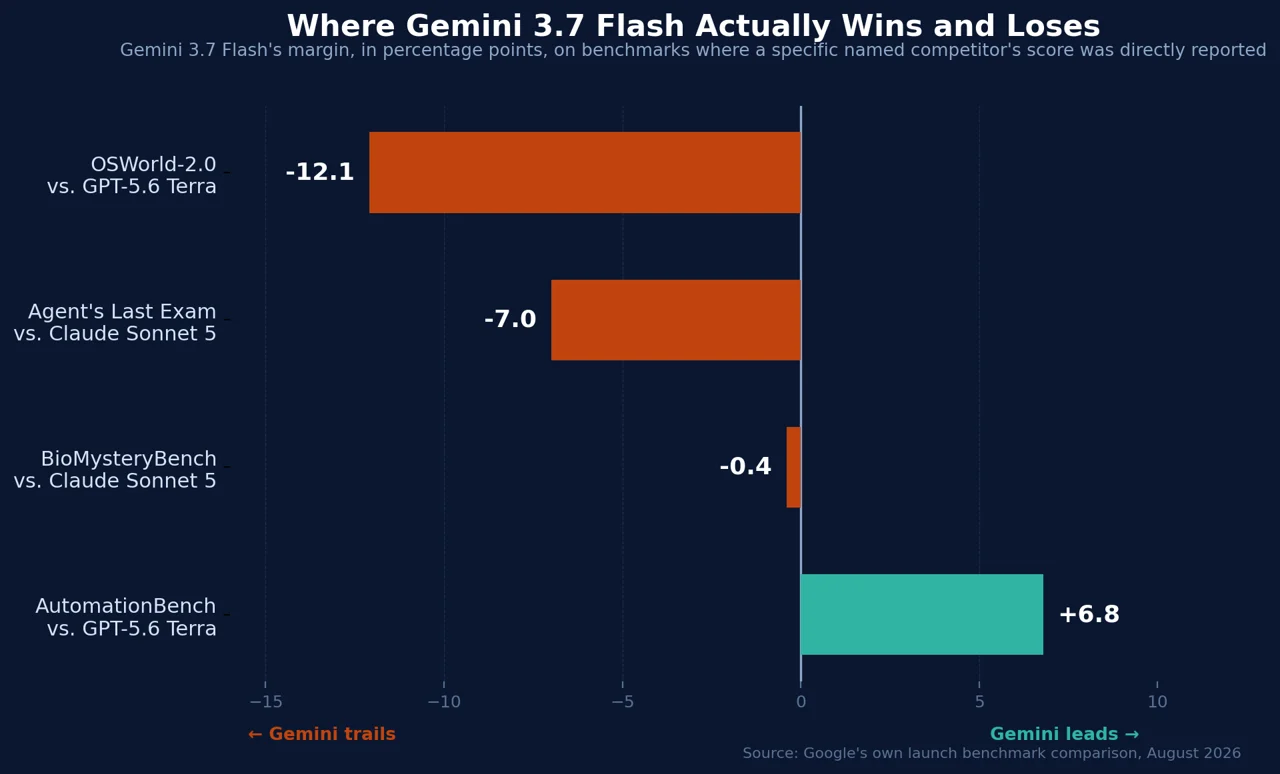
Google's launch materials lean into the wins, but independent benchmark trackers ran the fuller comparison, and 3.7 Flash doesn't sweep every category:
- OSWorld-2.0 (agentic computer use): GPT-5.6 Terra leads at 50.2% vs. Gemini's 38.1%
- Agent's Last Exam: Claude Sonnet 5 leads at 33.3% vs. Gemini's 26.3%
- BioMysteryBench (human-solvable category): a near-tie, Claude Sonnet 5 at 87.5% vs. Gemini's 87.1%
The pattern: 3.7 Flash's real strength is document-heavy, coding, and enterprise-automation work, exactly what Google built it for. On harder, more open-ended agentic reasoning, it's competitive but not always ahead.
What Google Says Changed Under the Hood
Beyond the numbers, Google says the model is more diligent in practice: it adapts better when it hits a roadblock, asks for clarification when intent is unclear, and follows multi-step instructions with more fidelity than its predecessor. Google frames this as putting more effort into multi-step planning and tool calls, which in practice means more disciplined execution, less manual oversight, and fewer retries across engineering workflows.
The Specs
Core Specifications
- 1-million-token context window, unchanged from prior Flash models
- Up to 64,000 output tokens per response
- Multimodal: reads text, images, audio, and video
- Customizable "thinking" settings, letting you trade reasoning depth for speed and cost per request
- Knowledge cutoff stays at March 2026, consistent with this being a refinement rather than a fresh training run
Safety Updates
The model ships with updated guardrails alongside the performance gains. Google describes the changes as updated safeguards against misuse in the domains of Chemical, Biological, Radiological, and Nuclear (CBRN) risk and cyber offense, applied in accordance with the company's approach to bioresilience and its cyber program, while still aiming to preserve legitimate, beneficial use cases in those same domains.
What It Actually Costs
The Headline Pricing
| Now through Dec 31, 2026 | Starting Jan 1, 2027 | |
|---|---|---|
| Input | $0.75 per million tokens | $1.50 per million tokens |
| Output | $3.75 per million tokens | $7.50 per million tokens |
How It Actually Compares
Google's own pricing table puts this in sharp relief against its two closest mid-tier rivals:
| Model | Input (per million tokens) | Output (per million tokens) | Blended cost at 80/20 input-output mix |
|---|---|---|---|
| Gemini 3.7 Flash | $0.75 | $3.75 | $1.35 |
| Claude Sonnet 5 | $2.00 | $10.00 | $3.60 |
| GPT-5.6 Terra | $2.00 | $12.00 | $4.00 |
That's roughly a third of the blended cost of Claude Sonnet 5 or GPT-5.6 Terra at typical usage ratios. For teams running agents at real volume, that per-dollar gap matters more than any single benchmark win. Worth building around this window if you're deploying a high-volume coding or document-processing agent, but budget for the price doubling once the introductory period ends.
Where to Access It
For Developers
For Enterprises
Available through the Gemini Enterprise Agent Platform and the Gemini Enterprise app
For Individuals
Live now inside Spark, Google's personal AI agent, for Google AI Pro and Ultra subscribers, rolled out across more than 160 countries at launch
Who This Is Actually For
The Clear Winners
- Startups and mid-market teams gain the most. The introductory price makes always-on agents affordable without a Pro-tier budget
- Regulated enterprises get a governed path through Gemini Enterprise rather than the raw API
The One Real Exclusion
Teams with data-residency or air-gap requirements are left out entirely, there's nothing to self-host here, unlike some open-weight competitors.
What Google Is Actually Demoing With It
The Concrete Builds
Beyond benchmark charts, Google's own launch showcased a few concrete builds worth knowing about: a playable 3D game with characters and textures generated in real time (paired with Google's Nano Banana image tool), a fully interactive landing page built from a single prompt, a robotics model trained faster using a three-agent graph loop, and static annual reports converted into interactive web experiences.
Why This Matters for Gemini Spark Users
If you've already got Gemini Spark running, 3.7 Flash became its underlying model the same day it launched, no setup required on your end. Given Spark's Chrome auto-browse and file-handling features lean heavily on exactly the skills this update improved, document reading, multi-step task follow-through, and adapting when something goes wrong, this should be a meaningful quality bump for anyone already using it, not just a benchmark story.
The Part Google Isn't Talking About
The Gemini 3.5 Pro Delay
Google didn't give a release date for Gemini 3.5 Pro, its actual flagship model, which has reportedly been delayed despite previously undergoing partner testing. Shipping a Flash update this fast, three weeks after the last one, reads at least partly as filling the gap while the bigger model stays in the oven. The release also arrives amid a busy stretch of competing launches from Grok and DeepSeek, so the timing isn't purely internal either.
A Leadership Change at DeepMind
The Flash release lands in the middle of a real organizational shift: Google DeepMind is reported to be undergoing a leadership transition, with Koray Kavukcuoglu replacing Demis Hassabis. Google hasn't tied that change to the Gemini 3.5 Pro delay directly, but the timing of a leadership transition alongside a stalled flagship release is hard to read as pure coincidence.
Is Gemini 3.5 Pro Even Still Coming?
Here's the detail that got less attention than it deserved. Google declined to discuss Gemini 3.5 Pro's fate directly, but confirmed it's already training for Gemini 4 and is "excited by early results." That leaves a real, open possibility that 3.5 Pro gets quietly shelved entirely, with Google skipping straight to a Gemini 4 Pro release instead of ever shipping the model investors have been waiting on since July.
The Honest Verdict
The Bottom Line
This isn't a flagship moment, and Google isn't pretending otherwise, the knowledge cutoff didn't move and this is explicitly a refinement, not a new model built from scratch. But the actual gains are real and land exactly where a workhorse model needs them: coding, documents, and enterprise automation, at a third of the blended cost of its closest rivals for the next several months. If you're already on Gemini Spark or building agents on Google's stack, this is a genuine upgrade with no extra work required. If you're waiting for Gemini 3.5 Pro, that wait just got a little longer, and it's now a fair question whether it's coming at all.
Sourced from Google's official model card and developer docs, cross-checked against Reuters, Bloomberg, and Axios. DeepMind leadership change reported by one outlet only, unconfirmed by Google.