

The Short Version
xAI released Grok 4.6 on August 12, 2026, the successor to Grok 4.5, which had shipped less than a month earlier. Rather than scaling up to a bigger model, xAI kept the same foundation and poured the improvement into post-training, better fine-tuning and reinforcement learning, aimed at long-running agents, multi-step coding, and interactive or visual work. It ties GPT-5.6 Sol on overall intelligence at a noticeably lower price, but it's genuinely slow to start responding, and it trails on the coding benchmarks engineering teams tend to care about most.
What Is Grok, Quickly
If you're not already familiar with it
Grok is the AI model family built by xAI, Elon Musk's AI company, and it's the model behind the AI features inside X (formerly Twitter). Grok has followed an unusually fast release cadence compared to other labs, Grok 4.5 shipped July 16, 2026, and Grok 4.6 followed less than a month later, on August 12.
That pace is deliberate
xAI has publicly signaled Grok 4.7 within weeks of 4.6, and Grok 5 before the end of 2026, a tempo few other frontier labs have tried to sustain.
A Real Demonstration Worth Knowing
Benchmark scores are one thing, seeing the model actually work is another. A day after launch, a developer known online as DirtyTesLa shared a demonstration where Grok 4.6 worked autonomously from a single prompt for 22 straight minutes and produced a working project complete with custom shaders, a minimap, and a time-of-day change feature, without additional prompting along the way. That kind of extended, unsupervised task completion is exactly what xAI positioned this release around, long-running agentic work rather than quick single-turn answers.
What Actually Changed From Grok 4.5
- Same foundation, better training. Reports differ on whether Grok 4.6 sits on the same base as Grok 4.5, but xAI's own announcement is notably silent on parameter count, the improvement is framed entirely around post-training, not scale
- A new top reasoning tier. Effort levels now go low, medium, high (the default), and a new xhigh setting for the hardest tasks
- More self-checking built in. xAI says the model tests and verifies its own work more often before finishing a task
- A meaningful benchmark jump. Grok 4.6 beats Grok 4.5 High on every published benchmark, in some cases by a wide margin
Full Pricing Breakdown
The headline price is simple, the fine print is where it gets more complicated.
| Tier | Input (per 1M tokens) | Output (per 1M tokens) | Cached input |
|---|---|---|---|
| Standard (under 200K prompt) | $2.00 | $6.00 | $0.50 |
| Long-context (200K+ prompt) | $4.00 | $12.00 | Applies to entire request |
| Priority / fast variant | 2x standard rate on everything | 2x standard rate on everything | 2x standard rate |
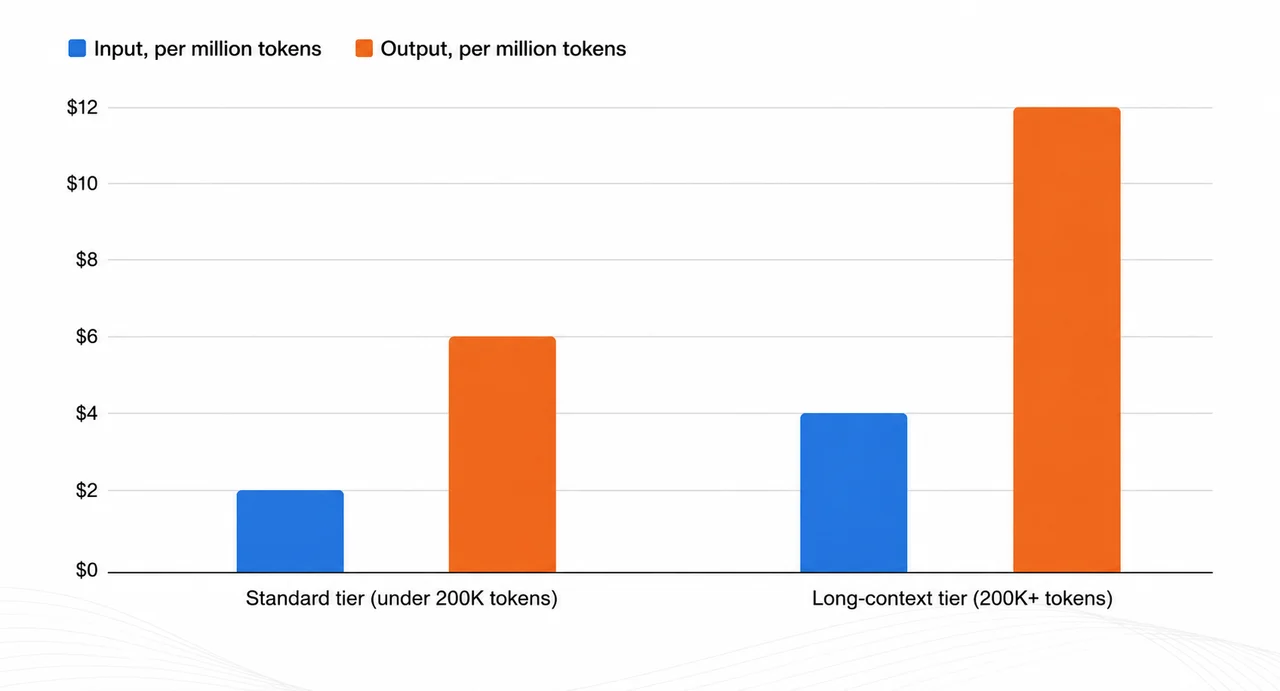
A few details worth knowing before budgeting around the headline number:
- The long-context tier isn't a surcharge on the extra tokens, it repriced the whole request. A prompt with 250,000 input tokens and 10,000 output tokens costs more than four times as much as a 100,000-token prompt with the same output, even though it's only 2.5 times larger, because crossing 200K moves the entire request into the doubled tier
- Tool calls cost extra. Web search, X search, and code execution each add $5 per 1,000 calls
- No batch discount on the flagship. Older models like grok-4.3 get a 20% Batch API discount for overnight, non-urgent work. Grok 4.6 doesn't, so high-volume batch workloads may actually be cheaper on an older model
- The fast variant has no published model ID yet. It's confirmed to exist and cost double, but isn't documented as a distinct, callable model on the API reference as of launch, worth checking the live console rather than hardcoding a name
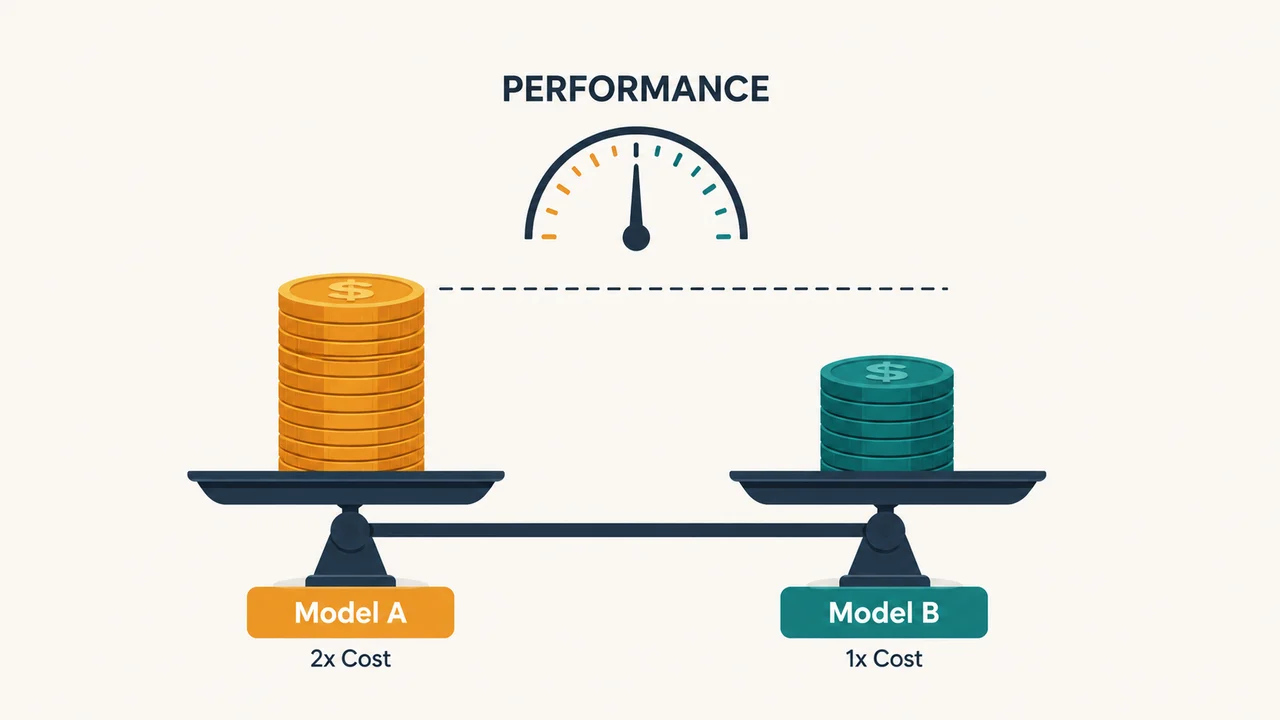
Against GPT-5.6 Sol's $5 input and $30 output pricing, Grok 4.6 is roughly 60% cheaper on input and 80% cheaper on output, according to OrcaRouter's pricing analysis, a real gap, not just favorable marketing framing.
Core Features
- 500,000-token context window, enough for a large codebase, a long research packet, or extensive agent conversation history
- Multimodal input: accepts text and images, though output is text only
- Function calling and structured outputs, standard for agentic and tool-using workflows
- Reasoning model architecture, using extended chain-of-thought before answering, adjustable across four effort levels
- Prompt caching support, xAI recommends a promptcachekey or conversation ID header so related requests hit the same server and cache more reliably
- Context compaction, for long-running agent loops that would otherwise need to carry every prior token forward indefinitely
- February 1, 2026 knowledge cutoff
How It Actually Performs
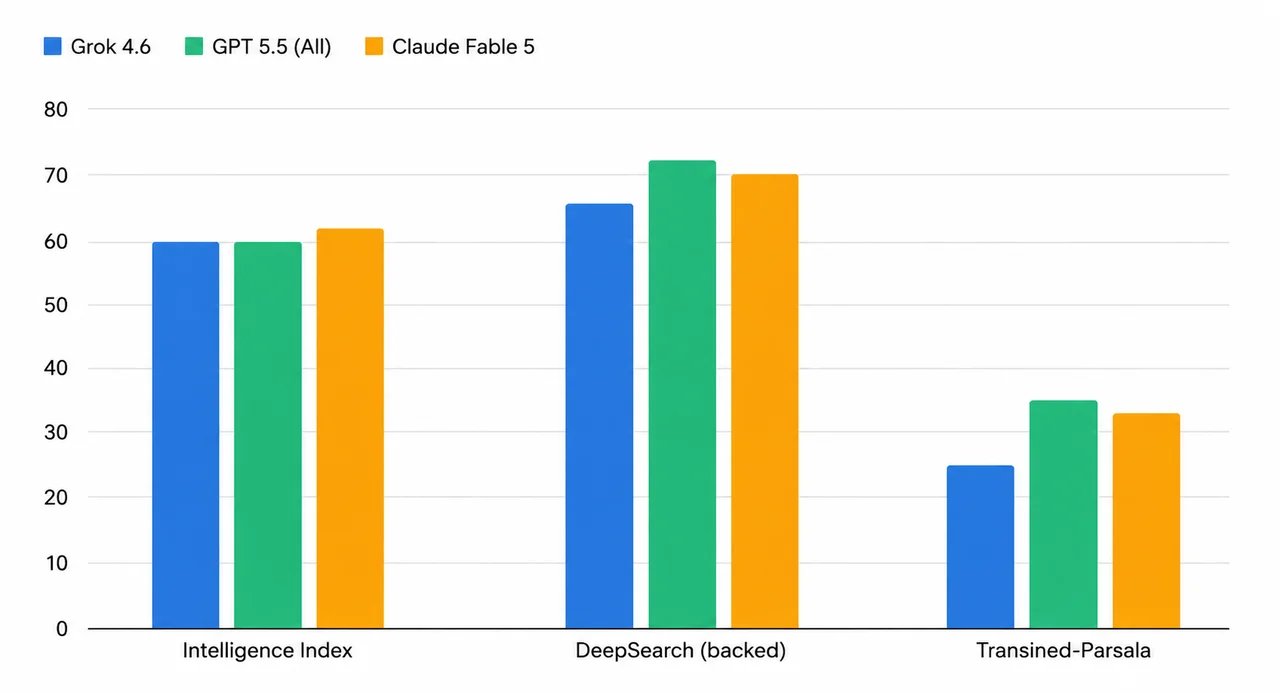
On the Artificial Analysis Intelligence Index, a composite of nine benchmarks, Grok 4.6 scores 61, tying GPT-5.6 Sol's max-reasoning configuration, one point behind Claude Fable 5 (62), two points behind Claude Opus 5 (63), and ahead of Kimi K3 (60), according to Artificial Analysis's independent testing. That's a five-point jump over Grok 4.5's score of 56.
The performance is genuinely uneven underneath that composite number, which matters more than the headline score:
- Wins: GDPval-AA v2 (1753 Elo, up from 1526), AA-Briefcase (1577, narrowly ahead of Fable 5's 1574), and Harvey LAB (15.8%, comfortably ahead of both GPT-5.6 Sol and Fable 5)
- Losses: DeepSWE v1.1 (65.9%, its weakest relative showing, behind GPT-5.6 Sol Max's 73% and Fable 5 Max's 70%), Terminal-Bench v3.0 (26%, well behind both rivals' roughly 34%, described by DEV Community's technical review as "not a rounding error"), and APEX-SWE (56.4%, behind Fable 5 Max's 58.8%)
The Real Limitations
- It's slow to start responding. Time to first token measures 42.09 seconds against a roughly 2.86-second median for models in its price tier, a significant real-world latency cost that the benchmark scores don't capture
- Below-average output speed. Roughly 67.6 tokens per second, slightly under the 68.5 t/s median for comparable models
- No published parameter count. xAI's own model card doesn't state one. Musk's public claim of 1.5 trillion parameters remains unverified against an official spec, and an earlier circulating figure of 2 trillion parameters turned out to be a misattribution of the upcoming Grok 4.7's 2.1 trillion parameter count
- Weakest on the coding benchmarks that matter most to engineering teams, specifically Terminal-Bench and DeepSWE, despite the model being positioned around agentic coding
- Some launch-week claims are self-reported and unverified. A 1753 score on LMSYS Chatbot Arena and a #1 spot on the Databricks leaderboard were both announced by Musk directly on X rather than published by the independent leaderboards themselves at time of writing
Who Should Actually Use This
- Teams running output-heavy agentic or coding workloads get the most out of Grok 4.6's pricing specifically, since the savings are largest on output tokens, which is where coding and long-agent-loop costs concentrate
- Latency-sensitive, real-time interactive use cases are a weaker fit, the slow time-to-first-token makes it a worse choice than faster competitors for anything where a quick response matters more than deep reasoning
- Terminal-heavy or DevOps-focused coding work should look elsewhere first, given how far it trails on Terminal-Bench specifically
- Budget-conscious teams already comfortable with some benchmark trade-offs are the clearest winners here, the intelligence-per-dollar case is genuinely strong if the specific weaknesses above don't touch your workload
Where You Can Actually Use It
Grok 4.6 is live now through the xAI API (OpenAI-compatible, served from us-east-1 and us-west-2), Grok Build, Cursor, OpenRouter, Vercel, and Cloudflare. Through August 19, Grok Build and Cursor users get double the included usage to test it.
Grok 4.6 vs the Rest of the Frontier
A quick side-by-side, pulling together everything above into one reference:
| Grok 4.6 | GPT-5.6 Sol | Claude Fable 5 | Claude Opus 5 | Kimi K3 | |
|---|---|---|---|---|---|
| Intelligence Index | 61 | 61 | 62 | 63 | 60 |
| Input price (per 1M) | $2.00 | $5.00 | $10.00 | $5.00 | Open weight |
| Output price (per 1M) | $6.00 | $30.00 | $50.00 | $25.00 | Open weight |
| Context window | 500K | Standard, expandable | 1M | Standard | 1M |
| Standout strength | Price-to-intelligence ratio | Coordinated agent work | Long-horizon depth | Efficient daily use | Open, self-hostable |
| Clearest weakness | Slow to start, weak on terminal work | Requires trusting a closed model | Cost | Not the absolute ceiling | Trails on overall intelligence |
What's Next
xAI's roadmap points to a bigger jump coming soon: Grok 4.7**, a 2.1 trillion parameter model, is expected within weeks, with**Grok 5 targeted before the end of 2026. If that holds, Grok 4.6 is the refinement release, and 4.7 is where xAI makes its next real scale jump.
Details reflect xAI's official launch materials, Artificial Analysis's independent benchmark testing, and technical coverage published within 24 hours of the August 12, 2026 release. Several figures, particularly parameter count and some leaderboard claims, remain unverified or self-reported, flagged above. Check xAI's own documentation for the latest, since pricing and specs may shift quickly this early after launch.