Introduction
Two years ago, AI automation was still a pilot project, something a few forward teams were testing quietly in one corner of the business. In 2026, it's closer to infrastructure. Recent surveys show AI is now used in at least one business function at most large organizations, though enterprise-wide scaling remains far less common than initial adoption. The interesting question isn't whether adoption grew, it's what actually changed to make it grow this fast.
The Quick Answer (For People in a Hurry)
- The economics flipped: automating a task is now cheaper than paying a person to do it, in many customer-facing roles
- Buying replaced building: most companies no longer need to construct their own AI tools from scratch
- Agents do real work now: not single suggestions, but multi-step tasks completed with minimal supervision
- AI stopped being a separate purchase: it's increasingly bundled directly into the software companies already use
The Cost Math Finally Works
For years, the pitch for AI automation was efficiency. In 2026, it's arithmetic. In many customer-service deployments, AI-assisted conversations cost substantially less than fully human-handled interactions, often by a wide enough margin that the comparison isn't close. That's not a marginal efficiency gain in those cases, it's a fundamentally different cost structure for one of the most common repetitive tasks in any company.
That math is a large part of why customer service tends to lead department-level automation adoption, and why AI already handles a meaningful share of customer interactions industry-wide, with that share expected to keep climbing over the next couple of years. When the cost difference is this large, the business case stops being a debate and starts being a spreadsheet.
From Building to Buying
Why did adoption accelerate so fast this specific year? Because the barrier to entry collapsed. Organizations increasingly prefer commercial AI platforms and embedded AI capabilities over building custom systems from scratch, a shift driven by falling model costs and rapidly improving off-the-shelf tools. The in-house engineering team that used to be a near-prerequisite for AI automation stopped being one.
What did that actually unlock? Mid-market and smaller companies that never had the engineering headcount to build a custom AI system suddenly had the same access as large enterprises, just through a subscription instead of a development team. That's a big part of why growth in smaller businesses has kept pace with, and in some categories outpaced, the large-enterprise segment this year.
Agents Do Real Work Now, Not Just Suggestions
The single biggest shift in 2026 isn't AI getting smarter, it's AI being trusted to finish something without a human approving every step along the way.
- Many organizations are experimenting with or beginning to scale AI agents, though broad enterprise deployment remains in its early stages, McKinsey reports roughly a quarter of organizations are scaling an agentic system somewhere, with a further share actively experimenting
- A large share of executives surveyed say they're increasing AI budgets specifically because of what agentic tools have already delivered, not purely because of projected future value
- Among companies that have deployed AI agents, a meaningful share report measurable productivity gains they can point to directly, not just a general sense that things feel faster
- Analysts increasingly expect AI agents to become a standard, expected feature inside enterprise software over the next few years, the same way search or notifications became standard features a decade ago
AI Is Now Embedded, Not a Separate Purchase
The other quiet driver: most companies aren't "adopting AI automation" as a distinct initiative anymore. It's arriving pre-installed.
- CRMs now ship with built-in lead scoring and outreach drafting
- Project management tools now summarize meetings and draft status updates automatically
- Design and writing tools now generate a first draft before you've typed anything
- Analysts expect AI copilots to be embedded in the large majority of enterprise workplace applications this year
When the AI feature is already sitting inside software a company already pays for, the adoption decision stops being "should we buy an AI tool" and becomes "should we turn this setting on." That's a much smaller decision, and it's a big part of why the growth curve looks the way it does.
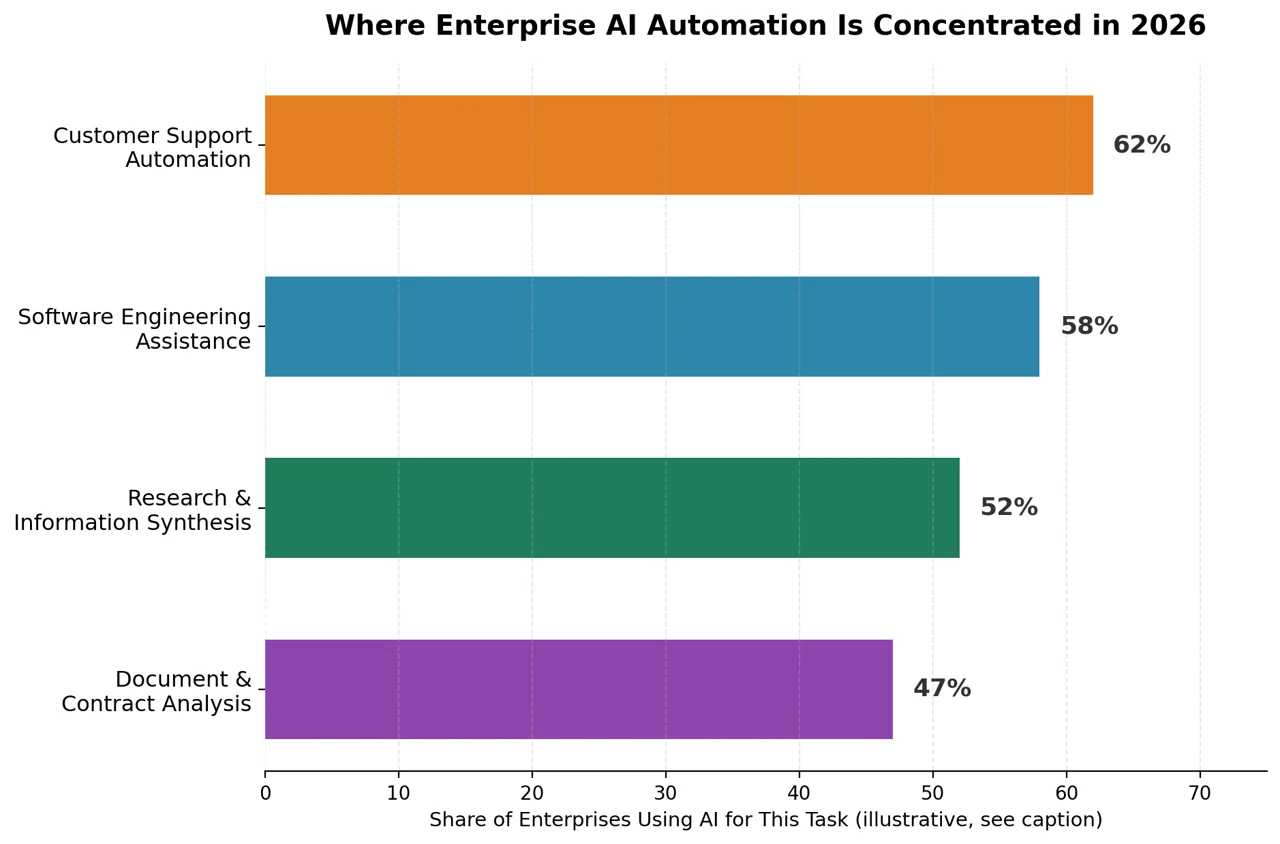
Illustrative figures compiled from industry AI-adoption surveys (Presenc AI's 2026 enterprise deployment data and Azumo's 2026 enterprise AI statistics), not from McKinsey, Stanford HAI, or IDC directly. Treat these as directional rather than precise, methodology varies by survey.
Final Verdict
None of these four drivers would have been enough on their own. Cheaper automation without agents that can actually finish a task wouldn't have moved the needle much. Agents that could finish tasks but still required a custom-built platform to access would have stayed limited to large enterprises. What made 2026 the breakout year is that all four lined up at once, cost, access, capability, and default distribution, and each one made the other three land harder.
Sources & Official References
- McKinsey, "The State of AI" (2026 survey series): https://www.mckinsey.com/capabilities/quantumblack/our-insights/the-state-of-ai
- Stanford HAI, AI Index Report 2026: https://hai.stanford.edu/ai-index
- IDC, worldwide AI and automation forecasts: https://www.idc.com/
Adoption figures vary across research firms depending on methodology and company size sampled; the ranges above reflect the general direction reported across multiple 2026 industry surveys rather than one single source. Check the linked reports directly for figures specific to your industry or region.