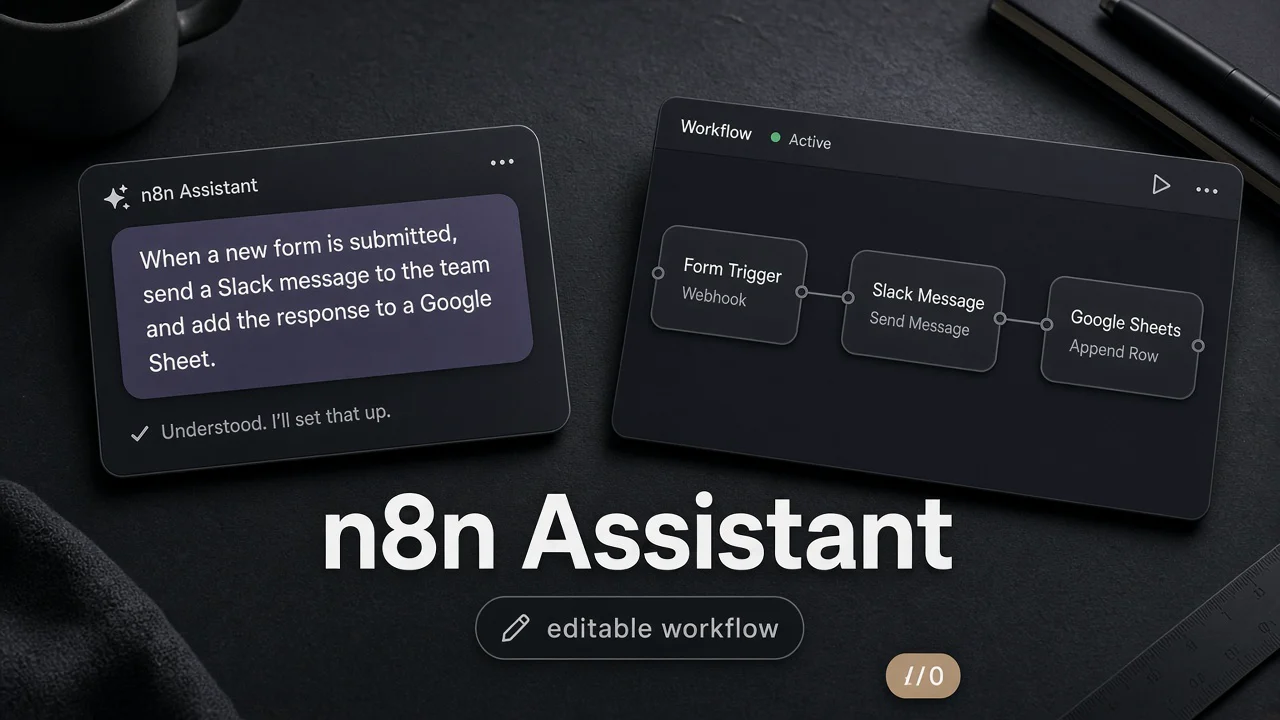
On September 9, 2026, n8n launched n8n Assistant in preview: describe an automation in plain language and it plans, builds on your canvas, asks for credentials, runs, and debugs - leaving a standard, hand-editable n8n workflow, not a one-shot black-box agent run. New Cloud Starter and Pro instances get it by default. Enterprise Cloud and npm are not the ready path. Self-hosted Docker uses your own model keys. Review before you activate anything important.
In short
- Preview product - review before production (Introducing n8n Assistant)
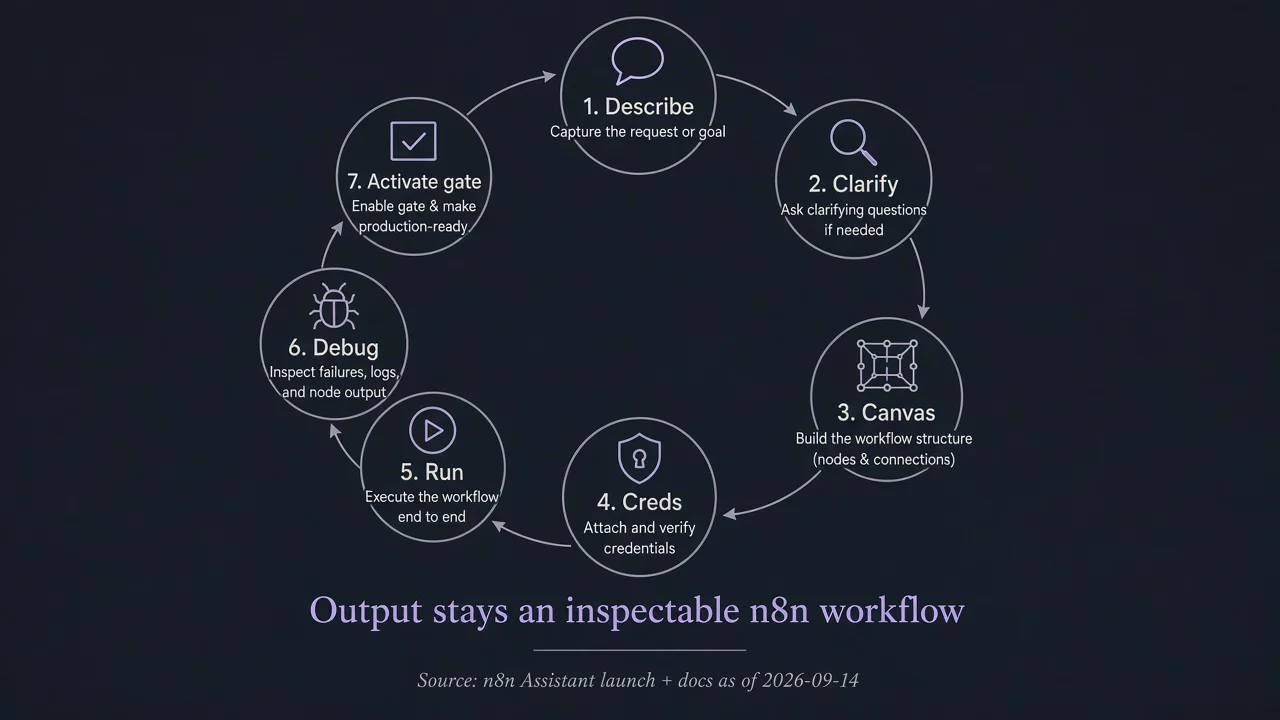
- Describe → clarify → canvas build → credentials → run → debug
- Output = inspectable, editable, re-runnable workflow with execution history
- Asks before credentials and activation / publishing
- Cloud plan AI credits (Starter/Pro); self-hosted BYOK; supersedes the old AI Workflow Builder
- Docker supported - blog cites 2.36+, changelog/community cite 2.35+ (both primary; do not flatten); npm unsupported
- Not another Zapier vs Make vs n8n bake-off - see the existing platform comparison once and stay on this loop
What does n8n Assistant actually do vs the old AI Workflow Builder?
The old AI Workflow Builder generated a workflow once and stopped. You got a starting graph, then you were on your own for credentials, first run, and every failure after that.
n8n Assistant (you may still see the older "AI Assistant" label in places) stays for the whole loop: it plans, builds on the canvas, asks when something is ambiguous, guides credentials, runs the workflow, reads execution data, and debugs failures. The result lives in n8n as a normal workflow your team can open next week - same editor, same logs, same hand edits.
That is the product promise in one line: AI helps you build and improve a real workflow, not hide the automation inside a chat transcript.
How do you go from a sentence to a runnable canvas workflow?
Describe the outcome, not the node graph. A good prompt names the trigger, the apps, what success looks like, and what should happen on failure. Ask it to confirm before publishing. Example shape (adapt to your stack):
When a new Typeform submission arrives, create or update a HubSpot contact,
notify #ops in Slack with the form answers, and ask me before activating.
If HubSpot fails, post the error to Slack and stop.
If you are brand-new to no-code automation habits, the adjacent starter How to Build Your First AI Automation Without Code covers mindset. This walkthrough is Assistant-specific.
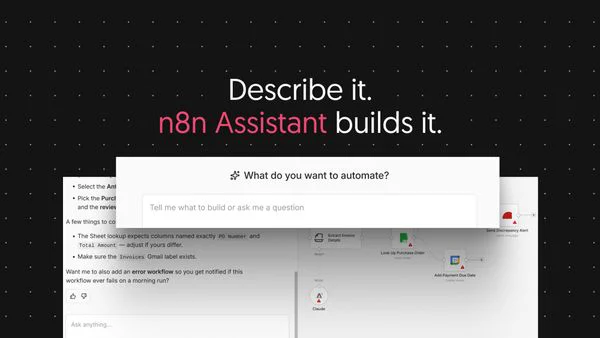
1) Describe the outcome
Open Assistant and say what should happen in production language. Include apps you already use. Skip "add an IF node after HTTP Request" unless you are fixing something specific.
2) Answer clarifying questions
When the ask is ambiguous, Assistant follows up ("which form?", "which Slack channel?") instead of silently building the wrong graph. Answer those before you expect a clean canvas.
3) Watch nodes appear on the canvas
Nodes wire into the same project canvas you would hand-edit. You can open chat beside the canvas or keep it compact - stay in the editor you already know.
4) Connect credentials the normal way
When a node needs an account, Assistant shows a credential card: pick an existing credential or create a new one. Secrets stay on standard n8n credential screens - do not paste API keys into chat. You still need a real third-party account (or permission to create one).
5) Run and watch execution data
Let Assistant run the workflow. Watch the same per-node inputs, outputs, and errors you would open by hand. On Cloud, community notes that the logs panel can open when an Assistant-built run starts - useful, not magic.
6) Debug, fix, re-run
On failure, Assistant diagnoses, proposes or applies a fix, and re-runs until the path is clean - or until something only a human can fix (missing account, wrong workspace permission, bad sample data).
7) Confirm before activation or publish
Assistant asks before consequential actions: credential access, activation, publishing, deleting, and other high-impact changes. Explicit confirm stays human. Do not treat the first green run as "ready for every customer."
Who can use n8n Assistant today?
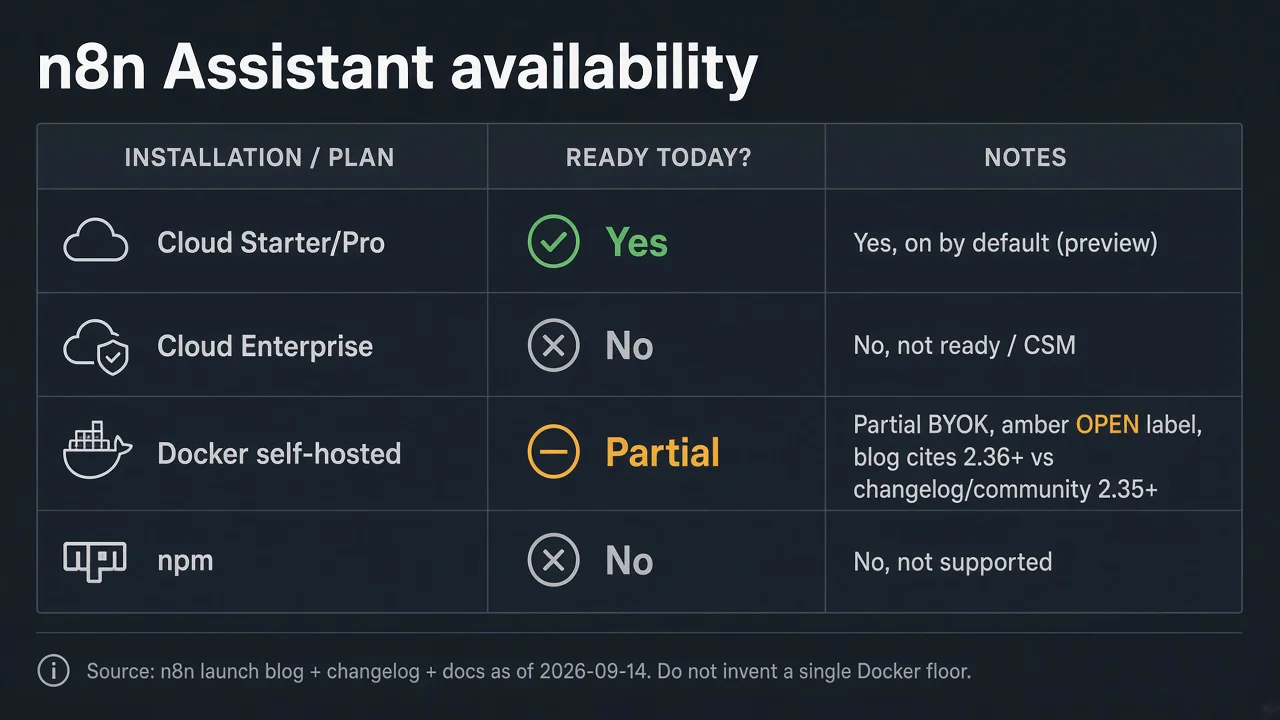
Today, new Cloud Starter and Pro instances get n8n Assistant on by default in preview; Cloud Enterprise and npm are not the ready path; self-hosted Docker uses your own model keys. Use this matrix as-of the Sep 9 launch blog, docs, community update, and pricing - then re-check before you promise a rollout.
| Surface | Availability | Keys / notes |
|---|---|---|
| Cloud new Starter / Pro | On by default (preview) | Launch blog + community Sep 10 |
| Cloud existing | On upgrade (community) | Existing instances get it when they upgrade |
| Cloud Enterprise | Not ready / excluded from default | Docs + pricing FAQ "except Enterprise"; CSM for preview |
| Self-hosted Docker | Supported (preview); BYOK | Version floor OPEN - see below |
| Self-hosted npm | Not supported | Docker path for Assistant |
| Self-hosted Enterprise | Roadmap / not ready | CSM for preview |
Docker version floor (do not flatten): the Sep 9 launch blog Availability section cites n8n 2.36 onwards. The official changelog and Paul Gordon's community note on easier self-hosted setup cite 2.35 or later. Setup docs say use current stable Docker without pinning one number. Until n8n reconciles the wording, treat both as primary sources: run a current stable Docker build, and if you are on 2.35.x verify Assistant against live docs for your build - do not invent a single undocumented floor.
Self-hosted needs a model provider key, a required sandbox, and optional search. The one-line setup (curl -fsSL https://get.n8n.io | sh) preconfigures sandbox + search; you still add the model key in AI settings or .env. Full steps: Set up n8n Assistant.
Credits (as-of pricing page; may change):
| Credit type | What it pays for | Notes |
|---|---|---|
| AI credits | Talking to Assistant (plan, build, debug) | Cloud: Starter 2,300/month; Pro 5,700 or 13,700 by plan size; trial 800 (expire with trial). Unused do not roll over. Buy-more "coming"; upgrade for a larger allowance today. Self-hosted BYOK = no Cloud AI credit cap. |
| Gateway credits | Model/tool nodes inside workflows | Not the same as AI credits |
Longer chats and debug loops burn more AI credits because usage is token-based. Do not invent a dollar-per-build number.
What still needs a human before you trust it?
Assistant is helpful. It is not your ops lead. The same automation trust gap still applies: a useful assistant does not replace a human who owns credentials, activation, and review.
- Credentials and third-party accounts - someone must own the Slack workspace, CRM, or form account.
- Activation and publish - explicit confirmation is required; treat that gate as real.
- Review - logic, credentials, and logs before business-critical use. First builds are not guaranteed production-ready.
- Hard limits from the launch post: not proactive; one instance only; does not drive your computer or browser to set up credentials for you.
Product usage detail lives in Use n8n Assistant. Preview callouts there match the blog: review before you rely on it.
Why keep an inspectable workflow instead of a one-shot agent run?
Keep the n8n workflow because teammates can open the same canvas next week - with execution history, credential governance, and schedule or webhook re-runs - instead of reconstructing a chat that "just did it."
An n8n workflow:
- Persists on the canvas for the next owner
- Keeps per-run execution history
- Uses normal credential governance
- Re-runs on schedule or webhook without re-prompting a model from scratch
That is why this post is not a platform bake-off. If you need Zapier vs Make vs n8n feature tables, use the existing comparison once and come back here for the Assistant loop.
When is a coding agent or a ChatGPT one-off a worse fit?
| Need | Prefer |
|---|---|
| Durable, audit-able graph teammates can own | n8n Assistant → canvas workflow |
| Recurring schedule / webhook runs + credential gates + per-node logs | n8n Assistant → canvas workflow |
| Open-ended coding with mid-run compiler/test feedback (and you accept hosting cost) | Coding agent |
| Truly one-shot help with nothing to hand over or re-run | ChatGPT (or similar) one-off |
No competitor pricing tables here - just pick the shape of work.
FAQ
Do I paste API keys or secrets into the Assistant chat?
No. Secrets stay on standard n8n credential screens, not in chat. When a node needs an account, Assistant shows a credential card so you pick an existing credential or create a new one. You still need a real third-party account (or permission to create one).
Does talking to Assistant spend AI credits or Gateway credits - and are they the same?
Talking to Assistant spends AI credits on Cloud (token-based; longer debug loops cost more). Gateway credits are separate and cover model/tool nodes inside workflows. They are not the same pool. Self-hosted Assistant uses your own model keys, so Cloud AI credit caps do not apply.
What Docker version do I need for self-hosted Assistant?
Primary sources still disagree. The Sep 9 launch blog says 2.36+. The changelog and official community self-hosted note say 2.35 or later. npm is unsupported either way. Use current stable Docker, add your model key, and confirm Assistant against live docs for your exact build until n8n unifies the floor wording.
Can I use Assistant on npm-installed n8n or Cloud Enterprise today?
No for npm, and not the ready path for Cloud Enterprise. Assistant needs the Docker path for community self-hosted. Cloud Enterprise is excluded from the default Cloud rollout; ask your CSM about preview. Starter and Pro Cloud (new instances by default; existing on upgrade) are the ready Cloud surfaces.
Does Assistant activate or publish workflows without asking me?
No. It asks for explicit confirmation before activation, publishing, credential access, deleting, and other high-impact changes. You still own the go-live decision.
Do unused Cloud AI credits roll over, and can I buy more today?
No. Unused AI credits do not roll over, and trial credits expire with the trial. Buy-more is listed as coming; today you upgrade for a larger monthly allowance. Credit numbers may change - confirm on n8n's live pricing page. Self-hosted BYOK has no Cloud AI credit cap.
What to do next
- Pick a non-critical automation (a Slack notify or a form → sheet path).
- On Cloud Starter/Pro, open Assistant - or on Docker, finish setup with BYOK.
- Run one describe → canvas → creds → run → debug loop.
- Read the graph and logs yourself before you activate.
- Keep production gates human while the product is in preview.
Preview status, credit allowances, and plan gates can change - confirm on n8n's live blog, docs, and pricing before you roll it out.