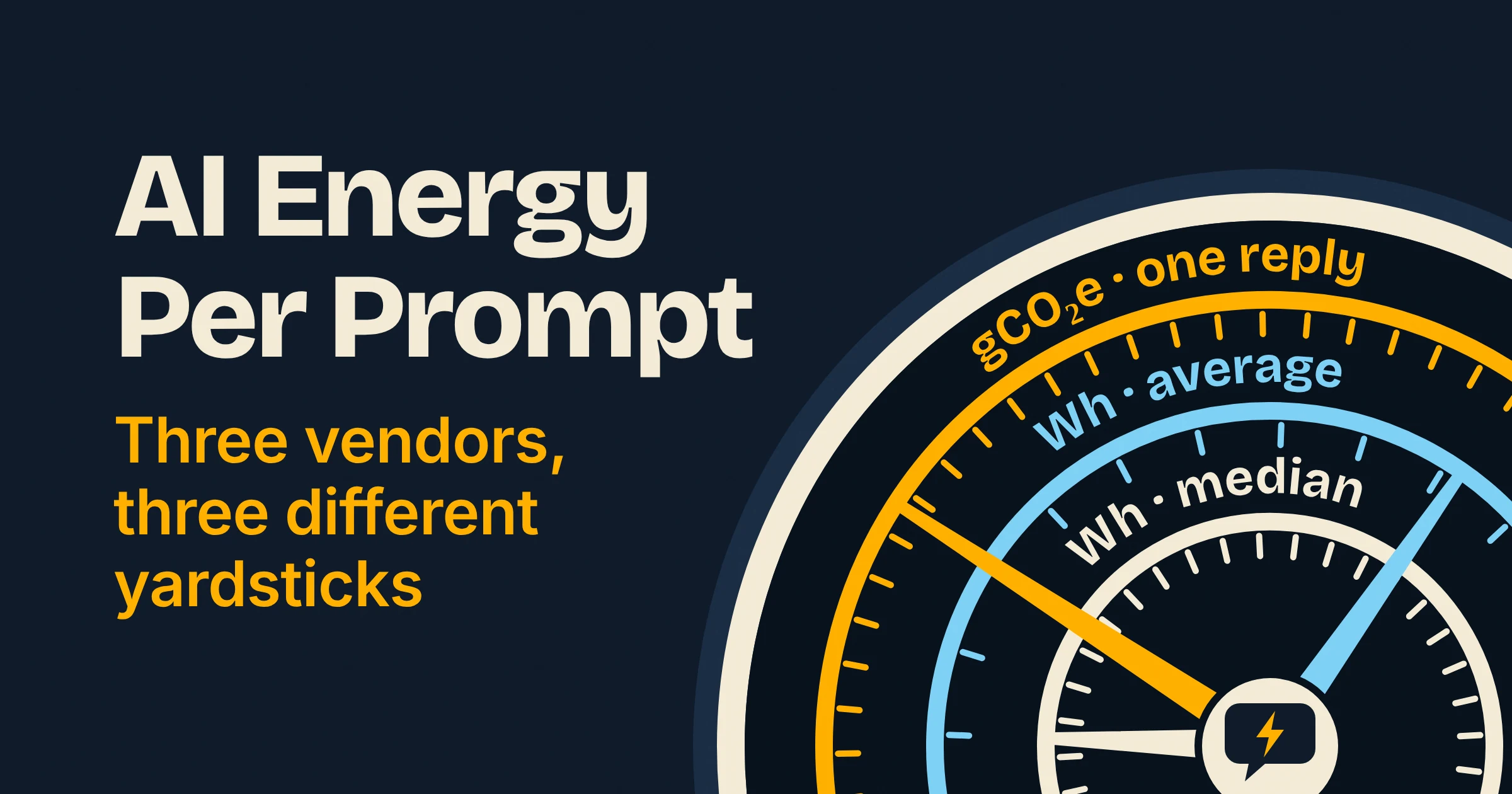
A typical text prompt to Google Gemini or ChatGPT uses a fraction of a watt-hour (Wh) of electricity, by the latest figures from Google and from OpenAI CEO Sam Altman. Google says the median Gemini Apps text prompt uses 0.24 Wh, about as much energy as watching TV for less than nine seconds. Altman says the average ChatGPT query uses about 0.34 Wh.
Mistral AI reports carbon and water for one Le Chat reply, but no energy number. All three figures date from 2025 and measure different things, so none of them can crown a greener chatbot. Below you get them in one table with their labels, a quick way to work out your own daily footprint, and a list of what these three still haven't published.
How much energy does AI use per prompt? The vendor numbers side by side
As of November 2026, the latest vendor figures are 0.24 Wh for a median Gemini Apps text prompt (Google), about 0.34 Wh for an average ChatGPT query (Sam Altman) and 1.14 gCO2e plus 45 mL of water for one 400-token Le Chat reply (Mistral AI). All three were published in 2025, and the research for this post found nothing newer from these labs.
gCO2e means grams of carbon dioxide equivalent: every greenhouse gas counted as if it were CO2.
| Vendor figure | Statistic | Energy | Carbon | Water | What it covers | Best for |
|---|---|---|---|---|---|---|
| Google, Gemini Apps (published August 21, 2025; May 2025 data) | Median text prompt | 0.24 Wh | 0.03 gCO2e | 0.26 mL, about five drops | Full serving stack, idle machines and cooling included; carbon and water from 2024 fleet averages; not verified by a third party | Everyday text chats with Gemini |
| Sam Altman, OpenAI (blog post, June 2025) | Average ChatGPT query | About 0.34 Wh | Not given | About 0.000085 gallons, roughly one fifteenth of a teaspoon | Model and method not stated | A rough ChatGPT ballpark |
| Mistral AI, Le Chat (July 22, 2025) | One 400-token reply | Not published | 1.14 gCO2e | 45 mL | Lifecycle, server manufacturing included; your device left out; peer-reviewed | A footprint that goes beyond electricity |
Median, average or one reply: read the label first
The three numbers use three different statistics. It's like comparing a café's typical coffee price, one regular's average spend and the price of a large latte: all true, none interchangeable.
- Median (Google). Line up every prompt from lightest to heaviest and take the one in the middle. MIT Technology Review points out that a median says little about the more energy-demanding queries.
- Average (Altman). Add up the energy of every query and divide by the number of queries.
- One 400-token reply (Mistral). A single answer of a fixed length. Tokens are the small chunks of text a model reads and writes.
What the vendors compare one prompt to
- Google says the energy of a median Gemini Apps text prompt is like "watching TV for less than nine seconds".
- Altman says an average ChatGPT query uses "about what an oven would use in a little over one second", or what "a high-efficiency lightbulb would use in a couple of minutes".
- OpenAI says Epoch AI's estimate of about 0.3 Wh for a typical GPT-4o query is "roughly equivalent to running a laptop or LED lightbulb for a few minutes".
What does each per-prompt number count, and what does it skip?
Google's 0.24 Wh counts the whole serving stack, Altman's 0.34 Wh comes with no stated method, and Mistral's figures cover a reply's lifecycle, server manufacturing included but your own device left out. Because the scopes differ, the numbers can't be ranked against each other.
Google: the full serving stack
According to Google's write-up of its method, the 0.24 Wh figure counts:
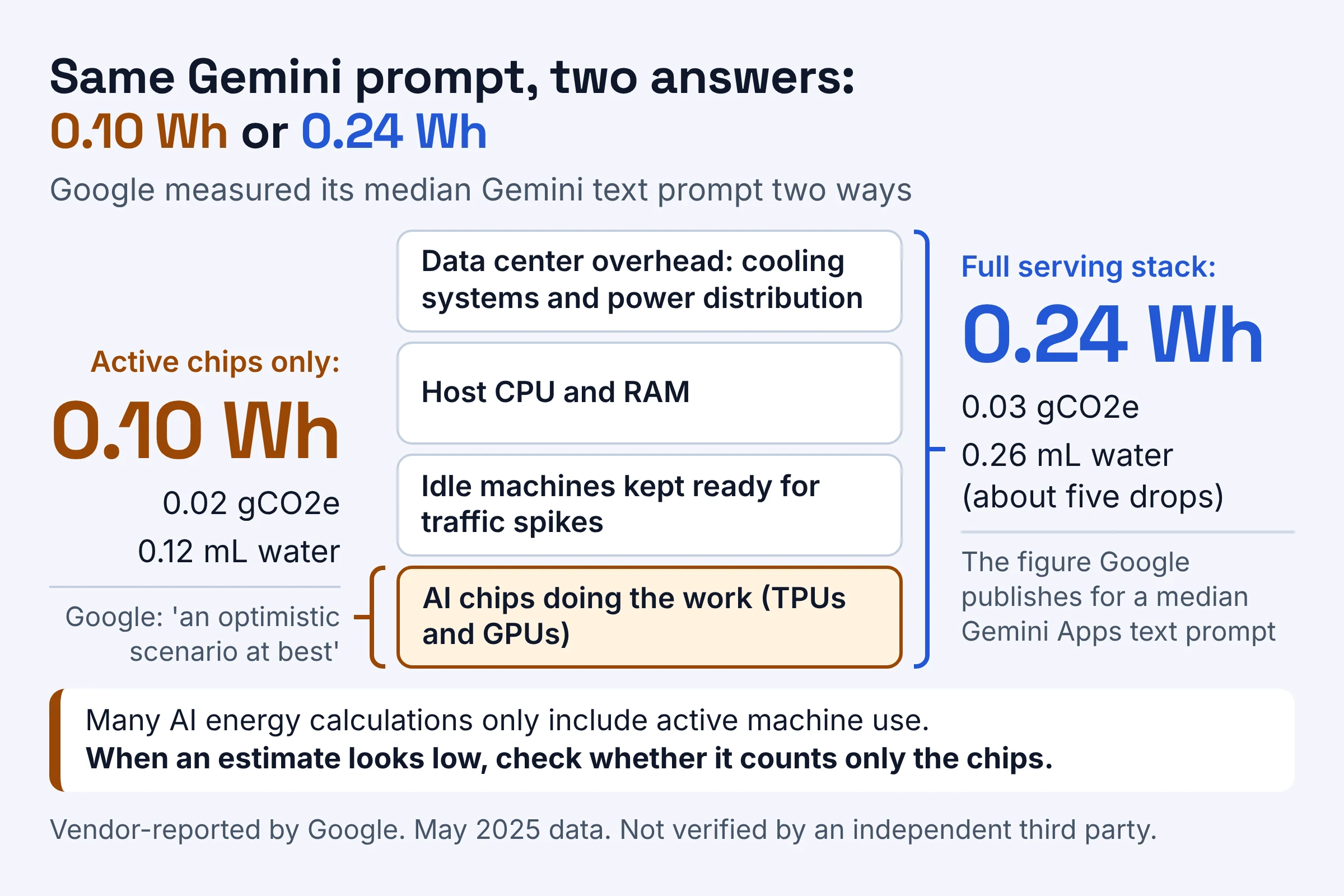
- the AI chips doing the work (Google's TPUs and GPUs);
- idle machines kept ready for traffic spikes;
- the host CPU and RAM, the ordinary computer parts around the AI chips;
- data center overhead such as cooling systems and power distribution;
- water the data centers consume for cooling.
Google also published a narrow version that counts only active TPU and GPU use: 0.10 Wh, 0.02 gCO2e and 0.12 mL of water for the median Gemini text prompt. Google calls this "an optimistic scenario at best" and says many current AI energy calculations only include active machine use. Same prompt, same company, two answers, a bit like pricing a restaurant meal by its ingredients and forgetting the kitchen, the staff and the rent.
So when another per-prompt estimate looks low, check whether it counts only the chips.
Google's own caveats matter too. The figure is a point-in-time analysis using May 2025 data, and Google says it doesn't represent every Gemini App text prompt or predict future performance. Google also says "The data and claims have not been verified by an independent third-party."
Over a recent 12-month period, Google says, the median prompt's energy dropped by 33x and its total carbon footprint by 44x. Its method notes compare the May 2025 analysis with a May 2024 baseline.
OpenAI: a number without a method
Altman's 0.34 Wh appeared in his blog post, The Gentle Singularity, not in a detailed technical paper, as MIT Technology Review notes. The post doesn't say which model or method the number is based on. IEEE Spectrum, which used the figure in its own math, says he stated it "without supporting evidence".
Mistral AI: a lifecycle view, with no watt-hours
Mistral's July 2025 report covers greenhouse gas emissions, water use and resource depletion. For one 400-token Le Chat reply, it gives a marginal impact of 1.14 gCO2e, 45 mL of water and 0.16 mg Sb eq.
Marginal impact means the extra footprint of one more reply, and Sb eq is the unit Mistral uses for resource depletion. The figures leave out your own laptop or phone, but they include upstream emissions such as making the servers.
Mistral ran the study with the consultancy Carbone 4 and France's ecological transition agency ADEME, and Resilio and Hubblo peer-reviewed it. It also published the footprint of training Mistral Large 2 plus 18 months of use, as of January 2025, but that's a model total, not a per-prompt number.
How much water and energy does one AI prompt use?
Google's latest numbers, as of November 2026, put the median Gemini Apps text prompt at 0.24 Wh and 0.26 mL of water, about five drops. Altman puts the average ChatGPT query at about 0.34 Wh and "about 0.000085 gallons of water; roughly one fifteenth of a teaspoon". Mistral puts one 400-token Le Chat reply at 45 mL of water, with no energy figure.
Google's water and carbon numbers start from its energy number. Google took the energy per prompt and applied two 2024 fleet-wide averages:
- for carbon, grid carbon intensity (how much CO2 comes with its electricity);
- for water, water usage effectiveness (how much water its data centers use per unit of energy).
Resist the urge to line up 0.26 mL against 45 mL and declare a winner. Google's covers serving a median prompt; Mistral's covers one 400-token reply across its lifecycle, upstream manufacturing included. Different scope, different question.
How much energy does a ChatGPT query use?
As of November 2026, there are two ChatGPT figures to go on. Sam Altman says about 0.34 Wh per average query (June 2025), and Epoch AI's independent analysis, which OpenAI cites, says about 0.3 Wh per typical GPT-4o query. Neither comes with OpenAI's own published measurements.
OpenAI's environmental impact page, first published August 22, 2025 and updated on June 9, 2026, describes Epoch's figure as "10x less than earlier estimates". The same page says proprietary energy benchmarks for models like GPT-4 aren't yet published. TechCrunch adds that Epoch's 0.3 Wh is an approximation too, because OpenAI hasn't published the details needed.
Count your own use carefully, too. Ask ChatGPT to tidy up a sales email, then for a shorter version, then a friendlier one, and you've sent three prompts, not one.
Is the 3 watt-hours per ChatGPT query figure true?
For an everyday ChatGPT text question, 3 Wh looks too high by the newer estimates as of November 2026. Epoch AI puts a typical query at about 0.3 Wh and Sam Altman puts the average at about 0.34 Wh. OpenAI says claims of up to 3 Wh per query are often "based on speculation and outdated assumptions", though it hasn't published its own measurements either.
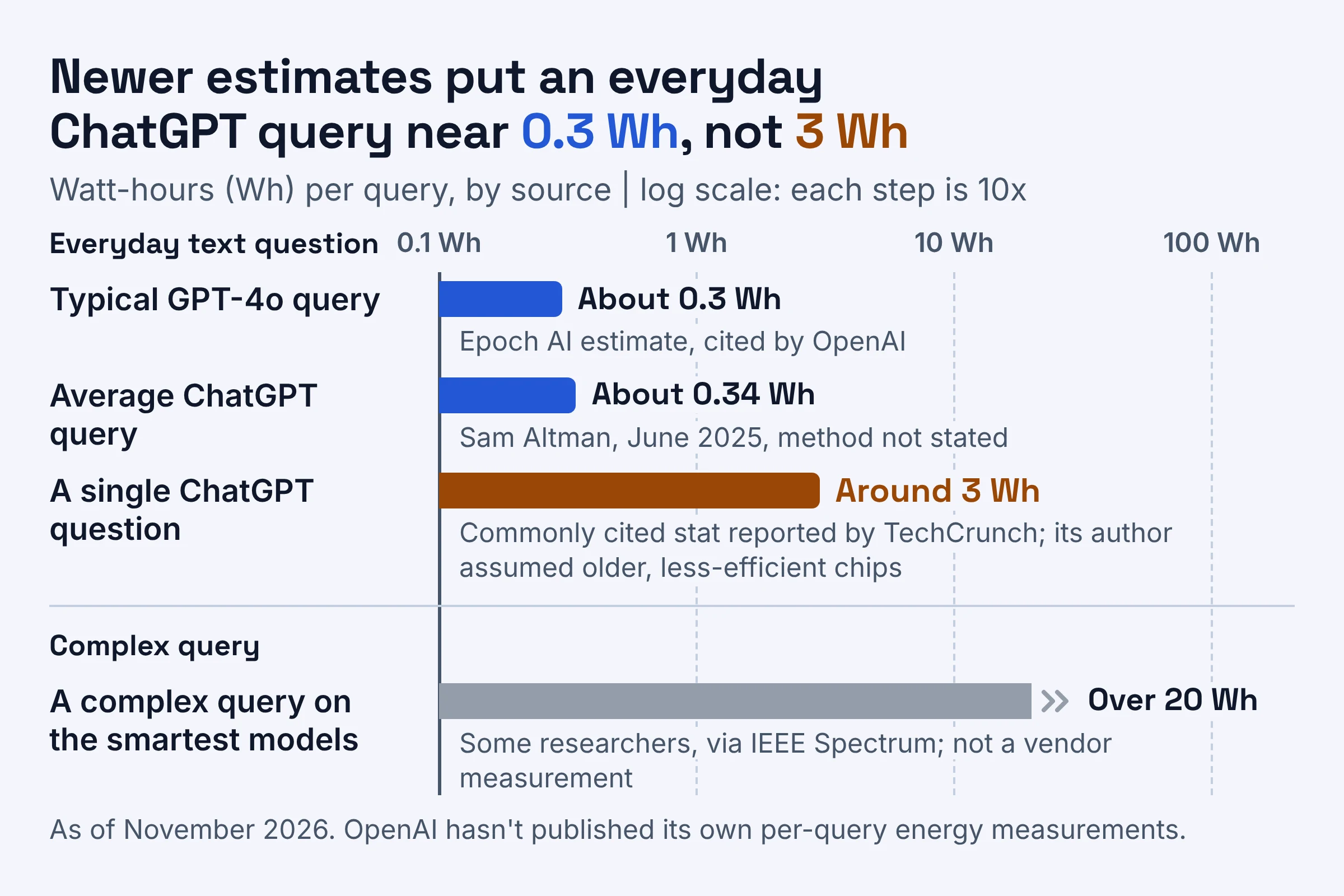
Here's where the big number came from:
- TechCrunch reported the commonly cited stat that ChatGPT needs around 3 Wh to answer a single question.
- The author of the report behind that estimate assumed OpenAI used "older, less-efficient chips", according to an Epoch AI analyst cited by TechCrunch.
Heavier queries are a different matter, and the evidence there is thin. TechCrunch notes that reasoning models think for seconds to minutes before answering, which uses more computing. IEEE Spectrum reports that some researchers say the smartest models can consume over 20 Wh for a complex query, which is not a vendor measurement.
A simple rule: if someone quotes 3 Wh for a quick ChatGPT question, ask for the source and the date. If they quote it for a long reasoning task, the honest reply is that none of the vendor figures covered here is for that kind of query.
Does an AI prompt use more energy than a Google search?
The vendor figures covered here can't tell you whether an AI prompt beats a Google search on energy: as of November 2026, they include no current energy figure for a Google search. The line you've probably seen, that ChatGPT uses "10 times as much as a Google search", is part of the same commonly cited 3 Wh stat that TechCrunch reported. Treat it with the same caution.
Don't swap in Google's 0.24 Wh either. That figure is for a median Gemini Apps text prompt, not a Google search, so it answers a different question.
How much energy does an AI image prompt use?
None of the vendor figures covered here gives a per-prompt energy number for making an image, as of November 2026. Google's 0.24 Wh is for text prompts, and MIT Technology Review notes the published numbers refer only to interactions with chatbots.
An expert quoted by MIT Technology Review also says figures for image and video use are still needed. TechCrunch adds that Epoch AI's 0.3 Wh estimate doesn't consider the extra energy of ChatGPT features like image generation.
So if you make twenty product shots for a shop listing, say a flat-lay photo of a lavender candle on linen, there's no vendor number to multiply. Plugging the text figure in for each image would be a guess dressed up as a measurement.
What haven't Google, OpenAI and Mistral published yet?
As of November 2026, the main gaps are image and video prompts, heavy reasoning queries, OpenAI's own benchmarks, a watt-hour figure from Mistral and any outside check of Google's numbers. Keep this list handy when someone hands you a single AI uses X per prompt number.
- Image and video prompts. An expert quoted by MIT Technology Review says these numbers are still needed.
- Long or reasoning-heavy queries. The over 20 Wh figure comes from some researchers cited by IEEE Spectrum, not from a vendor.
- OpenAI's own benchmarks. OpenAI says proprietary energy benchmarks for models like GPT-4 aren't yet published.
- Watt-hours from Mistral. Mistral reports carbon, water and resource depletion, not energy.
- Outside checks of Google's data. Google says its data and claims haven't been verified by an independent third party.
- A shared yardstick. Mistral says AI companies ought to publish their models' environmental impacts using standardized, internationally recognized frameworks. The three figures here still use three different scopes.
- Fresh numbers. All three per-prompt figures date from 2025, and Google says energy per median prompt is subject to change as models, architectures and user behavior change.
How do you work out your own daily AI footprint?
Multiply the prompts you send in a day by one vendor's per-prompt figure, and keep that vendor's label on the result. With Google's median of 0.24 Wh, its latest figure as of November 2026, 30 text prompts a day come to 7.2 Wh.
daily footprint = prompts per day x one vendor's per-prompt figure
Say you lean on an assistant for 30 small jobs a day: drafting replies, summing up meeting notes, fixing a spreadsheet formula. Here's that day worked out with each vendor's own number. It's an illustration, not a measurement.
| Figure used | Per prompt | 30 prompts a day | Best for |
|---|---|---|---|
| Google, median Gemini Apps text prompt | 0.24 Wh, 0.03 gCO2e, 0.26 mL water | 7.2 Wh, 0.9 gCO2e, 7.8 mL water | A day of ordinary Gemini text chats |
| Sam Altman, average ChatGPT query | About 0.34 Wh | About 10.2 Wh | A rough ChatGPT day, method unknown |
| Mistral AI, one 400-token Le Chat reply | 1.14 gCO2e, 45 mL water | 34.2 gCO2e, 1,350 mL water | A day of 400-token Le Chat replies, lifecycle included |
Read each row on its own. The rows use different statistics and scopes, so the gaps between them don't show which assistant is greener.
Three checks keep your estimate honest:
- Your prompts may not be typical. If you work with long documents or reasoning models, the median won't tell you much about those heavier queries.
- The Mistral row assumes 400-token replies. Yours may run longer or shorter.
- Don't blend vendors. Google's energy plus Mistral's water mixes two scopes into one meaningless number.
Small per prompt, big in total
MIT Technology Review calls the figures for asking a chatbot a question "undoubtedly small". Scale is a different story: OpenAI had said ChatGPT receives 2.5 billion prompts per day, MIT Technology Review reported in September 2025. IEEE Spectrum calculated that at 0.34 Wh per query, ChatGPT's daily queries add up to 850 megawatt-hours, "enough to charge thousands of electric vehicles every day".
The International Energy Agency (IEA) estimates data centers used around 415 TWh (terawatt-hours) of electricity in 2024, about 1.5% of global use. In its Base Case scenario, it projects around 945 TWh by 2030, just under 3% of the global total.
The IEA expects power use in accelerated servers (machines built around AI chips), mainly driven by AI adoption, to grow 30% a year in that scenario. It also stresses substantial uncertainty about data center use today and in the future.
What should you do with these numbers?
Treat the vendor figures as labelled estimates, not facts about AI in general. Quote each with its source and statistic, run your own daily math with the figure that matches your assistant, and cut the computing you don't need.
- Quote it with its label. Write 0.24 Wh per median Gemini Apps text prompt, Google, May 2025 data, never AI uses 0.24 Wh per prompt.
- Run your own day with the matching figure. Count yesterday's prompts and multiply by one figure. Use Google's for Gemini text chats, Altman's for a rough ChatGPT ballpark or Mistral's for Le Chat carbon and water, and keep the statistic next to the answer.
- Use the smallest model that does the job. Mistral advises choosing the model size best adapted to your needs. It says a model 10 times bigger generates impacts about one order of magnitude (roughly tenfold) larger for the same number of tokens, so save the biggest model for work that needs it.
- Ask once, not five times. Mistral also advises grouping queries to limit unnecessary computing. Put your whole request into one prompt instead of five follow-ups; our prompt template guide for ChatGPT, Copilot and Gemini shows how to build that one prompt.
When a lab publishes a newer per-prompt number, drop it into the same formula and keep its label on.