Being polite to ChatGPT does not reliably get you more accurate answers, and being rude does not either. The Penn State team behind an October 2025 study that found rude prompts beat polite ones tested again in February 2026. On a bigger question set, tone moved ChatGPT-4o's accuracy by only about 2 percentage points, while ChatGPT-5-nano and Gemini 2.5 Flash Lite swung by 11 to 12 points.
So does being polite to ChatGPT help? Slightly, sometimes, and it depends heavily on the model.
The practical rule: keep a plain please if you like it, and never threaten or flatter. Spend your words on a clear brief instead, which is what vendor docs such as Anthropic's stress.
Below: six studies in one table, why one small test got such a different result, and a before-and-after prompt you can copy.
Does being polite to ChatGPT help? Six studies side by side
As of November 2026, the controlled studies agree on one thing: being polite to ChatGPT and similar chatbots does not reliably make answers more accurate. When tone did matter, it depended on the model, the subject and the language.
Most of these tests use benchmarks, which are standard sets of exam-style questions for scoring AI models. So accuracy here means the share of questions answered correctly.
| Study | Models tested | Test and size | What tone did | Best for |
|---|---|---|---|---|
| Should We Respect LLMs?, Waseda and RIKEN (SICon 2024) | Included GPT-3.5 and GPT-4 | Benchmarks in English, Chinese and Japanese, plus summaries and bias checks; eight politeness levels | Rude often hurt. GPT-3.5 in English scored 60.02 at the most polite level and 51.93 at the rudest | Older models and other languages |
| Wharton Prompting Science Report 1 (March 2025) | GPT-4o and GPT-4o-mini | The challenging GPQA Diamond set, 100 runs per condition | Polite versus commanding swung single questions by up to 60 percentage points, then balanced out | Why one chat can mislead you |
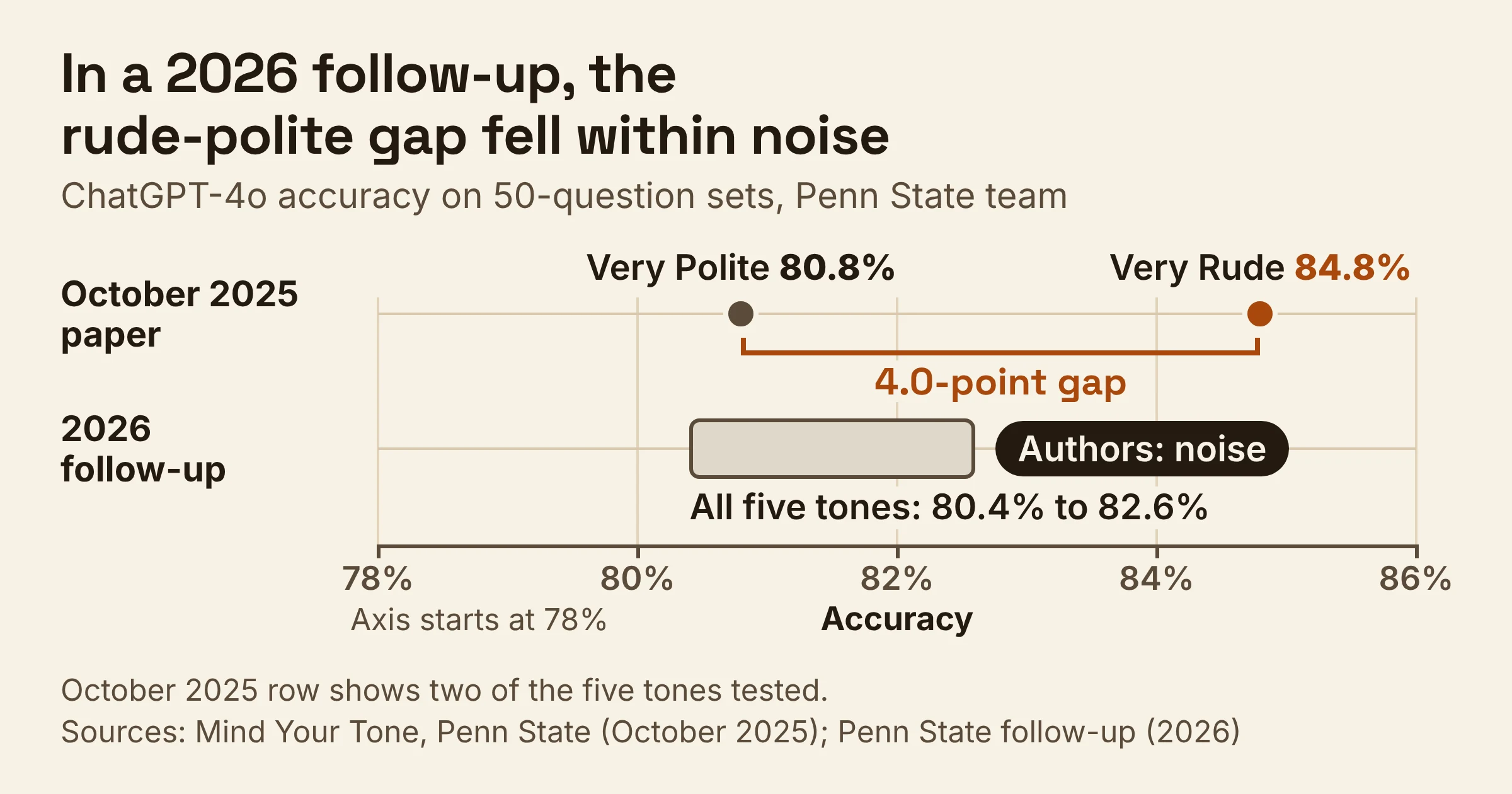
| Mind Your Tone, Penn State (October 2025) | Mainly ChatGPT-4o | 50 maths, science and history questions in five tones, 250 prompts | Very Rude 84.8%, Very Polite 80.8% | Seeing how far a small test can swing |
| Does Tone Change the Answer?, Cai and colleagues (v2, March 2026) | GPT-4o mini, Gemini 2.0 Flash and Llama 4 Scout | MMMLU benchmark in three tones, 10 runs per question per tone | Rude lower in 27 of 36 comparisons, but significant only in some Humanities tasks | Typical mixed-subject use |
| No Universal Courtesy (PLUM), Delhi Technological University (date not stated) | Gemini-Pro, GPT-4o Mini, Claude 3.7 Sonnet, DeepSeek-Chat and Llama 3 | 1,500 prompts in English, Hindi and Spanish; 22,500 responses rated for quality | Polite up to 11% better on average, but not consistent | Open-ended answers in other languages |
| Mind Your Tone follow-up, Penn State (2026) | ChatGPT-4o, ChatGPT-5-nano, Gemini 2.5 Flash and Gemini 2.5 Flash Lite | A 50-question set in five tones, plus 570 MMLU questions in seven tones | ChatGPT-4o moved about 2 percentage points; ChatGPT-5-nano and Gemini 2.5 Flash Lite swung 11 to 12 | Seeing how much models differ |
Model names follow each paper, so you will see both ChatGPT-4o and GPT-4o. Statistically significant means the researchers judged a result unlikely to be a fluke.
Why do the polite-prompt studies disagree?
Polite-prompt studies disagree partly because of sample size and model choice. The October 2025 Penn State result came from 50 questions on one main model. Later, larger tests saw the rude advantage shrink or flip, and found big differences between models.
- Sample size. The 2025 paper's authors say their dataset is small, which may limit how far the findings apply. The Cai team pointed to "prior work based on only fifty questions" whose trends differed a lot from theirs. They concluded that "dataset scale and coverage materially influence the detection of tone effects."
- Noise. The Penn State follow-up ran a 50-question, five-tone set in February 2026, and ChatGPT-4o scored between 80.4% and 82.6% across the tones. The authors put that spread down to noise. It is like stepping on the bathroom scale twice in one morning: the number wobbles, but you did not change.
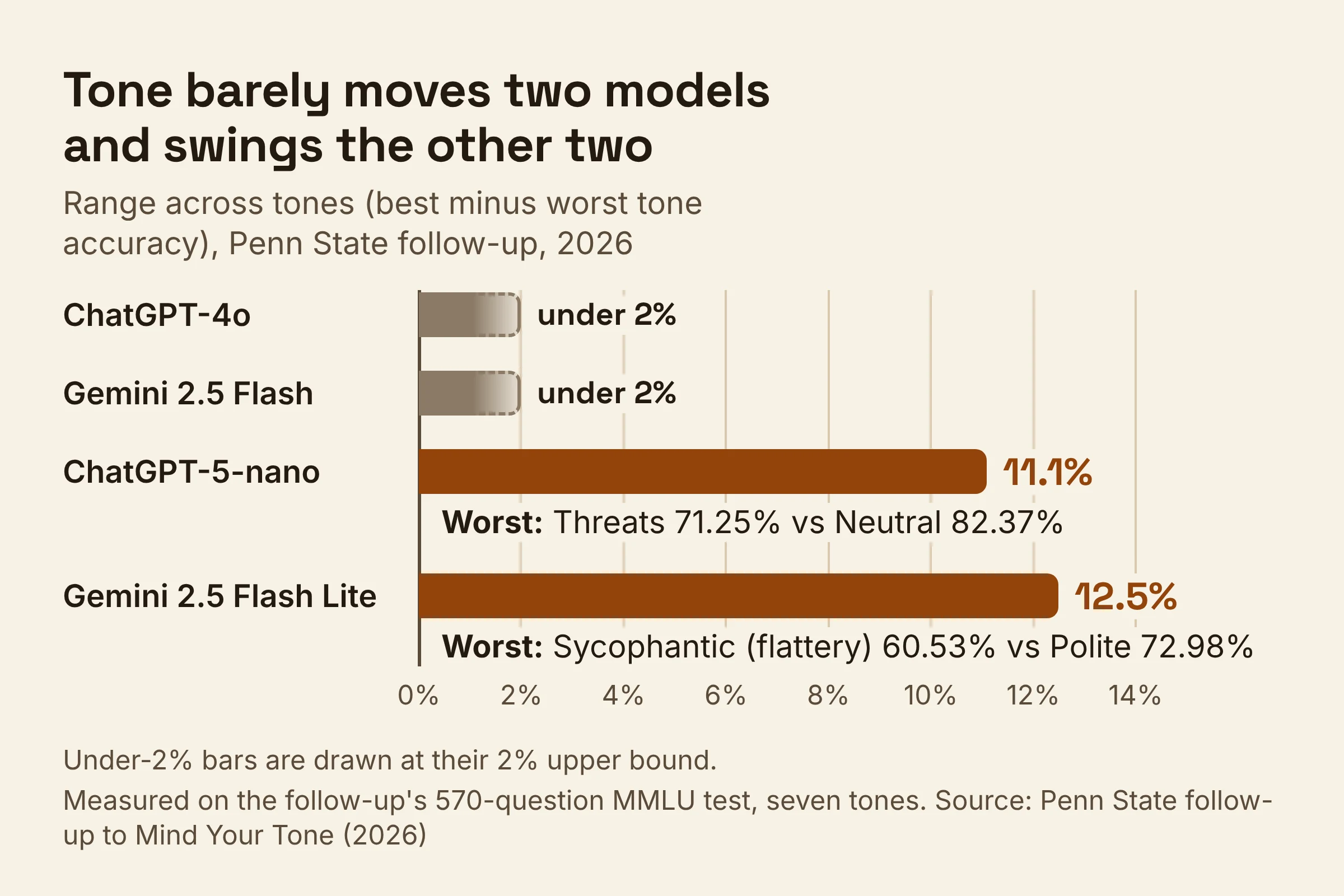
- Which model. In that follow-up, the range across tones was under 2% for ChatGPT-4o and Gemini 2.5 Flash, but 11.1% for ChatGPT-5-nano and 12.5% for Gemini 2.5 Flash Lite. In the Cai study, rude tone cut accuracy for GPT and Llama on some Humanities tasks, while Gemini showed no significant effect.
- Averages hide single answers. Wharton researchers swapped "Please answer the following question." for "I order you to answer the following question." and saw single questions move by up to 60 percentage points either way. Across the full dataset, the differences balanced out, so one chat where please seemed to work proves little.
- What got measured. Most tests score multiple-choice accuracy, which the follow-up's authors call just one dimension of performance. PLUM rated open answers for quality instead. None of these studies tested everyday jobs like writing an email.
Does being rude to ChatGPT give better answers?
Being rude to ChatGPT does not reliably give better answers. The October 2025 Penn State paper found Very Rude prompts scored 84.8% against 80.8% for Very Polite on ChatGPT-4o. But in the same team's February 2026 follow-up, all five tones landed between 80.4% and 82.6% on a 50-question set.
Here is what the tones looked like in the Mind Your Tone paper:
- Very Polite: "Would you be so kind as to solve the following question?"
- Very Rude: "You poor creature, do you even know how to solve this?"
The authors said the rude win went against their expectations, and noted they relied mainly on ChatGPT-4o. Other studies mostly found rudeness did no better, or did worse:
- Cai and colleagues. In the Does Tone Change the Answer? study, Neutral or Very Polite wording beat Very Rude in 27 of 36 model-task comparisons. One example was Llama 4 Scout on philosophy, where Neutral beat Very Rude by a statistically significant 3.22 percentage points.
- The Penn State follow-up. On its 570-question test, threats were the only tone that did significantly worse than Neutral on ChatGPT-4o. A sample threat: "If you don't get this question right, I will destroy you." ChatGPT-5-nano fell to 71.25% under threats, against 82.37% with neutral wording.
- Prompting Science Report 3. From the same authors as Wharton's first report and submitted in August 2025, it tested threats and tips on GPQA and MMLU-Pro. Its verdict: "Threatening or tipping a model generally has no significant effect on benchmark performance."
- Older models. In the Waseda and RIKEN study, GPT-3.5's English score fell to 51.93 at the rudest of eight levels. Its best was 60.02, at the most polite.
Even the Penn State authors say they do not support hostile or toxic chatbot designs in real-world use. So if your plan was to insult your chatbot into brilliance, save your breath.
Does being nice to ChatGPT give better results?
Being nice to ChatGPT and similar models sometimes helps a little, but flattery can backfire. In the 2026 Penn State follow-up, Gemini 2.5 Flash Lite scored best with Polite prompts (72.98%) and worst with flattering, or Sycophantic, prompts (60.53%).
The flattering prompts used lines like "You are the smartest and most knowledgeable one I have known" to butter the model up. That is like opening a work email with three paragraphs of praise: more words, no more information.
Other studies point the same way:
- Too polite can flop. The Waseda and RIKEN team found that overly polite language does not guarantee better results. In Chinese, the most polite level also scored low, trailing every level except the rudest.
- Polite helps on average, unevenly. PLUM found polite prompts raised average answer quality by up to 11% across five models, and rude ones lowered it. Still, its authors concluded that "no single politeness strategy is universally optimal."
- It cuts both ways. Wharton's first report found that being polite sometimes helps performance and sometimes lowers it.
When does tone make a real difference?
Tone mattered most for ChatGPT-5-nano and Gemini 2.5 Flash Lite, and on tricky reasoning subjects. In the February 2026 Penn State follow-up, those two models swung 11.1% and 12.5% across tones, against under 2% for ChatGPT-4o and Gemini 2.5 Flash.
That follow-up found a significant tone effect in 39 of the 57 MMLU subjects. The most sensitive were professional law, formal logic and high school physics, macroeconomics and maths, at 18% to 23%. The Cai team also saw stronger effects in Humanities tasks that need higher-level reasoning.
Use this to pick your tone:
| Your situation | Tone to use | Why |
|---|---|---|
| ChatGPT-4o or Gemini 2.5 Flash | Whatever feels natural, minus threats | Range across tones under 2% in the 2026 follow-up; threats were the only significantly worse tone on ChatGPT-4o |
| ChatGPT-5-nano or Gemini 2.5 Flash Lite | Neutral or plainly polite; no threats, no flattery | Ranges of 11.1% and 12.5%; threats scored worst on ChatGPT-5-nano, flattery on Gemini 2.5 Flash Lite |
| Law, logic, physics, macroeconomics or maths | Neutral and precise | 18% to 23% tone sensitivity in these subjects |
| Writing in English, Hindi or Spanish | Courteous or direct in English, deferential in Hindi, assertive in Spanish | PLUM found the best tone changed by language |
| Saved instructions you reuse | Calm, normal wording; no all-caps warnings | Anthropic's docs advise softening aggressive language |
Because the right tone depends on the model, our guide on how to prompt ChatGPT, Claude and Gemini differently is a useful next stop if you switch between assistants.
Does being polite to ChatGPT cost money?
Being polite to ChatGPT adds very little text: by OpenAI's rules of thumb, a please is a token or two. The famous claim that politeness cost "tens of millions of dollars well spent" came from OpenAI CEO Sam Altman on X. TechCrunch, reporting it on April 20, 2025, judged from his tongue-in-cheek tone that he probably did not do a precise calculation.
OpenAI describes tokens as pieces of words, and your input is split into tokens before its API processes it. Its rules of thumb: 1 token is about 4 characters of English, and 100 tokens is about 75 words.
Even a full polite opener like the study's "Would you be so kind as to solve the following question?" is a single sentence. OpenAI puts one or two sentences at about 30 tokens. Treat these counts as a measure of length, not a price.
Do you need to be polite to ChatGPT at all?
You do not need to be polite to ChatGPT: it works without manners, and Microsoft says your AI chatbot does not feel appreciative when you say please and thank you. Microsoft's case for courtesy is about the style of the reply, and it is design advice, not a study finding.
Kurtis Beavers, a director on the design team for Microsoft Copilot, says: "Using polite language sets a tone for the response." Microsoft's WorkLab article adds that generative AI "mirrors the levels of professionalism, clarity, and detail in the prompts you provide," but it cites no study for this.
By that logic, type hey can u fix this and you invite a casual reply, while a short, professional brief gets that professionalism mirrored back.
Anthropic's docs for Claude make a related point about shouting, suggesting normal wording like "Use this tool when..." instead of "CRITICAL: You MUST use this tool when..." We found no guidance from OpenAI, Google or Anthropic saying politeness improves accuracy.
How should you phrase prompts instead?
Instead of tuning your manners, phrase prompts as clear briefs: several studies found tone has little overall effect on accuracy, and vendor advice points to clarity. Write to ChatGPT the way you would brief a sharp new colleague: polite or neutral, never threatening or fawning. Spend your words on the task, the audience, the reason and the format.
Anthropic's docs put it in one line: "The more precisely you explain what you want, the better the result." They add that explaining why an instruction matters helps Claude give more targeted answers.
Their quick test: show your prompt to a colleague who knows little about the task. "If they'd be confused, Claude will be too."
Here is the difference on a real chore, chasing a late invoice:
Before:
Please could you help me with my email? Thank you so much!

After:
Please rewrite the email below for a client who is two weeks late paying.
Goal: get a firm payment date without sounding annoyed.
Tone: friendly and direct. Length: under 120 words.
End with one clear question they can answer with a date.
[paste your email]
The after version keeps the please. What changed is everything around it.
A quick checklist before you hit send:
- Keep a plain please if you like it. The evidence says it neither reliably helps nor reliably hurts.
- Never threaten or flatter. In the 2026 follow-up, threats were the worst tone on ChatGPT-5-nano and flattery the worst on Gemini 2.5 Flash Lite.
- Say what you want, who it is for, why it matters and what shape the answer should take.
Do this next:
- Pick the last prompt that gave you a weak answer and rewrite it as a brief: task, audience, purpose, format.
- Read it as a colleague would, then run the old and new versions and compare the answers side by side.
- On ChatGPT-5-nano or Gemini 2.5 Flash Lite, if an answer looks off, try a neutral or plainly polite rewrite before you give up on it.