Yes, Gemini 4 Hydrogen is free in two places as of November 2026. It runs in Google Search for all users globally. It also runs in the free Gemini app, but only when auto model selection decides it suits your prompt.
Elsewhere, access is paid or not yet spelled out. Gemini in Google Sheets and Google Antigravity start with paid Google AI Pro and Ultra plans. On the paid Gemini API, Hydrogen costs $1.50 per million input tokens and $7.50 per million output tokens.
That is a quarter below Argon's introductory price and less than half of what Argon costs after November 30, 2026. Google says Hydrogen is coming to all API tiers.
Is Gemini 4 Hydrogen free? Where you get it, surface by surface
As of November 2026, Gemini 4 Hydrogen is free for everyone in Google Search. Free Gemini app users also get it, through auto model selection. Sheets and Antigravity start with paid Google AI Pro and Ultra plans.
The table below pulls access details from Google's own launch pages for Hydrogen and Argon. The Argon column shows how much further Hydrogen reaches.
| Google surface | Gemini 4 Hydrogen access | Gemini 4 Argon access | Best for / what it means for you |
|---|---|---|---|
| Google Search | Everyone, globally, free | AI Mode: Google AI Pro or Ultra only | Free Hydrogen answers right in Search |
| Gemini app, free plan | Only when auto model selection picks it for your prompt | Not included | You may already be using it without knowing |
| Gemini app, Pro or Ultra | Not spelled out in Google's launch pages | Included | Paid users have Argon on hand either way |
| Gemini in Google Sheets | Starting with Google AI Pro and Ultra | Not covered in the pages we checked | Hydrogen in Sheets needs a paid plan for now |
| Google Antigravity | Paid Google AI Pro and Ultra | Google AI Ultra only | Pro subscribers get Hydrogen here, but not Argon |
| Orchestrator (inside Antigravity) | Google AI Ultra (pairs Carbon with Hydrogen) | Not applicable | Ultra-only for now |
| Gemini API in Google AI Studio | Available; Google says it's coming to all tiers | Paid tier only | Free-tier limits for Hydrogen weren't in the launch pages we checked |
| Android Studio | Via the Gemini API | Via the paid tier of the Gemini API | Same billing as the API |
| Gemini for business | Listed by Google as a place to start | Not covered in the pages we checked | Work accounts can build on it |
What Hydrogen changes in Google Search
The Search upgrade has the widest reach, because Google says it's live for all users globally. According to Google, Hydrogen brings "more images, structured responses, comparison tables, and custom tools built for you."
Say you search for project-management apps for a five-person team. Instead of a wall of text, you may now see a comparison table in the answer.
If you build on the API, our Google AI Studio page covers the tool itself. Google's Hydrogen launch post is the primary source for the free app and pricing details.
Can you choose Hydrogen yourself in the free Gemini app?
No, not directly. As of November 2026, Google says free Gemini app users get Gemini 4 Hydrogen "via auto model selection when it's the appropriate model for the prompt."
Auto model selection means the app picks which model answers each message. You don't choose from a menu. Think of a taxi dispatcher: you say where you're going, and the dispatcher decides which car turns up.
Some prompts will get Hydrogen and some won't. Google's launch pages don't explain how the app decides.
For paid subscribers, the Hydrogen launch pages don't spell out a manual model picker. What is clear is that Argon in the Gemini app is limited to Google AI Pro and Ultra. That makes auto-selected Hydrogen the Gemini 4 model Google's launch pages mention for free app users.
How much does Gemini 4 Hydrogen cost per million tokens?
According to Google's launch post (November 2026), Gemini 4 Hydrogen costs $1.50 per million input tokens and $7.50 per million output tokens. That price is flat across its whole 1 million-token context window.
A token is a small chunk of text, roughly a piece of a word. You pay for what you send in (input) and for what the model writes back (output).
"Flat" means the rate stays the same whether you send one short email or a stack of PDFs. You won't land in a pricier band as your prompt grows.
| Model and period | Input, per million tokens | Output, per million tokens | Notes | Best for |
|---|---|---|---|---|
| Gemini 4 Hydrogen | $1.50 | $7.50 | Flat across the 1 million-token window | Everyday work at lower cost |
| Gemini 4 Argon, introductory (until November 30, 2026) | $2 | $10 | Cached input tokens 95% off | Teams already tuned to Argon |
| Gemini 4 Argon, after November 30, 2026 | $4 | $20 | Standard price per Google | Same, at double the intro cost |
Our sources don't include Gemini 4 Carbon's API price, so check Google's pricing page if you're weighing Carbon.
Worked example: one month of a reporting tool
Say a small agency runs a client-reporting tool on the API. In a month, it sends 10 million input tokens and gets back 2 million output tokens.
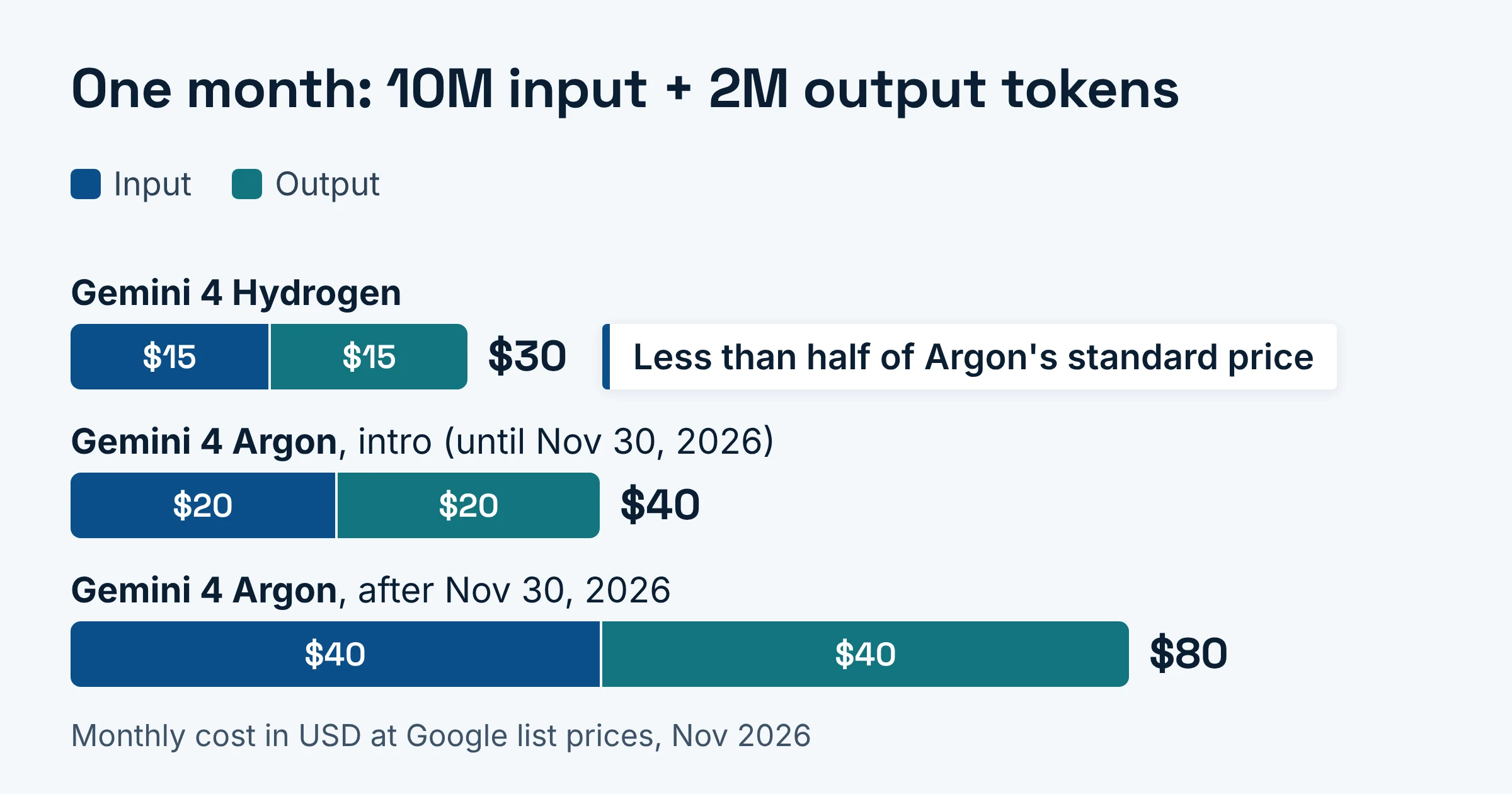
- Hydrogen: 10 million × $1.50 = $15 for input, plus 2 million × $7.50 = $15 for output. Total: $30.
- Argon, introductory price: 10 million × $2 = $20, plus 2 million × $10 = $20. Total: $40.
- Argon, after November 30, 2026: 10 million × $4 = $40, plus 2 million × $20 = $40. Total: $80.
At these list prices, the same month of work costs less than half as much on Hydrogen as on Argon's standard rate.
Two catches before you switch
Caching. Google's Argon post lists cached input tokens at 95% off alongside the introductory price. We found no cached-input price for Hydrogen. If your app resends the same long instructions with every request, check Google's API pricing page before you trust the simple maths above.
The free API tier. Google says Hydrogen is coming to all tiers of Google AI Studio and the Gemini API. The launch pages don't list free-tier rate limits, though. Treat free API access as announced, not yet something you can plan around.
Is Gemini 4 Hydrogen better than Gemini 4 Argon?
On Google's own numbers, the two are level and Hydrogen is cheaper. Google says Hydrogen scores 51 to Argon's 50 on the Artificial Analysis Intelligence Index at its default high thinking level. It reaches 54 at xhigh and often finishes tasks faster than models in its class.
These are Google's reported results. The pages in our research don't include independent benchmarks. A gap that small on a single index is a tie for practical purposes, so the real story is price and speed.
On speed, Google says Hydrogen finishes tasks 2.5 times faster than Gemini 3.8 Flash at its default setting. If you leaned on the older Flash model for quick jobs, that's the comparison that matters to you.
What Hydrogen is built for
Google says Hydrogen takes up to 1 million tokens of input and can write up to 1 million tokens of output. The aim is to turn dense PDFs, spreadsheets, charts, audio and recorded video into "polished, cited reports and structured deliverables."
In practice, you could feed in a quarter's sales spreadsheets plus a recording of the review meeting, then ask for one summary report.
Which Hydrogen thinking level should you pick?
As of November 2026, Gemini 4 Hydrogen has four thinking levels: low, medium, high (the default) and a new xhigh tier. Google frames them as a trade-off between quality, speed and cost. Start at high and move only when you have a reason.
A thinking level controls how much the model reasons before it answers. More thinking usually helps on hard problems, but replies come slower and you're billed for more tokens.
If your tool lets you choose, here's a rule of thumb (our suggestion, not Google's):
- Low: sorting emails, tagging support tickets, rewriting a sentence. Fast jobs where the answer is obvious.
- Medium: drafting routine replies, summarising a short meeting, tidying a product description.
- High (default): most real work. Google measures its score of 51 at this level.
- xhigh: the hard stuff, such as untangling a messy multi-file analysis or a tricky bug. Google reports its score of 54 here. Expect longer waits and bigger bills.
The money-saving habit is to step down when high is overkill. Don't step up just because you can.
What is Orchestrator, and do you need Pro or Ultra for Antigravity?
Orchestrator is a mode in Google Antigravity that pairs Gemini 4 Carbon with Gemini 4 Hydrogen. As of November 2026, it is rolling out to Google AI Ultra subscribers only. Hydrogen on its own in Antigravity starts with paid Google AI Pro and Ultra plans.
Google describes Hydrogen as the "high-efficiency execution engine in multi-model workflows" alongside Carbon and Argon. In plain terms, Hydrogen handles the fast execution work in these multi-model setups.
On Google's Terminal-Bench 4.0 test, Orchestrator came close to Carbon's own task success rate. Google says it used 24% less quota and finished 19% faster on average.
Antigravity access by plan, per Google's launch pages:
- Google AI Pro: Hydrogen.
- Google AI Ultra: Hydrogen, Argon and Orchestrator.
Google says Orchestrator will support "additional models and plans" in the future, but hasn't given dates. More on the tool itself is on our Google Antigravity page.
Hydrogen, Argon or Carbon: which one should you use?
For most everyday tasks, start with Gemini 4 Hydrogen. As of November 2026, Google positions it as a standalone everyday model, scores it level with Argon on its chosen index, and prices it below Argon. Reach for Argon or Carbon only when your own tests show Hydrogen falling short.
Pick Hydrogen if:
- you use the free Gemini app or Google Search and want Gemini 4 at no cost;
- you're on Google AI Pro and use Antigravity, where Argon needs Ultra;
- you pay per token and want the lower bill from the worked example;
- you turn long documents, recordings or spreadsheets into reports.
Stick with Argon if:
- you've tested your own prompts and Argon clearly wins on your tasks;
- your workload leans hard on cached input, where Argon's introductory 95% discount may change the maths. Check the post-November 30 terms first.
Reach for Carbon if:
- Hydrogen at xhigh still can't handle the job. On Terminal-Bench 4.0, Google uses Carbon's task success rate as the yardstick for Orchestrator. For who can use Carbon and where, see our guide to Gemini 4 Carbon access and Argon's December price.
The one-line rule: Hydrogen at high, then Hydrogen at xhigh, then Argon or Carbon. Move up a step only when the cheaper step fails on real work.
What should you do before Argon's price rises after November 30?
If you pay for Argon on the API, test Hydrogen now. Argon's introductory $2 and $10 rates end on November 30, 2026, after which $4 and $20 per million tokens apply, according to Google's Argon announcement.
A three-step plan:
- Check what you already have. Ask Google Search a comparison-style question, and use the free Gemini app as normal. Hydrogen may already be answering you.
- Run a side-by-side test. Take a small batch of real prompts, such as the reports, emails or code tasks you actually run. Send them to Hydrogen at high and to Argon, then compare the answers and how long each takes.
- Do the cost maths with your own volumes. Plug your monthly input and output tokens into the worked example above. If Hydrogen passes step 2, make it your default before Argon's standard price kicks in.
We checked prices and access on Google's launch pages in November 2026. Both change often.