
In a Figure AI demo, two humanoid robots handle groceries that neither had seen during training. Nobody wrote a rule for each item, so how do humanoid robots learn a skill like that? Mostly from data, not hand-written rules: people steer them while they record, they practice in simulation, and they copy how people move. Then one general robot brain, trained on all of it, turns plain instructions into motion.
Two robots and groceries they had never seen
The surprise in Figure's Helix demo is that the groceries were never part of the robots' training. Imagine walking into a stranger's kitchen and knowing what to do with every item in their shopping bags. That is the robot version.
The software running them is called Helix. Figure calls it a vision-language-action model, or VLA (an AI that looks at a scene, understands a request in plain words, and turns both into movement).
Figure says robots with Helix can now "pick up virtually any small household object," including thousands of items.
Think about what that means. Nobody typed in one rule for a box, another for a bottle, and another for a squishy bag. There are too many things in a kitchen for that.
So the skill had to come from somewhere else. To see where, it helps to know how robots used to be built.
The old way: a rule for everything
Robots used to be programmed by hand, one rule at a time.
MIT Technology Review calls this the original craft of robotics: "anticipating every possibility and encoding it in advance." That works in a factory, where the same part shows up in the same spot all day. It breaks in a home, where a sock can be anywhere and no two mugs look alike.
Around 2015, MIT Technology Review says, the leading labs "started to do things differently." Instead of writing a rule for every case, researchers began letting robots learn. NVIDIA calls this robot learning: a set of methods that help a robot pick up new skills.
It is the same split you see in software between AI automation and AI agents: a fixed path someone designs, versus a system that works out its own steps.
For you, this shift changes the question to ask about any robot. It is no longer what was it programmed to do? It is what was it shown?
How humanoid robots learn: think of a cooking student
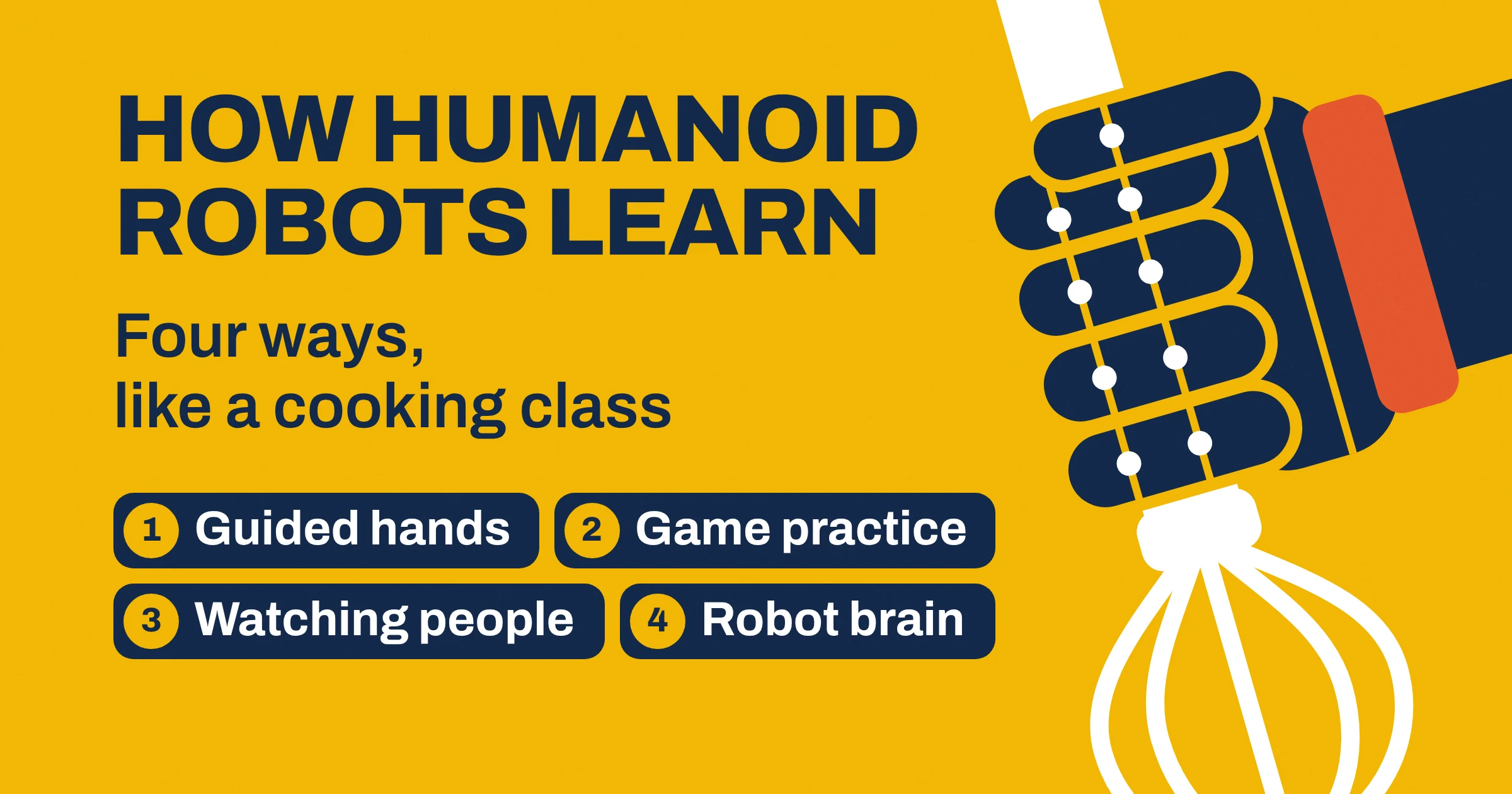
A cooking student picks up skills in the same four ways a humanoid robot does, so one kitchen can explain them all.
- A teacher guides your hands. The chef stands behind you and moves the knife with you. You feel exactly how a good cut goes. For robots, this is a person steering the robot while it records.
- A game kitchen where burnt pans cost nothing. You practice the same omelet over and over, and a mistake costs nothing. For robots, this is simulation: a video-game copy of the world.
- Cooking videos. You watch people chop onions online. You see what they do, though you cannot feel what their hands feel. For robots, this is learning from human videos and human movement.
- Kitchen sense. After enough of all three, you can read a new recipe and just cook it. For robots, this is one general model that turns plain instructions into movement.
Each way teaches something the others cannot. The best robots, like the best cooks, use more than one.
Way 1: A human drives, the robot takes notes
The most direct way to teach a robot is to steer it yourself while it records everything. This is called teleoperation (controlling a robot from a distance, like a very expensive video game).
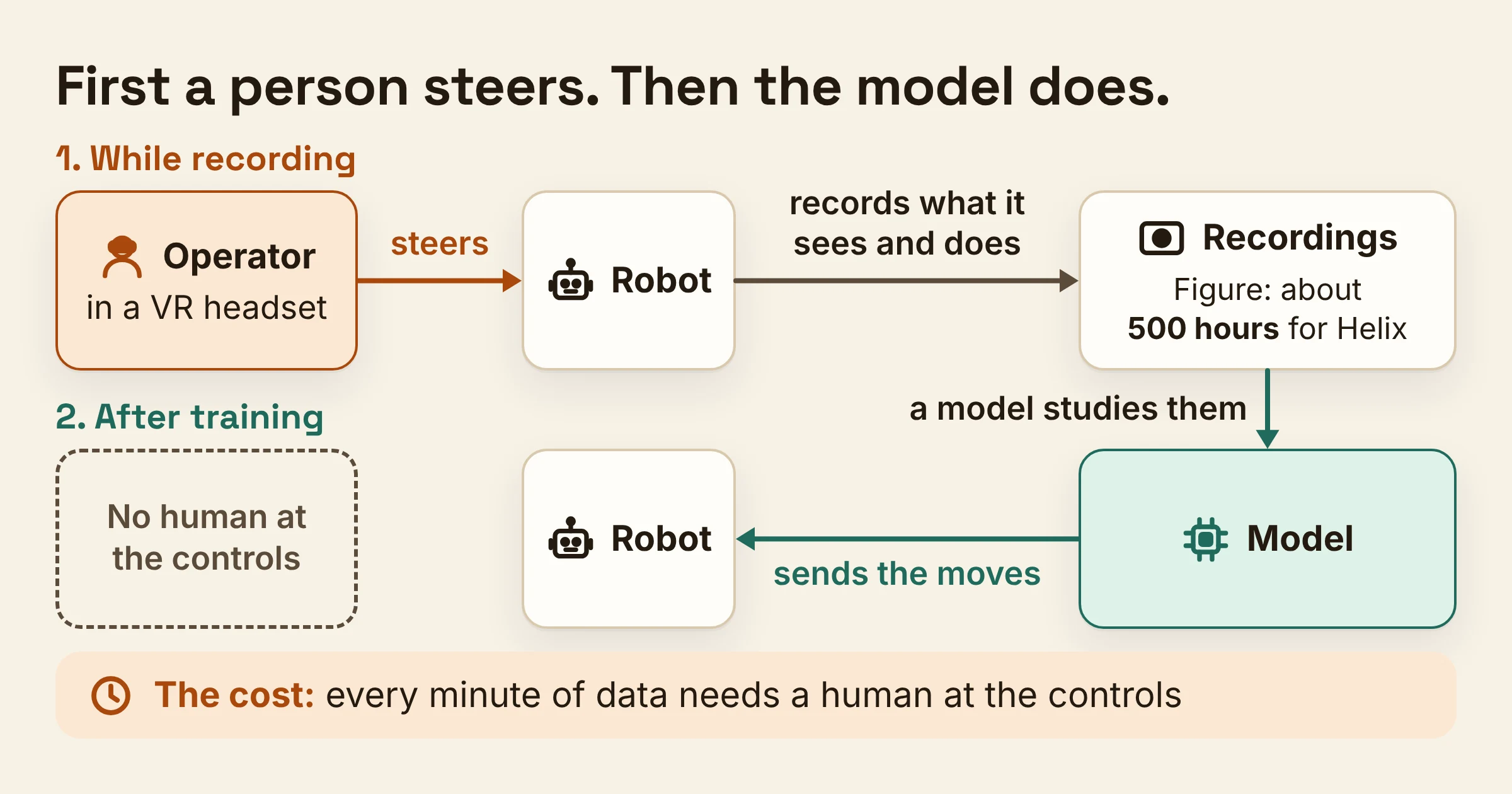
Boston Dynamics and the Toyota Research Institute collect this kind of data for the Atlas humanoid, both on the real robot and in simulation. The operator wears a VR headset (virtual reality goggles), so they feel like they are standing in the robot's workspace.
The robot records each demonstration. Later, a model studies those recordings and learns to copy them.
Boston Dynamics sums it up neatly: "if you can demonstrate it, the robot can learn it." It also says that teaching a robot new ways to handle objects no longer takes an advanced degree and years of experience.
This is how the grocery robots got their start. Figure collected about 500 hours of teleoperated behavior to train Helix, from several robots and several operators. That is roughly three months of full-time work for one person, all spent steering robots.
Google has done this too. MIT Technology Review reports it spent 17 months handing people robot controllers and filming them doing tasks.
Some home robots are even meant to learn this way on the job. 1X says that for a chore its NEO robot does not know, owners can book a 1X Expert to guide it. NEO learns while the work gets done.
Why it matters: this data is especially valuable, because it shows a real robot body doing the real job. It is also costly.
NVIDIA says real robot data is "costly and time-consuming." One reason: with teleoperation, every minute needs a human at the controls.
Way 2: Practice for years inside a video game
Simulation can let a robot cram years of practice into a few hours, Figure says, inside a video-game copy of the world.
The method Figure uses is called reinforcement learning (trial and error, with a reward for what works). It is like training a dog with treats, except the dog is software and it never gets full.
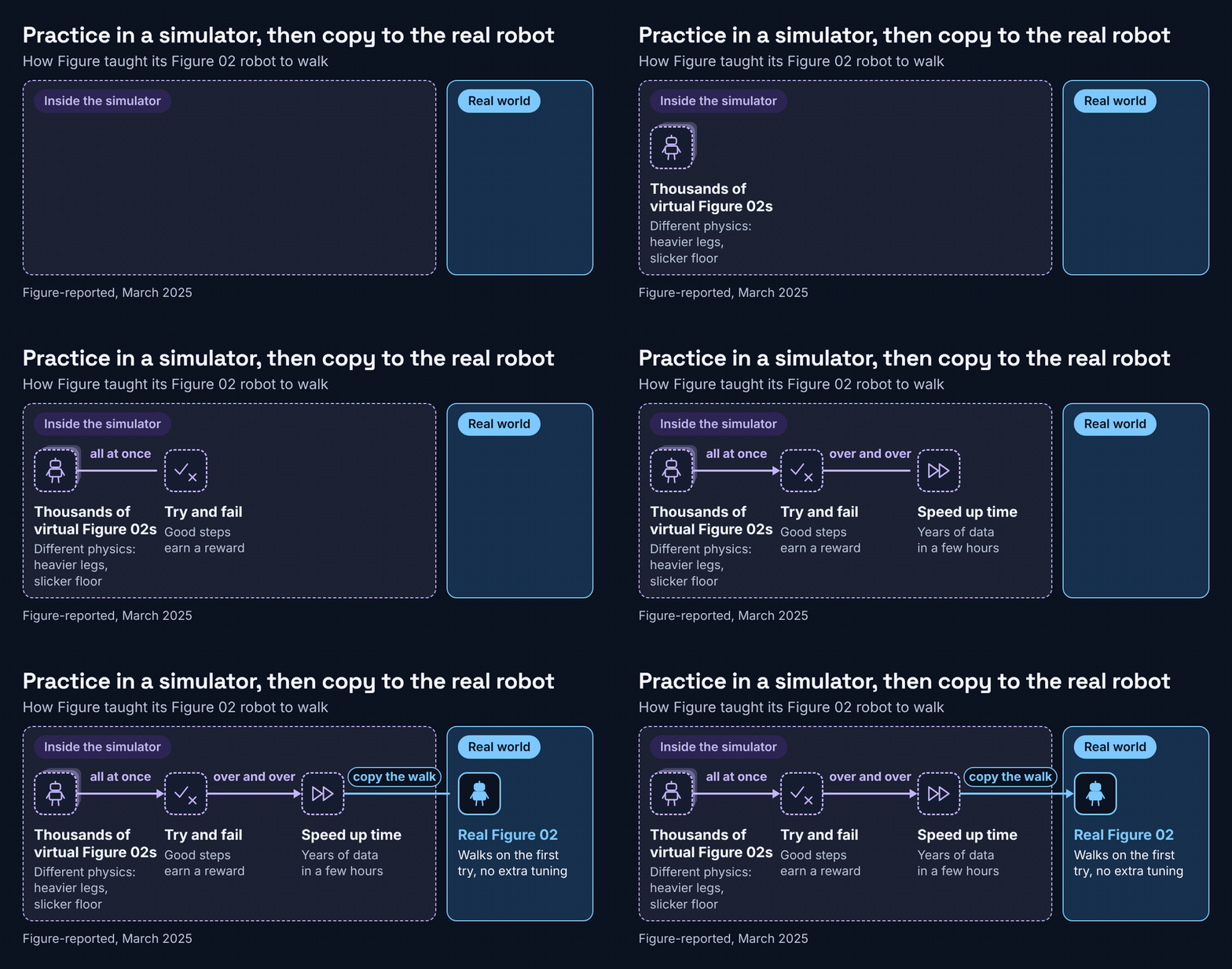
Here is how Figure taught its Figure 02 robot to walk, step by step:
- Build a crowd of copies. Thousands of virtual Figure 02 robots run in the simulator at once. Each has its own physical settings. Picture one with slightly heavier legs and another on a slicker floor.
- Let them try and fail. Steps that work earn a reward. Falls do not. Nothing breaks, because nothing is real.
- Speed up time. Figure says it simulates years of data in only a few hours.
- Copy the result to the real robot. Figure says the walking skill transfers to real hardware zero-shot (it works on the first try) with no extra tuning.
The mixed-up physics is the clever part. A robot that practiced in many slightly different bodies is less likely to be thrown off by the real one.
Figure even showed 10 Figure 02 robots walking on the same neural network (the learned program inside the robot), with no tweaks for any of them.
NVIDIA makes practice data in simulation too. It says it generated over 750,000 synthetic trajectories (computer-made practice movements) in just 11 hours. NVIDIA says that equals about 6,500 hours, or nine months nonstop, of human demonstrations.
The honest limit: a game kitchen is never quite a real kitchen. MIT Technology Review reports that the limits of simulation mean it plays "a far smaller role today than it did in 2018."
So when Figure's robot walks smoothly, it already did most of its falling inside a computer. But simulation is one tool, not the whole answer.
Way 3: Learn by watching people
Robots also learn from the biggest teaching library there is: people, moving.
Figure uses this for walking style. It rewards the robot for copying recordings of human walking, so its steps look more like yours and less like a wind-up toy.
NVIDIA leans on video. The bottom layer of training data for its robot model, called GR00T N1, is internet-scale web data and human videos. These give the model a broad sense of what things look like and what words mean.
This is where the cooking analogy wobbles. A student who watches a chef can guess how their own wrist should turn. A robot cannot.
NVIDIA says human videos show how people handle objects but "lack motor control" information: which motor to turn, how hard, and when.
So video teaches a robot what a task should look like. It still needs one of the other ways to learn how its own body does it.
Way 4: One robot brain that takes instructions
The fourth way ties the other three together: one general model that sees, understands a request, and moves the body.
That is the vision-language-action model from the grocery demo. Helix splits the job in two, a bit like a head chef and a line cook.
System 2 is the head chef, the slow thinker. It is a vision-language model (an AI that understands both pictures and words) that was first trained on internet data. It runs on the robot and thinks about 7 to 9 times a second.
System 1 is the line cook, the fast hands. It sends commands to the whole upper body 200 times a second, down to wrist angles and finger bends.
That internet-first step will sound familiar if you have read our guide to how AI models get smarter in training stages. Chatbots start the same way.
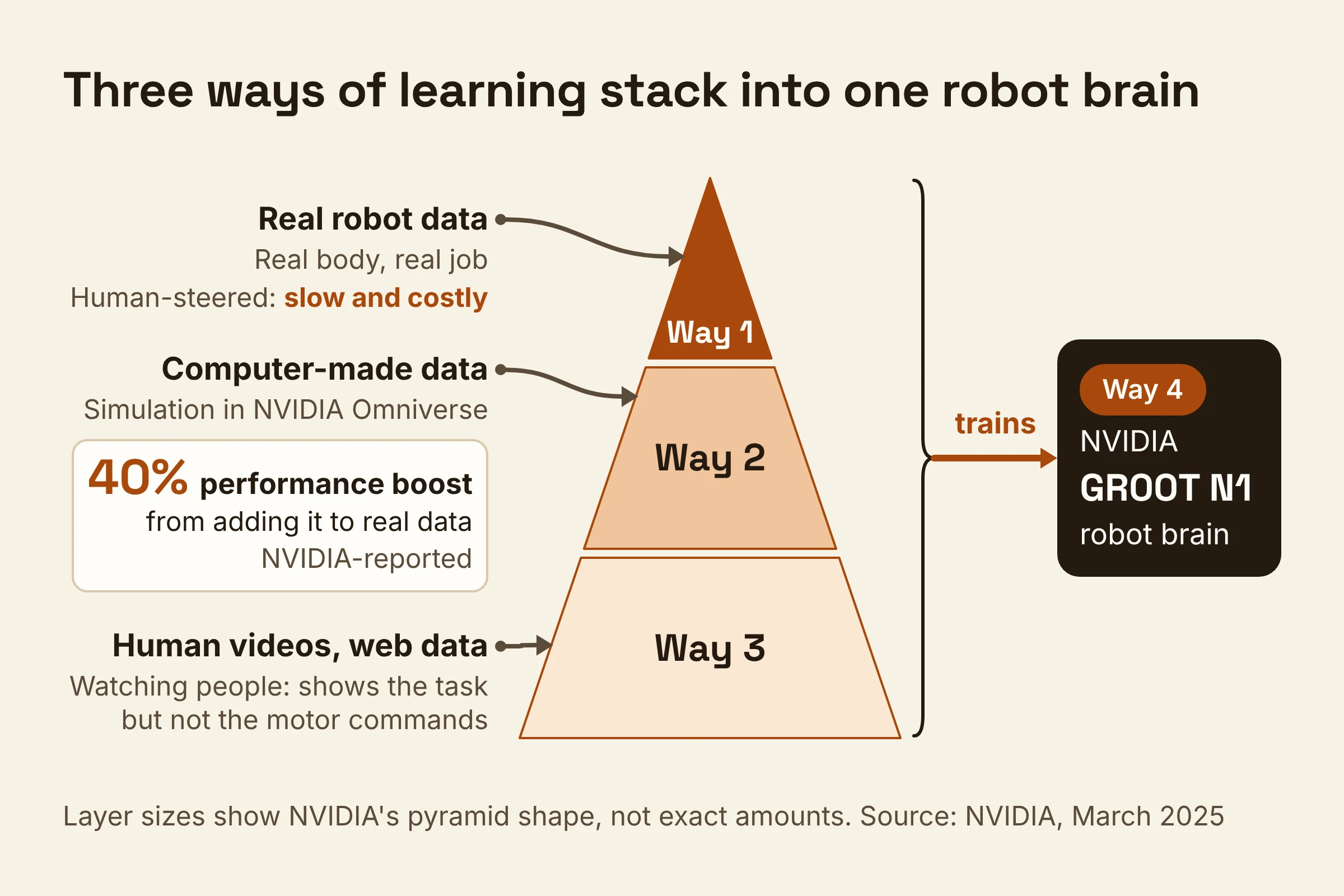
NVIDIA's GR00T N1 shows how the four ways stack up. NVIDIA calls it "the world's first open foundation model for generalized humanoid robot reasoning and skills," which is NVIDIA's own claim.
Its training data is shaped like a pyramid. Human videos and web data form the wide base, and computer-made data from NVIDIA's Omniverse platform sits in the middle. Real robot data, collected by teleoperation, sits at the small peak.
In other words, Ways 3, 2 and 1, mixed together. NVIDIA reports that adding the synthetic data to real data gave GR00T N1 a 40% performance boost. A version called GR00T-N1-2B is on Hugging Face, a popular site for sharing AI models.
Boston Dynamics does something similar with Atlas. It trains one policy (the part of the AI that picks the robot's next move) on all its data from every task. In its demo, each of three subtasks starts with a plain-language prompt to that policy.
Google DeepMind calls Gemini Robotics 2 its most advanced vision-language-action model. It says that for the first time, its model can control entire humanoid robots. In the demo, Apptronik's Apollo humanoid takes in an instruction, walks to the table and picks up the watering can.
This is the kitchen sense from the analogy. You say what you want, and the robot works out the moves.
Who uses what, and how real is it today?
Much of the robot learning in the efforts below is still a demo, research or early access, and the companies say so themselves. Here is where six well-known efforts stand, based on the sources listed below.
| Robot or model | How it learns | How real it is | The catch |
|---|---|---|---|
| Figure robots with Helix (Figure AI) | About 500 hours of human-steered recordings, fed into one VLA model | Company demo | Figure calls these early results |
| Atlas (Boston Dynamics with Toyota Research Institute) | Human steering in VR, on the real robot and in simulation, into one policy | Research | Boston Dynamics says there is "still much work to be done" |
| Gemini Robotics 2 on Apptronik's Apollo (Google DeepMind) | A VLA model; its launch page does not say what data it learned from | Early-access partners only | Movement speed needs work, and "multi-finger dexterous manipulation remains challenging" |
| GR00T N1 (NVIDIA) | Human videos, simulation and human-steered robot data, mixed | Open model, posted on Hugging Face | Real robot data is slow and costly to collect |
| NEO (1X) | 1X's Redwood AI model, plus a human 1X Expert for chores it does not know | 1X says early owners will get basic autonomy; delivery dates are not on its page | 1X says it arrives with basic autonomy and grows over time |
| Digit (Agility Robotics) | Not stated in these sources | Commercial deployment at GXO, after a pilot in late 2023 | It can lift only 35 pounds, MIT Technology Review reports |
A few details sit behind that table. Google DeepMind's robot-control models are for early-access partners only. Its reasoning model, Gemini Robotics ER 2, is on Google AI Studio and in private preview.
Digit is the only commercial deployment on the list. GXO (a logistics company) and Agility Robotics signed a multi-year deal to begin deploying Digit, after a trial run in late 2023.
The companies call it the industry's first formal commercial deployment of humanoid robots. At a SPANX facility, Digit moves totes (plastic bins) from other robots onto conveyor belts.
MIT Technology Review reports that Amazon, Toyota and GXO have all deployed Digit. It also reports that the rare humanoids in real warehouses are "often confined to test zones and pilot programs."
Back to the groceries: how to watch the next robot video
The grocery skill came mostly from two of the four ways: about 500 hours of human-steered recordings, fed into one general robot brain. No rule for each item, just a lot of shown examples.
Next time a robot video goes viral, run it through this quick check:
- Who was steering? If a person was driving the robot during the clip, you are watching a puppet show, not a learned skill.
- What did it learn from? Human-steered recordings, simulation, video, or a mix? And were the objects new to it, like Figure's groceries?
- Demo, early access or deployment? A company video, a partners-only program and a paid warehouse job are three very different things.
- What does the company admit? Honest teams name their limits. Look for that line.
These questions matter more each year. MIT Technology Review reports that companies and investors put 6.1 billion dollars into humanoid robots in 2025, four times what went in during 2024.
The catch is still data. Peter Chen, a cofounder of Covariant, told MIT Technology Review that his company's robot "might not work well yet in the places where you don't have good training data." So the most useful question about any robot is the simplest one: what was it shown?
Sources
- Figure AI, Helix: A Vision-Language-Action Model for Generalist Humanoid Control, February 2025
- Figure AI, Natural Humanoid Walk Using Reinforcement Learning, March 2025
- NVIDIA, Accelerate Generalist Humanoid Robot Development with NVIDIA Isaac GR00T N1, March 2025
- Google DeepMind, Gemini Robotics 2 brings whole body intelligence to robots, July 2026
- Agility Robotics, GXO Signs Industry-First Multi-Year Agreement with Agility Robotics, June 2024
- MIT Technology Review, How robots learn: A brief, contemporary history, April 2026