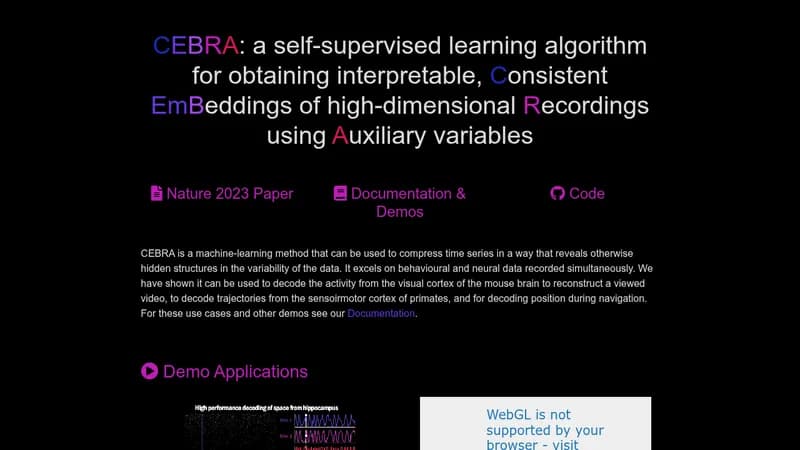
CEBRA is a machine-learning method for compressing time series data to reveal hidden structures, particularly in simultaneously recorded behavioral and neural data. It uses a self-supervised learning algorithm to obtain interpretable, consistent embeddings of high-dimensional recordings using auxiliary variables.
Key Features
- Jointly uses behavioural and neural data in a supervised (hypothesis-driven) or self-supervised (discovery-driven) manner
- Produces consistent and high-performance latent spaces
- Can be used for decoding neural activity to reconstruct viewed videos, decode trajectories, and decode position during navigation
- Works with calcium and electrophysiology datasets across sensory and motor tasks
- Supports single and multi-session datasets for hypothesis testing or label-free use
Use Cases
- Decoding activity from the visual cortex of the mouse brain to reconstruct a viewed video
- Decoding trajectories from the sensorimotor cortex of primates
- Decoding position during navigation (e.g., rat hippocampus data)
- Mapping of space and uncovering complex kinematic features
- Producing consistent latent spaces across 2-photon and Neuropixels data
Who It's For
Neuroscience researchers and computational scientists working with neural and behavioral data.