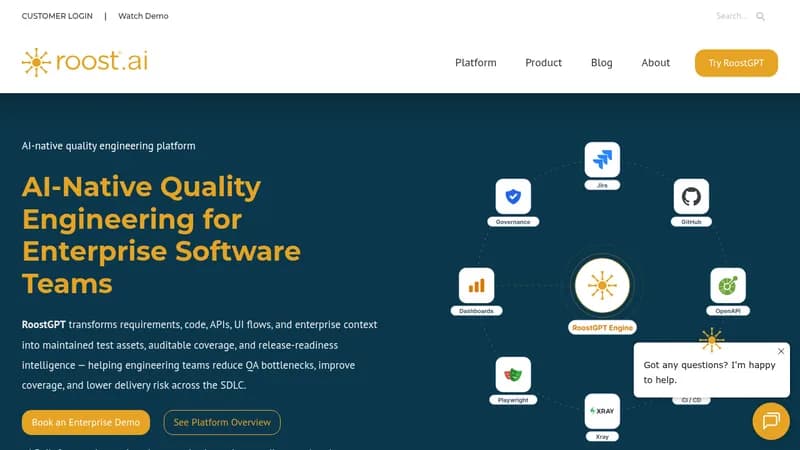
RoostGPT is an AI-native quality engineering platform designed for enterprise software teams. It connects to requirements (Jira), source code (GitHub, GitLab, Bitbucket, Azure DevOps), API specifications (OpenAPI, Swagger), UI flows, and existing test assets to generate, maintain, govern, and report test coverage across the SDLC. The platform supports unit testing, API testing, UI automation (Playwright), functional testing, manual test case generation, and documentation. It provides features such as requirement-to-test traceability, compilable unit tests on code changes, executable API tests from specifications, UI automation without manual scripting, and release-readiness intelligence for leadership. RoostGPT offers role-based access control, secure isolated execution, flexible deployment (cloud, on-premise, hybrid), auditable workflows, and human-in-the-loop review. It targets industries like banking, insurance, healthcare, and enterprise SaaS where quality, governance, and compliance are critical.
Key Features
- Requirements to Test Coverage: Transforms Jira stories, acceptance criteria, and business rules into structured test assets.
- Compilable Unit Tests: Analyzes code changes and dependencies to generate language-specific unit tests that compile.
- API Testing: Converts OpenAPI/Swagger specs into executable API tests covering auth, payloads, and edge cases.
- UI Automation: Discovers UI components and generates maintainable Playwright scripts from a URL and workflow context.
- Test Maintenance: Updates impacted tests when requirements, code, APIs, or UI flows change.
- Governance and Reporting: Supports audit logs, RBAC, traceability, review workflows, and dashboards for release readiness.
Key Benefits
- Generates compilable, language-specific unit tests from code changes and dependency analysis
- Connects requirements to test assets with traceability and governance
- Supports multiple test types: unit, API, UI, functional, and manual
- Maintains tests as software changes, reducing automation decay