Run an AI SEO audit on a site with a few hundred posts and you will get answers within minutes. Which pages compete against each other, which posts lost half their traffic since spring, which topics you never covered, where your internal links should go. Faster than any spreadsheet workflow, cleaner than any consultant's first pass, and largely wrong in ways that are hard to see until you act on it.
That last part is the part nobody puts on the landing page. The AI layer in modern SEO tools, and the AI agents people are wiring up to those tools, has gotten genuinely good at surfacing candidates: candidate cannibalization pairs, candidate dead pages, candidate gaps, candidate links. It has stayed bad at the thing that actually determines whether your rankings improve, which is deciding which candidates are real. Improvise dressed up in technical vocabulary is still improvise, as Sitebulb put it when explaining why its MCP connector hands AI pre-audited data instead of raw guesses.
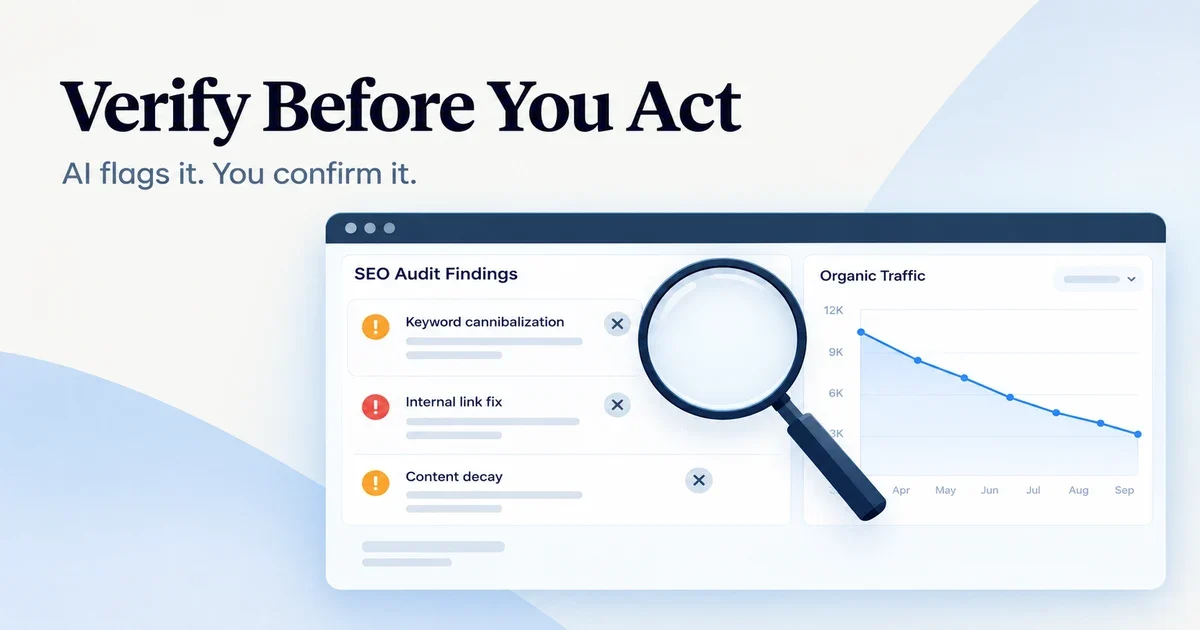
So this guide is built around a verify-before-acting workflow. Four audit jobs, each one showing what the AI layer produces, where it hallucinates or over-flags, and the manual check you run before anything ships. All tool states and prices are as of September 2026, because this category has spent the last twelve months rebranding, restructuring plans, and shipping MCP connectors, and most older reviews describe products that no longer exist.
What an AI SEO audit actually is (and what it hallucinates)
An AI SEO audit is not one thing. In September 2026 it shows up in three shapes:
First, AI features inside established SEO tools. Semrush's Copilot reads your Site Audit and Position Tracking data and surfaces prioritized, plain-language recommendations. Surfer, which rebranded as Positive Surfer after joining Group Positive in late 2025, runs a Content Audit that flags decaying pages and quick-win refreshes. Clearscope's Protect module watches published pages and flags decline.
Second, MCP connectors, the big change of 2026. Sitebulb shipped a hosted MCP server that lets Claude or ChatGPT query your finished crawls in plain English: summarize the audit, rank the risks, show what changed since last crawl. Screaming Frog went the other direction in its version 24.0 release in May 2026, shipping a local MCP server that can actually start crawls and pull reports. Semrush includes 50,000 MCP API units per month with its SEO subscriptions and has published official agentic workflows for exactly the four jobs this article covers.
Third, DIY agents: people connecting GSC, GA4, and crawler exports to Claude or ChatGPT and asking for an audit. This is the shape that hallucinates most, for a structural reason. An LLM with no crawl data can't see that 4,000 URLs sit behind a wrong canonical, but it will not say so, it will improvise. The output looks like an audit and contains your URLs and real-sounding severity ratings, some of which are invented.
Even the well-grounded setups share two failure modes. Over-flagging: show a decay detector any downward line and it will hand you 200 "declining" URLs, of which 150 are seasonal noise, SERP-feature churn, or a query that simply cooled off. And confident wrongness on close calls: two pages targeting adjacent keywords is often intent overlap (cannibalization) and often healthy coverage, and the model will pick one explanation with total confidence either way.
The consequence is a simple division of labor that the rest of this guide applies to each job: the AI produces candidates, the human confirms or kills them, and only confirmed items get changes.
Job 1: Cannibalization, finding the pages that fight each other
Cannibalization is when two or more pages from the same site rank for the same keyword in Google's top 100, splitting visibility and backlink signals between them. The AI-era detection is solid. Semrush's Position Tracking has a dedicated Cannibalization Report that flags affected keywords, shows the competing URLs per keyword, and scores your Cannibalization Health as a percentage you can trend over time. Ahrefs flags the same pattern from the rank-tracking side. Surfer ships a cannibalization report on its Pro tier and above.
Where the AI layer over-steps: it will propose fixes, and the fixes carry real cost. Consolidating two pages with a 301 redirect is a one-way door, and canonicalizing or de-optimizing a page affects a URL that might be earning traffic you haven't looked at. The report also can't tell you whether two ranking URLs genuinely compete, or whether Google simply shows whichever page fits the moment's intent.
The manual verification takes about ten minutes per pair and looks like this:
- Open Search Console, Performance report, filter to the keyword, and check the Pages tab. Both URLs drawing impressions for the same query is the real signal. One URL ranking with the other nowhere in the data is a tracking artifact, not a fight.
- Read both pages. Same intent means consolidate. Different intents, a beginner guide versus a product comparison, means they can coexist, and you may just need clearer differentiation in titles and internal anchors.
- Check traffic history on both URLs before choosing a survivor. The right primary is usually the page with more links, more content depth, and more conversions, not the one currently ranking 9 instead of 14.
If you consolidate, the AI can draft the merge plan: which sections survive, where redirects point, which internal links to repoint. That's a good use of it. Choosing which page lives is not.
Job 2: Internal links, where AI suggestions look right and aren't
Internal linking is the job where AI assistance is most tempting and most full of traps, because the suggestions arrive fully formed and specific. Semrush's own agentic SEO guide shows exactly how specific: its internal linking workflow returns recommendations with source, destination, anchor text, and the exact sentence where the link should attach. That's seductive. It reads like finished work.
It is not finished work. Anchor suggestions can be based on a paraphrase of your page that doesn't match your actual voice. The "exact sentence" sometimes doesn't exist on the page, or exists with different words, or exists in a paragraph where the link makes the sentence worse. And the destination choice is frequently a weak page, because the agent matched topics without accounting for which page deserves the authority.
The verification pass for internal links:
- Does the sentence exist? Open the source page and find it. If the AI invented or paraphrased it, you write the sentence yourself, which is the entire editorial judgment anyway.
- Does the link help a reader on that page? If you have to squint to see the relevance, it fails, no matter how semantically similar the two pages are.
- Does the destination deserve it? Point links at pages that need authority, not just pages that are topically adjacent. The best internal link targets are strong pages starved of internal links, which is a pattern tools like Sitebulb surface directly (where authority pools, which commercial pages have almost no internal links pointing at them) rather than guessing one link at a time.
One useful habit from the Semrush workflow worth keeping: it separates link suggestions from structural findings, orphaned pages, broken internal links, important pages linked only from low-value sections. Treat those two outputs differently. Structural findings come from crawl data and are usually trustworthy. Individual link suggestions are candidates until you've read the sentence.
Job 3: Content gaps, term coverage is not accuracy
Content gap analysis is where the AI tooling is most mature and where the interpretation trap is easiest to fall into. The tools work:
Clearscope grades your page's term and entity coverage against what currently ranks for the keyword, A++ down to F, and its Content Inventory flags which published pages have drifted. MarketMuse, which has been a Siteimprove company since late 2024, still does the deepest cluster-level work in the category, modeling topical authority across your whole inventory and showing which clusters competitors cover and you don't. Surfer's Pro tier adds coverage gap analysis to the same end.
The trap is treating a term-list gap as an editorial mandate. When the report says your page is missing "agentic workflows" and "MCP connectors" compared to the ranking set, three things could be true: the term names a real subtopic your page should cover, it's a synonym of something you already wrote under a different name, or it's a phrase that appears in ranking pages for incidental reasons and will add nothing but noise to yours. The report distinguishes between none of these.
So the manual pass is a demand check, not a coverage check. For each gap: does the term describe a distinct thing your reader would want? Does it have search demand of its own, or at least a real presence in the current SERP? Would covering it make the page more useful, or just longer? Coverage is not accuracy, and hitting every recommended term says nothing about whether any claim in the piece is true, which matters rather more for whether people link to it.
A second gap trap: cluster-level gap analysis (MarketMuse's strength) recommends whole new pieces of content. An AI-recommended "gap" that spans five paragraphs to justify is often a section inside an existing post, not a new URL. Creating it as a new page is how cannibalization gets manufactured, which conveniently brings you back to Job 1.
Job 4: Content decay, the slow slide you can catch with a comparison
Content decay is the quiet one: a page that held position 4 for two years slides to 9, then 14, over six months, without a single alert. Search Console has no decay report, so the detection pattern, whether a human or an agent runs it, is always some version of the same comparison: this 90 days against the previous 90, or this year against last year, sorted by pages with declining clicks.
AI makes the comparison step nearly free. Semrush lists decay detection among its published agentic workflows, combining performance history with page context to propose which URLs need investigation. Surfer's Content Audit does the same from its side, with rank drop alerts on Standard plans and up. The AI version's weakness is precision: it flags anything with a declining line, including seasonal topics on their off-year, pages a competitor's AI Overview quietly absorbed impressions from, and low-volume pages where a swing from 40 impressions to 25 is statistical noise dressed up as a 38 percent decline.
The verification sequence that separates decay from everything else:
- Compare year-over-year, not just trailing months, if the topic has any seasonality. A page on tax deadlines declines every August.
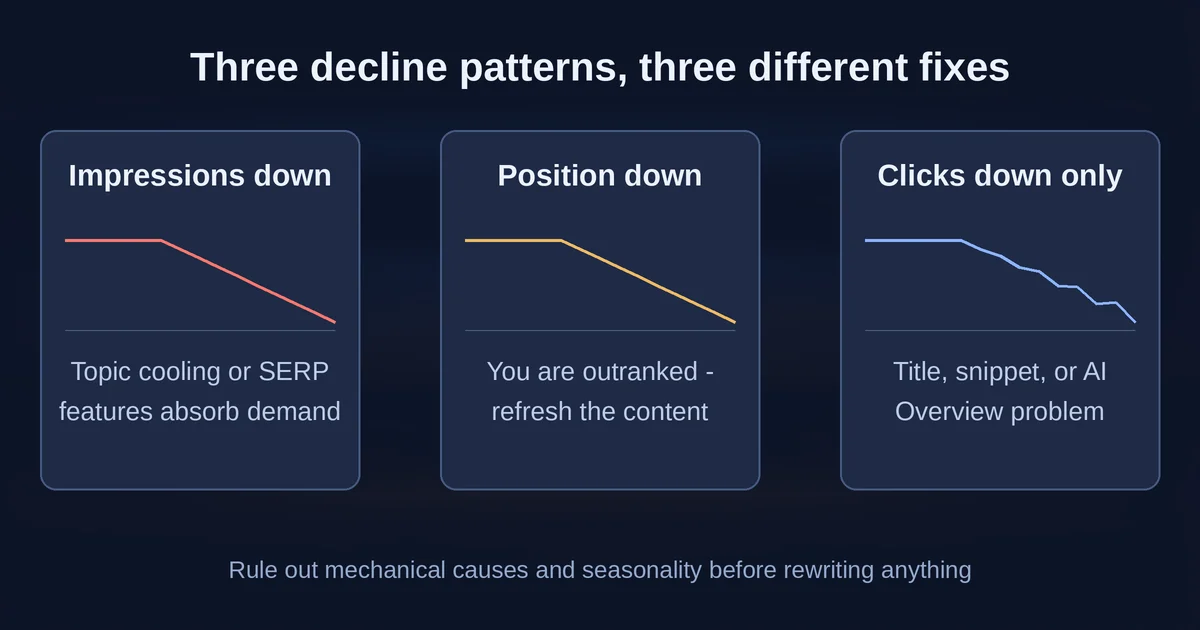
- Separate the three decline patterns: impressions falling with stable position means the topic itself is cooling or a SERP feature is absorbing demand; position falling with stable impressions means you're being outranked and the content needs work; clicks falling while impressions hold means a title, snippet, or AI Overview problem, which no amount of content rewriting will fix.
- Rule out mechanical causes before touching the content. A canonical flipped by a template update, a noindex tag, a broken internal link, or a title overwritten by a plugin update all look exactly like decay in the traffic data and take five minutes to fix. This is what crawl comparison is for: both Screaming Frog (since version 15) and Sitebulb can diff two crawls and show precisely what changed on the page.
- Check whether a core update landed on the drop date. Decay is gradual; a ranking drop over 2 to 4 days across many pages at once is an algorithm event, and the fix is different.
Only pages that survive all four checks get a rewrite. And when you do rewrite, rank by lost impressions times remaining demand, not by percentage decline, a page that fell from 3 to 9 on a big query is worth more than one that fell from 40 to 90 on one nobody searches.
The tool landscape, September 2026 edition
A quick state-of-the-category, because half the reviews online describe last year's products:
- Semrush is the closest thing to a complete AI audit platform: Copilot recommendations on all plans, the Cannibalization Report in Position Tracking, Site Audit's internal linking report, an AI Toolkit for citation visibility, and 50K monthly MCP API units plus official agentic workflow guides. Its own guidance is explicit that a human should implement what the agent proposes.
- Sitebulb matters for its MCP connector: your finished crawl, with its 300-plus prioritized hints, readable by Claude or ChatGPT, read-only, with five pre-built Skills (triage, what-changed, client-facing audit, release check, dev tickets). It even gives back honest scores, demoting issues that won't rank-effect, which makes the AI layer harder to fool.
- Screaming Frog (v24, 2026) is the local alternative, an MCP server that can drive crawls end to end, at £199 a year with 500 URLs free. Less hand-holding, more agent-operated.
- Surfer / Positive Surfer is the content-side pair: Content Audit, rank drop alerts, a Pro-tier cannibalization report, and 1-click internal linking that requires a connected Search Console. After the Group Positive acquisition it repositioned around AI search visibility, but the audit features still run on GSC data.
- Clearscope ($129/mo Essentials, unlimited users) is the term-coverage grader with a monitoring module, a QA gate for pages you already own, not a gap-discovery engine.
- MarketMuse does the deepest cluster-level gap analysis but has moved pricing behind a demo wall since the Siteimprove acquisition, so budget conversations start with a sales call.
- Linkody ($14.90/mo) is the honest counterexample: pure backlink monitoring, checks every 24 hours, emails you when a link is lost or goes nofollow, no AI anywhere. Link decay is a real audit job, and it needed exactly zero machine learning, just a cron job with good judgment about what to check.
None of these tools will refuse your business if you skip verification. All of them will happily hand you a list of 200 things to change. The lists are where the value is, and also where the damage is.
The workflow that catches AI mistakes before you act on them
Pulling the four jobs into one operating loop you can run weekly or monthly, depending on site size:
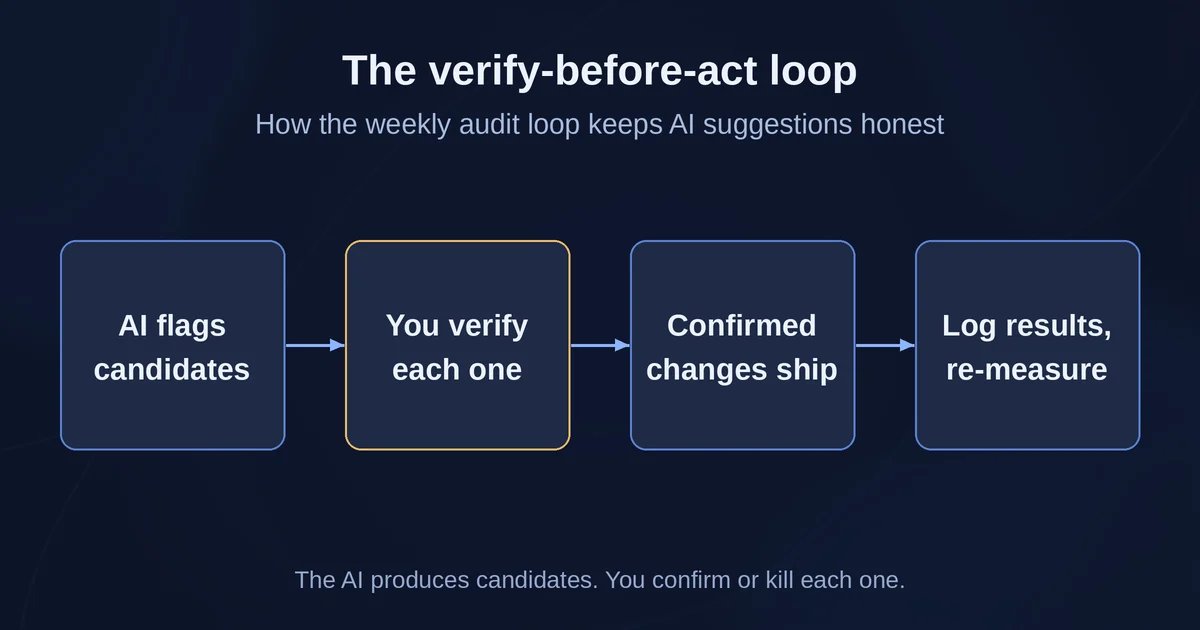
- Collect, don't decide. Point the tools at the data: a Sitebulb or Screaming Frog crawl, GSC export, Semrush cannibalization and position data. If you're using an agent, connect the MCP servers rather than pasting CSVs, the failure rate of an AI reasoning over a spreadsheet it can't verify is much higher than one with live data access.
- Run each detector, get candidates. Cannibalization pairs, link suggestions, gap terms, decaying URLs. Everything is a candidate until confirmed. Nothing is an instruction.
- Verify each category with its specific check. GSC impressions for cannibalization pairs, the actual sentence for link suggestions, demand for gap terms, the mechanical-cause and seasonality sweep for decay. Budget real time: ten minutes per cannibalization pair, a minute or two per link suggestion, as long as it takes to stop flagging pages that were never broken.
- Batch what survives into changes. Merges and redirects, link edits, section additions, rewrites. Let the AI draft the merge plan or the rewrite brief, an editor approves.
- Log what you did and re-measure in 60 to 90 days. This is the step everyone skips and the one that builds the pattern library. When a refresh recovers, note why. When a cannibalization consolidation goes nowhere, note that too. Your next audit runs on that history, and it's the one thing no tool can generate for you.
That last step is also what turns the AI layer from a risk into leverage. The tools are good enough now, September 2026's MCP connectors in particular, that the bottleneck is no longer collecting findings. It's the 20 minutes of skepticism per audit that keeps you from redirecting the wrong page.
Pricing and plan details are as published by the vendor around September 2026 and can change, confirm on the official site.
If you want to go deeper on working with AI instead of just running it, read our guide to what the MCP protocol actually is, the practical differences between AI agents and AI automation, and why AI hallucinates in the first place, which is the mechanism behind every false positive this article taught you to catch.