
Why these tools stay hidden
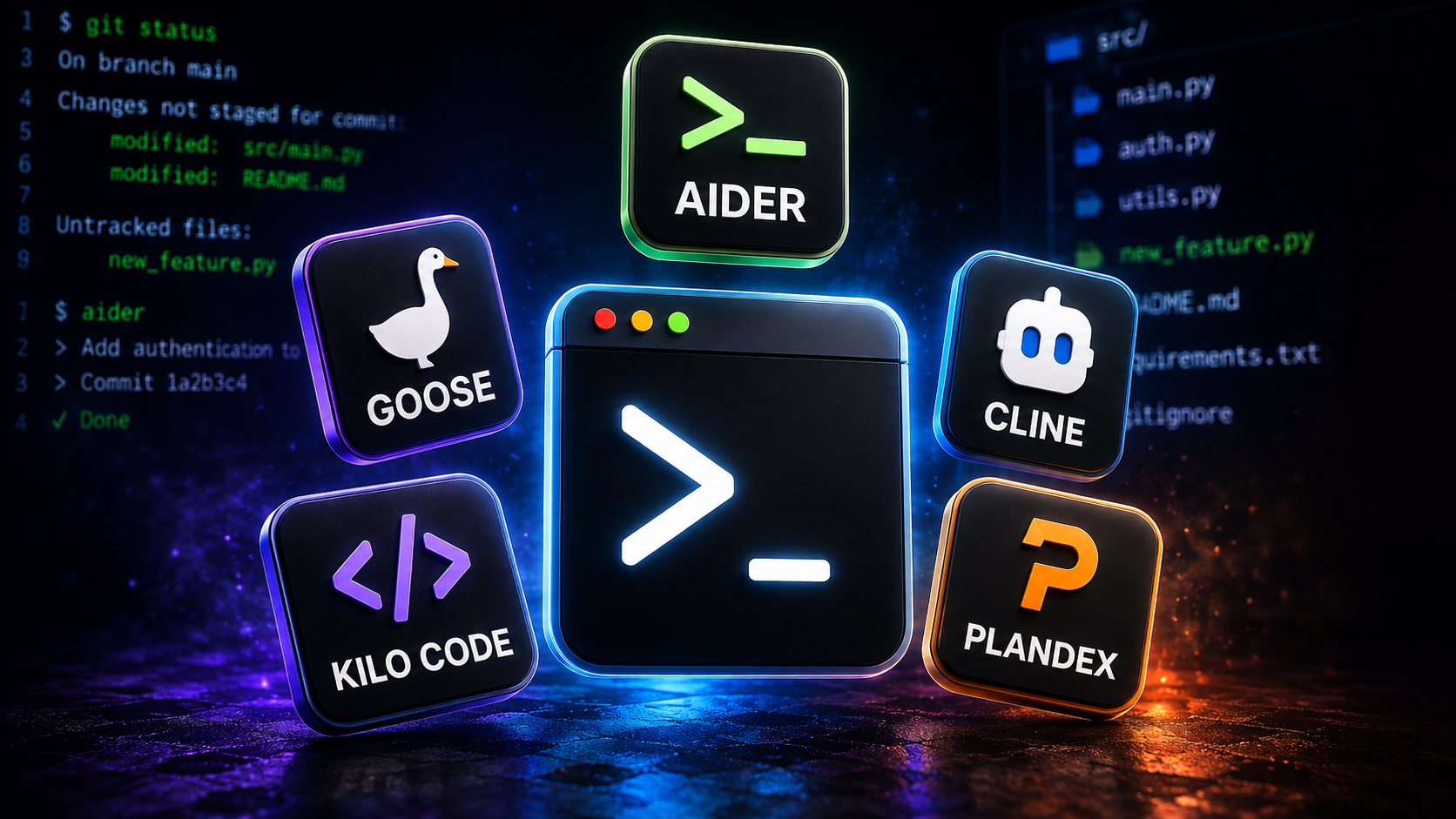
None of these five tools have a marketing team, a funding round measured in billions, or a parent company with a reason to put them in front of every developer's feed. A few belong to solo maintainers or small foundations. What they have instead is years of daily use inside a specific niche: git-native editing, fully local execution, JetBrains support, or handling codebases too large for a typical context window.
They also tend to share three traits that make them easy to overlook in a headline roundup but genuinely useful in daily work:
- Bring-your-own-key pricing. All five are free to install; you only pay for whichever model's API you point them at.
- Open licensing. Apache 2.0 or MIT across the board, meaning the entire codebase is auditable and forkable.
- Model-agnostic by design. None of them are locked to one lab's models, which is precisely the trait that made OpenCode the top-ranked tool in this month's power rankings and yet somehow doesn't get associated with any of these five, despite them sharing the same philosophy.
Aider: the git-native pair programmer
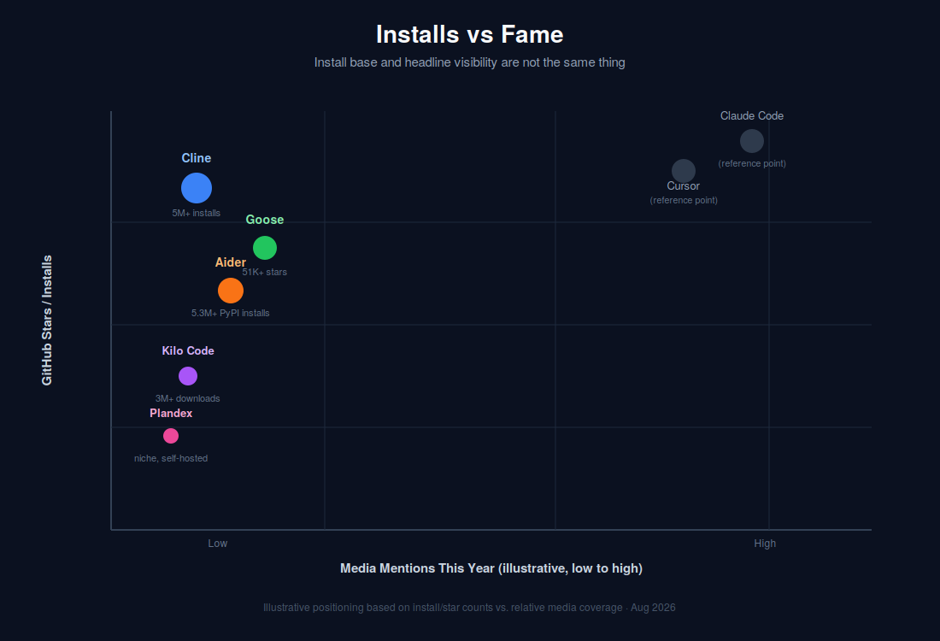
What it is. Aider is an open-source, terminal-only AI pair programming tool, Apache 2.0 licensed, with over 41,600 GitHub stars and more than 5.3 million PyPI installs, according to a feature proposal filed against NousResearch's Hermes agent project. It was started by Paul Gauthier as a side project in 2023 and has grown into a project with hundreds of contributors, shipping releases roughly every two weeks according to NxCode's setup guide.
The core idea. Aider treats your repository as a living document and every AI-generated change as a git commit. Point it at a set of files, describe a change, and Aider edits the files directly and auto-commits with a descriptive message and a co-authored-by trailer, keeping human and AI commits clearly separated. Every session can run on its own branch, which means the entire git history becomes a complete record of what the AI did and when.
What makes it different from a chat-first tool:
- Tree-sitter-powered repo mapping, which builds an understanding of the entire codebase's structure without loading every file into context, letting it work well on large projects.
- Architect mode, a two-model workflow that separates planning from implementation for complex refactors: one model proposes the plan, a second executes it.
- Headless-capable, meaning it can be invoked without a full pseudo-terminal session, which the NousResearch proposal specifically calls out as unusual among coding agents.
- 100-plus LLM providers via LiteLLM, spanning Claude, DeepSeek, Gemini, GPT, and local models through Ollama, so nothing about the tool depends on any single lab staying in business or staying cheap.
Where it fits.NxCode's comparison against OpenCode frames the split cleanly: Aider is the systematic, git-first refactoring engine, mature and proven at scale; OpenCode is the more modern, polished terminal IDE with LSP-level intelligence. A meaningful number of developers reportedly run both, Aider for repo-wide systematic changes and OpenCode for interactive exploratory sessions.
Goose: Block's model-agnostic local agent
What it is. Goose started life inside Block, the fintech company behind Square, Cash App, and Tidal, and was open-sourced in early 2026. It has since been donated to the Agentic AI Foundation (AAIF), a project under the Linux Foundation, moving it from a single company's internal tool to a foundation-governed open-source project. Per The AI Agent Index, Goose carries 51,000-plus GitHub stars and 500-plus contributors, independently verified against live vendor data in July 2026.
The core idea. Goose is built in Rust and runs as a CLI, a desktop app, or an API, described by one reviewer as handling "code, workflows, research, writing, automation, and data analysis use cases that would otherwise require multiple specialized tools." It is entirely free under Apache 2.0 with no paid tier at all; the only cost is whatever LLM API usage you connect it to.
Standout features:
- First-class MCP support, both consuming MCP servers as tools and exposing itself as an MCP server for other agents to call, with Block shipping official servers for GitHub issue management, PostgreSQL queries, Slack messaging, and Jira integration, per OpenAIToolsHub's review.
- Continuous mode, run as goose run --continuous --budget 2.00, which lets the agent iterate unattended until it hits a dollar cap. The same review reports a roughly 40-turn refactor on Claude Sonnet landing around $0.60 to $1.20 in practice.
- True local-only operation. Paired with Ollama, Goose is one of the few AI coding agent configurations viable in healthcare, government, or finance settings where code cannot leave controlled infrastructure, according to both OpenAIToolsHub and RockB's technical review.
- 15-plus AI providers and 70-plus MCP extensions, per RockB, running on macOS, Linux, and Windows with both CLI and desktop interfaces.
Where it fits. RockB's honest framing: Claude Code leads on raw benchmark performance, with an 80.9 percent SWE-bench score representing the current autonomous-coding ceiling. Goose's edge is elsewhere, specifically task persistence, provider flexibility, and being genuinely viable for regulated industries that cannot use a cloud-only tool at all.
Cline: the quiet installs champion
What it is. Cline is arguably the least hidden tool on this list by install count and the most hidden by mindshare. It began life as Claude Dev in 2024, a scrappy VS Code extension built around Anthropic's models exclusively, before rebranding and expanding into a model-agnostic agent. By mid-2026 it had passed 5 million VS Code Marketplace installs, and GitHub star counts across sources in 2026 range from roughly 57,400 to 64,928, with the variance reflecting when each snapshot was taken during a fast-growing year, per Automation Atlas and Tech Insider's comparison.
The core idea. Cline reads and edits files in the active VS Code workspace and runs terminal commands, but every meaningful action, file edit, terminal command, or browser interaction triggers an explicit approval gate before execution. That human-in-the-loop design is the whole personality of the tool: it is built around never taking a destructive action without a visible sign-off first.
On the numbers that matter for trust:
- Tech Insider's comparison reports Cline holding a 4-out-of-5 rating across 304 VS Code Marketplace reviews, actually higher than Anthropic's own official Claude Code extension, which sits at 3.5 out of 5 across a larger 743-review sample, though the piece is careful to note Claude Code's heaviest users likely review the CLI experience elsewhere, not the extension.
- Plan/Act modes structure every session into a proposal phase and an execution phase, giving the human a natural checkpoint between the two.
- BYOK pricing, entirely free to install, with typical monthly API spend reported between $8 and $150 depending on model choice and workload, according to a 2026 breakdown from developer platform Totalum cited by Tech Insider.
- As of 2026, Cline also offers an optional hosted path, pay-as-you-go inference credits billed directly through Cline for teams that would rather have one bill than manage individual provider keys, alongside a custom-priced Enterprise tier.
Where it fits. Cline's real claim to fame is not a feature. It's the fact that it spawned an entire fork ecosystem, which brings us to the next two tools on this list.
Kilo Code: what happens after a fork war
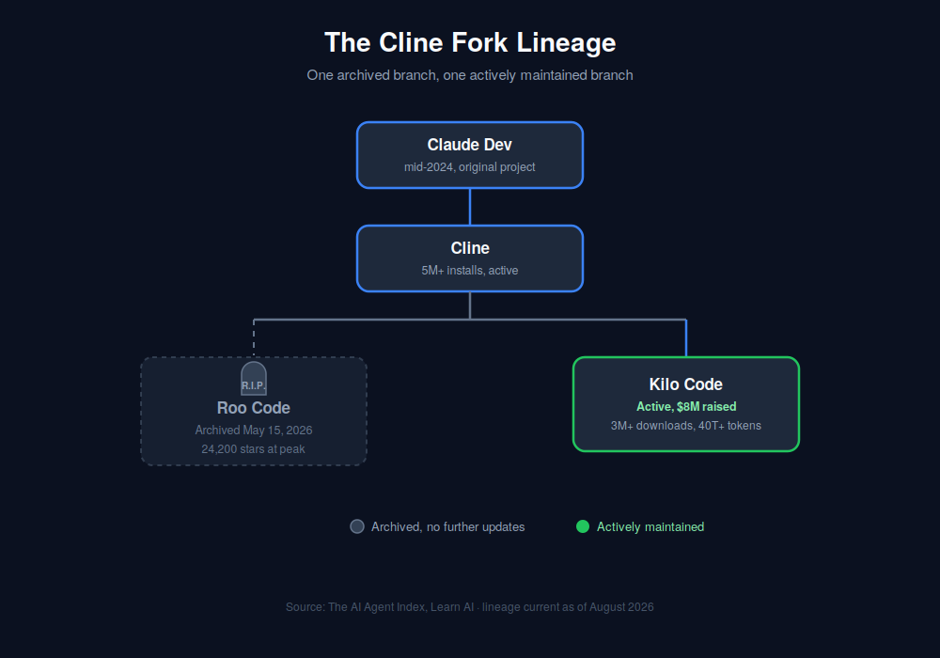
What it is. Kilo Code is the current, actively maintained descendant of a lineage that runs Claude Dev → Cline → Roo Code → Kilo Code, tracing back to mid-2024. It launched in March 2025 as a fork of Roo Code, which was itself a fork of Cline, and was co-founded by Sid Sijbrandij, GitLab's co-founder and former CEO, and Scott Breitenother, founder of data consultancy Brooklyn Data, per Learn AI's writeup. It raised $8 million in seed funding in December 2025, led by Cota Capital with participation from General Catalyst.
The core idea. Kilo Code's stated goal, in its own framing, was to merge Cline's accessibility with Roo Code's advanced functionality, then add its own layer on top: an Orchestrator mode for coordinating specialized sub-agents across a complex task, inline autocomplete, and something called the Kilo Gateway.
What sets it apart:
- 500-plus models from 60-plus providers, at zero markup, meaning Kilo Code passes through exact provider rates rather than adding its own margin, according to OpenAIToolsHub's review.
- Auto Model routing, shipped mid-2026, which automatically picks the right model for each subtask, planning, coding, debugging, or explanation, based on task type and a configured budget tier.
- Both VS Code and JetBrains support, plus a standalone CLI called Kilo CLI, extending beyond Cline's VS Code-only footprint.
- By mid-2026, the project had surpassed 3 million downloads across both marketplaces and processed more than 40 trillion tokens, with 25,400-plus GitHub stars, per The AI Agent Index's comparison against Roo Code.
Where it fits.OpenAIToolsHub's practical framing: pick Cline if you want a proven, focused, VS Code-only agent with a mature community; pick Kilo Code if you want multi-model flexibility, JetBrains support, or Orchestrator mode for genuinely complex, multi-part tasks.
Plandex: built for tasks that are too big for everything else
What it is. Plandex is a terminal-only, MIT-licensed coding agent purpose-built for one specific failure mode: AI coding demos that fall apart the moment a task gets large, a repository gets messy, or a model needs disciplined review across dozens of files. It supports up to 2 million tokens of effective context, per Terminal Trove's tool listing, and can index directories with 20 million tokens or more using tree-sitter project maps.
The core idea. Every proposed change lives in a cumulative diff review sandbox, kept entirely separate from the actual working directory until a developer explicitly approves it. Combined with automatic rollback if a command fails, this makes Plandex unusually safe for large, hours-long refactors where a half-applied change would otherwise be a serious problem.
Notable specifics:
- Configurable autonomy: full auto mode for end-to-end execution with minimal interaction, or granular step-by-step control for tasks where every move needs inspection.
- Multi-LLM support across OpenAI, Anthropic, Google, and 400-plus models via OpenRouter, per Terminal Trove's specification table.
- No MCP support, no IDE integration, and no multi-file editing in the sense of a unified diff across files at once, according to the same Terminal Trove listing, real limitations worth knowing before adopting it for a team workflow.
- The original hosted Plandex Cloud service is winding down, per a 2026 review from ToolJunction, which means all current users are self-hosting or running local mode with their own API keys.
Where it fits.The AI Agent Index's assessment is direct about the tradeoff: Plandex remains "a viable self-hosted option for power users comfortable with terminal workflows who want fine-grained control over large multi-file tasks," but teams that need rich IDE integration, MCP support, or a stable hosted product should look at Claude Code or Cursor instead. This is not a tool trying to be everything. It is a tool trying to be the best option for one specific, genuinely hard problem: context that outgrows what everything else can hold.
Side-by-side comparison
| Tool | License | Interface | GitHub stars (approx.) | Free tier | Standout feature |
|---|---|---|---|---|---|
| Aider | Apache 2.0 | Terminal only | 41,600+ | Free, BYOK | Git-native auto-commit workflow |
| Goose | Apache 2.0 | CLI, desktop, API | 51,000+ | Free, BYOK, no paid tier at all | Foundation-governed, true local-only operation |
| Cline | Apache 2.0 | VS Code, JetBrains | 57,400–64,928 | Free, BYOK, optional hosted credits | 5M+ installs, human-in-the-loop approval gates |
| Kilo Code | Apache 2.0 | VS Code, JetBrains, CLI | 25,400+ | Free, BYOK, zero markup pricing | Orchestrator mode, Auto Model routing |
| Plandex | MIT | Terminal only | Not independently confirmed | Free (self-hosted) | 2M-token context, diff review sandbox |
Which one actually fits your workflow
A practical breakdown rather than a single "best" answer, since these five solve genuinely different problems:
- You live in git and want every AI change to be a reviewable, revertable commit. Aider.
- You need code to never leave your machine, for compliance or plain paranoia. Goose, paired with Ollama.
- You want the most mature, most-installed VS Code extension with a visible approval gate on every action. Cline.
- You're already using Cline or Roo Code and want JetBrains support, multi-model routing, and zero-markup pricing. Kilo Code.
- You're working on a task that spans dozens of files and keeps blowing past every other tool's context window. Plandex.
The Roo Code cautionary tale
Worth including because it's the clearest lesson this category has produced all year. Roo Code, the fork that sits directly between Cline and Kilo Code in the lineage, reached 24,200 GitHub stars and 1.56 million VS Code installs at its peak. Then, on May 15, 2026, Roo Code Inc. archived the entire GitHub repository and pivoted the company to Roomote, a Slack-based AI engineering product with no relation to the original VS Code extension, according to The AI Agent Index's comparison.
The extension itself still installs and still works under its Apache 2.0 license. What it no longer gets is bug fixes, security patches, or any adaptation to future VS Code API changes, since there is no active maintainer behind it anymore. The Index's own advice to existing Roo Code users is blunt: plan a migration to Kilo Code, Cline, or OpenCode for any long-term reliance on the tool.
The lesson generalizes past Roo Code specifically. Open source and free-to-use are real protections against vendor lock-in, but they are not protection against a company simply walking away from a product. Apache 2.0 guarantees the code stays available and forkable. It does not guarantee anyone keeps maintaining it.
Open questions and reasons for caution
- GitHub star counts genuinely vary by source and snapshot date across this piece, sometimes by several thousand for the same tool depending on which month a given review was published. Treat every star count here as directional rather than exact.
- Cline's rating comparison against Claude Code's official extension is a real number from a real source, but the underlying review samples differ enough in size and use case that the comparison should be read with real caution rather than as a clean verdict.
- Plandex's cloud service winding down is a signal worth taking seriously: even a genuinely well-built tool in this category can lose its hosted option, reinforcing the same lesson as the Roo Code archival, just less abruptly.
- None of these five tools has the backing, benchmark visibility, or blind-review testing that the tools in this month's power rankings get. That is exactly why they're in this piece, but it also means claims about their relative quality rely more heavily on scattered reviewer testing than on standardized, repeatable benchmarks.
Sources: NousResearch Hermes agent repository, NxCode, OpenAIToolsHub, RockB, The AI Agent Index, Automation Atlas, Tech Insider, Learn AI, Terminal Trove, and ToolJunction. All figures current as of August 2026 and subject to change as these projects continue to ship.