Quick Answer
- Anthropic released Claude Opus 5 on July 24, 2026, its fourth new model in under two months, following Mythos 5, Fable 5, and Sonnet 5
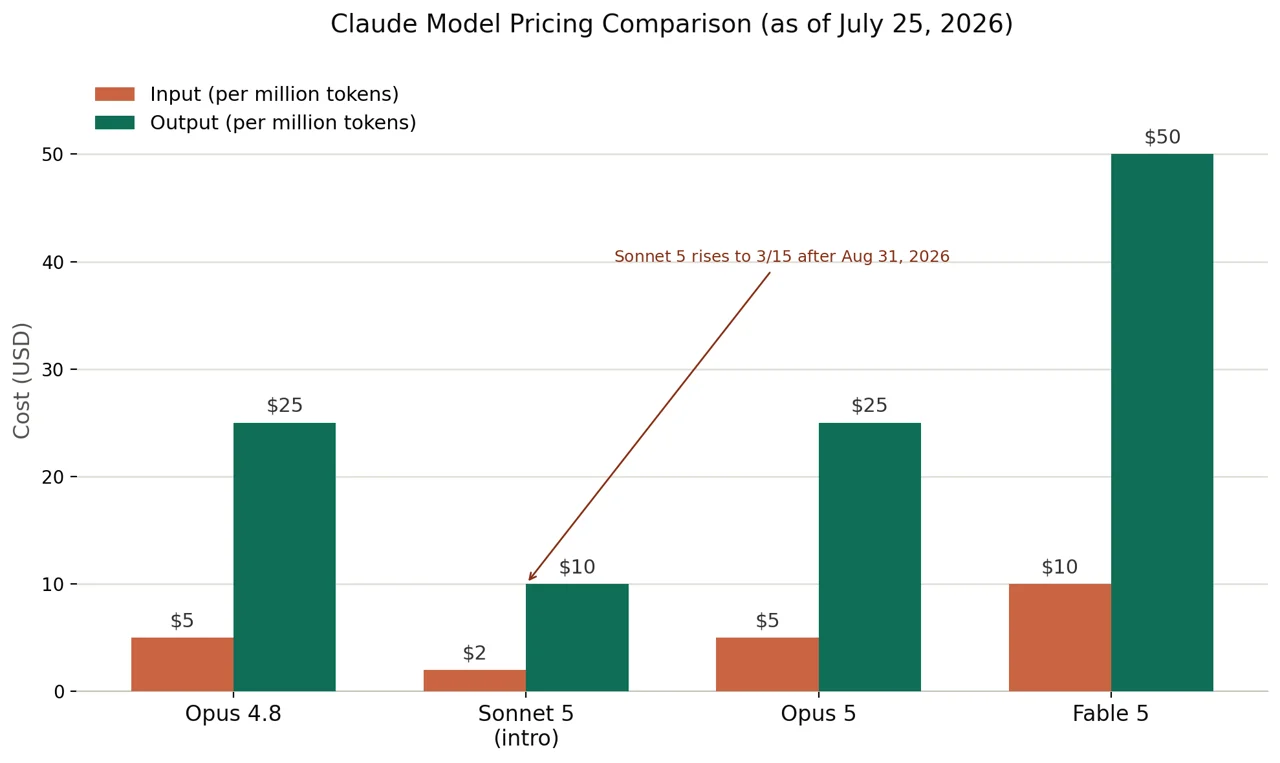
- It delivers intelligence close to Fable 5 at half the price, priced the same as its predecessor, Opus 4.8 ($5 input / $25 output per million tokens)
- It's now the default model on Claude Max and the strongest option on Claude Pro
- The headline new feature is an effort toggle, low, medium, or high, letting you trade cost for capability on a per-task basis
What Is Claude Opus 5
Opus 5 is Anthropic's new everyday, professional-tier model, positioned as a thoughtful, proactive assistant built for daily business use rather than chasing the absolute top of the leaderboard at any cost. Anthropic describes it as coming close to Fable 5's frontier intelligence while running at roughly half the price of a comparable top-tier model.
It's part of a rapid release stretch. Mythos 5 and Fable 5 launched in June, Sonnet 5 followed shortly after, and Opus 5 is the fourth model in this family to ship in under two months, each one aimed at a different point on the capability-versus-cost curve.
What's Actually New
- An effort toggle: choose low, medium, or high effort per task, so routine work stays cheap and fast while harder problems can pull more capability when needed
- Self-verification: Opus 5 checks its own work and recovers from errors without needing a human to step in and redirect it
- Smoother fallback routing: if a task needs to hand off to a different model tier, the transition is designed to be less disruptive than in earlier versions
- State-of-the-art coding and knowledge benchmarks: Anthropic reports new highs on Frontier-Bench (43.3%) and GDPval-AA, evaluations covering coding and real-world knowledge work, ahead of both Opus 4.8 and Fable 5 on these specific tests
- Still behind Mythos 5 on cybersecurity tasks, which remains the more restricted, specialist-access model in Anthropic's lineup
How to Access It
- Claude Pro and Claude Max subscribers: Opus 5 is already live, it's the default model on Max and the top available option on Pro, no separate setup needed
- API users: available at the same pricing tier as Opus 4.8, $5 per million input tokens and $25 per million output tokens, making it a straightforward drop-in upgrade for anyone already building on Opus 4.8
- Early enterprise partners, including Harvey and Zapier, were already using it ahead of the public announcement and reported meaningful reductions in token usage for comparable tasks
The Effort Toggle, Explained
This is the feature most worth understanding before you start using Opus 5 seriously.
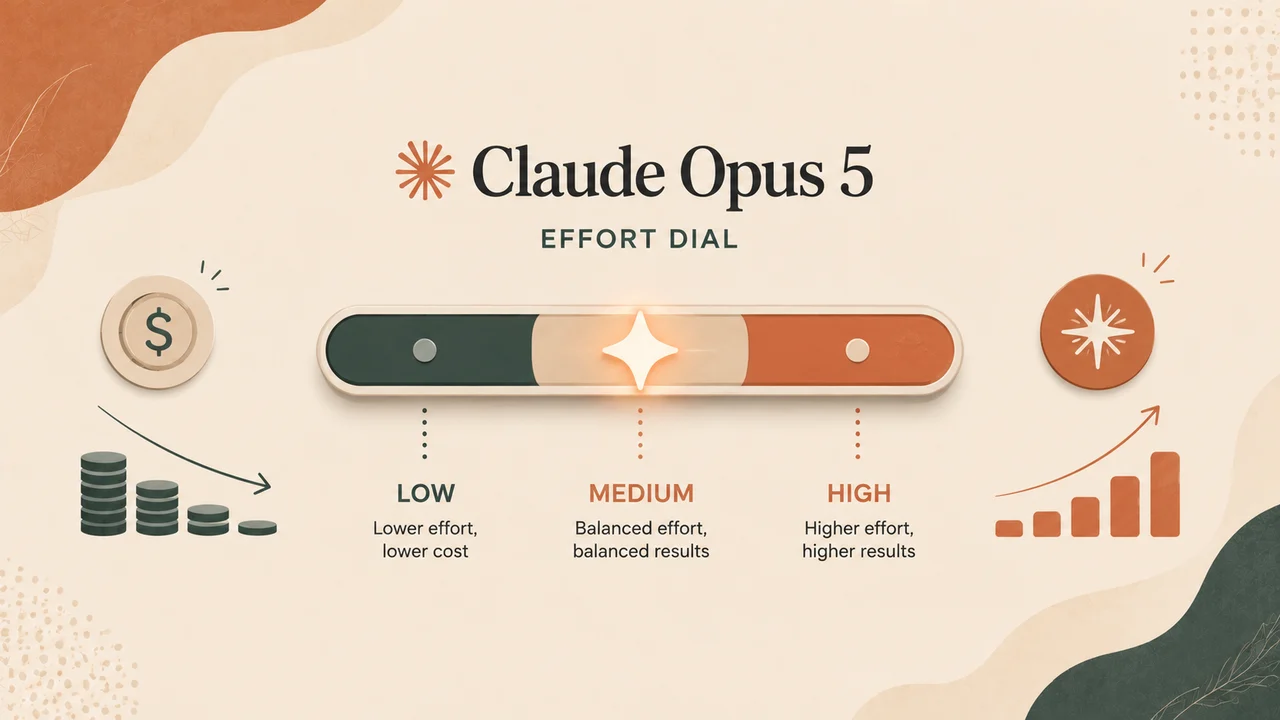
- Low effort: fastest and cheapest, best for simple, bounded tasks where you don't need deep reasoning, quick edits, short answers, routine formatting
- Medium effort: a balanced default for most everyday professional work
- High effort: closer to Fable 5-level depth for harder problems, at a higher cost per task
Rather than picking one model for everything, the practical approach is matching effort level to the task, saving high effort for the handful of requests each day that genuinely need it.
Pricing at a Glance
The chart worth internalizing before you decide anything: Opus 5 costs exactly the same as Opus 4.8, while delivering better benchmarks. Fable 5 costs roughly double for its extra ceiling. Sonnet 5 remains the budget option.
How It Compares
| Opus 4.8 | Sonnet 5 | Opus 5 | Fable 5 | |
|---|---|---|---|---|
| Released | May 28, 2026 | June 30, 2026 | July 24, 2026 | June 9, 2026 |
| Positioning | Previous flagship | Near-Opus performance, lower cost | Efficient daily driver | Frontier, Mythos-class |
| Pricing (per million tokens) | $5 / $25 | $2 / $10 | $5 / $25 | $10 / $50 |
| Effort control | No | No | Yes, low/medium/high | Adaptive thinking, always on |
| Best for | Legacy workloads | Cost-sensitive everyday tasks | Daily professional use with cost control | Longest, most demanding tasks |
Benchmarks and Numbers
| Metric | Result |
|---|---|
| Frontier-Bench | 43.3%, new state of the art |
| ARC-AGI-3 | 30.2% |
| GDPval-AA | New state of the art for coding and knowledge work |
| Cybersecurity tasks | Still trails Mythos 5 |
| Intelligence Index | Narrowly the most intelligent model tested, comparable to Fable 5 at 26% lower cost per task |
| GDPval-AA v2 (max effort) | 1861 Elo, +114 over Fable 5 |
| AA-Briefcase (agentic knowledge work) | 1720 Elo, +146 over Fable 5 |
| Coding Agent Index (xhigh, with Claude Code) | Joint first place, highest score on SWE-Atlas-QnA |
| Average cost per Intelligence Index task | $2.03 (max), vs $2.75 Fable 5, $1.80 Opus 4.8, $1.53 Sonnet 5 |
| Effort scaling on GDPval-AA v2 | 407 Elo points separate low from max effort, output tokens vary roughly 8x |
The practical read: Opus 5 gets close to or matches Fable 5 on intelligence while costing meaningfully less per task, which is the whole point of the effort toggle, you're paying for exactly the capability a given task needs.
Who Should Use It
- Teams already on Opus 4.8: this is a straightforward upgrade at the same price, with better benchmarks and the new effort control
- Businesses watching AI spend closely: the effort toggle gives you a direct lever to control cost without switching models entirely
- Anyone who doesn't need Fable 5's absolute ceiling: if your work is bounded, daily, professional tasks rather than the longest, most complex jobs, Opus 5 gets you close to that intelligence for meaningfully less
Getting Started Tips
- Start most tasks at medium effort and only move to high when the output quality genuinely isn't good enough, this keeps costs predictable while you learn where the line actually is for your work
- If you're migrating from Opus 4.8, expect the same pricing but noticeably better coding and knowledge-task performance, no budget changes needed to try it
- For the hardest, longest-running problems, Fable 5 still holds the ceiling, Opus 5 is built for efficient daily use, not to replace Fable 5 entirely
Sources & Official References
- Anthropic, official Claude Opus 5 announcement: anthropic.com/news/claude-opus-5
- Artificial Analysis, independent Opus 5 benchmark analysis: artificialanalysis.ai/articles/opus-5
- Fortune, on the effort toggle and release context: fortune.com
- Android Headlines, on enterprise partner results and benchmarks: androidheadlines.com
Sourced from Anthropic's official announcement and Artificial Analysis's independent testing. Data current as of July 27, 2026, check the links above for updates.