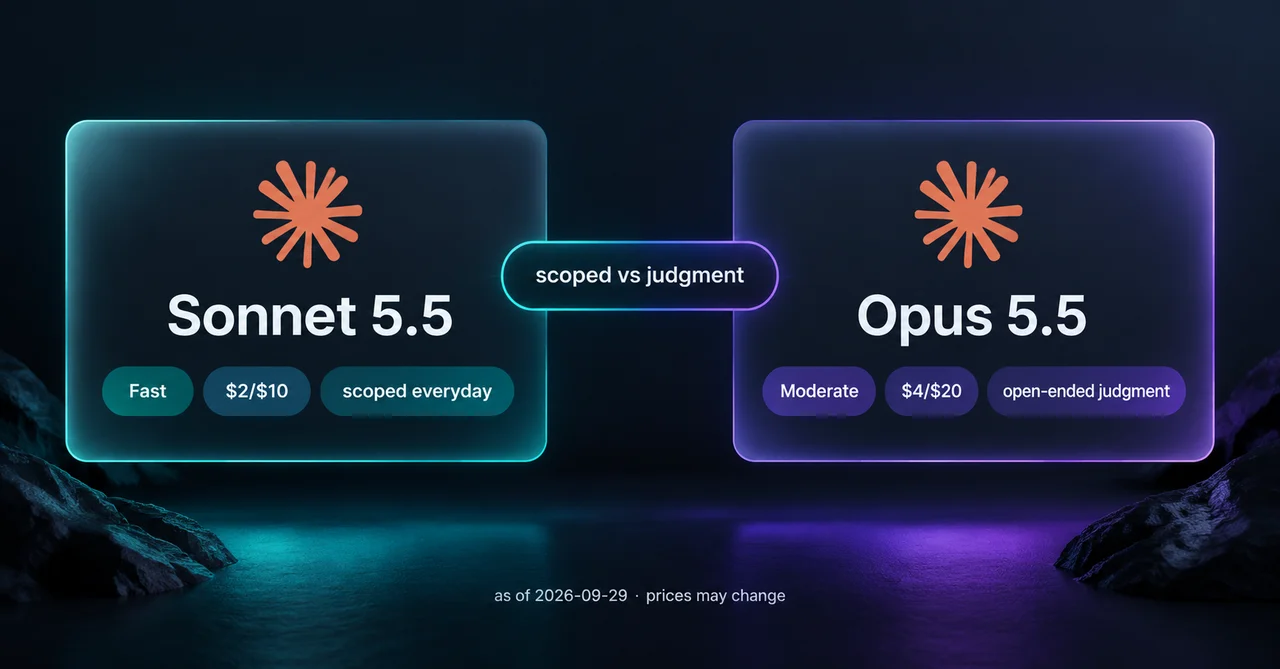
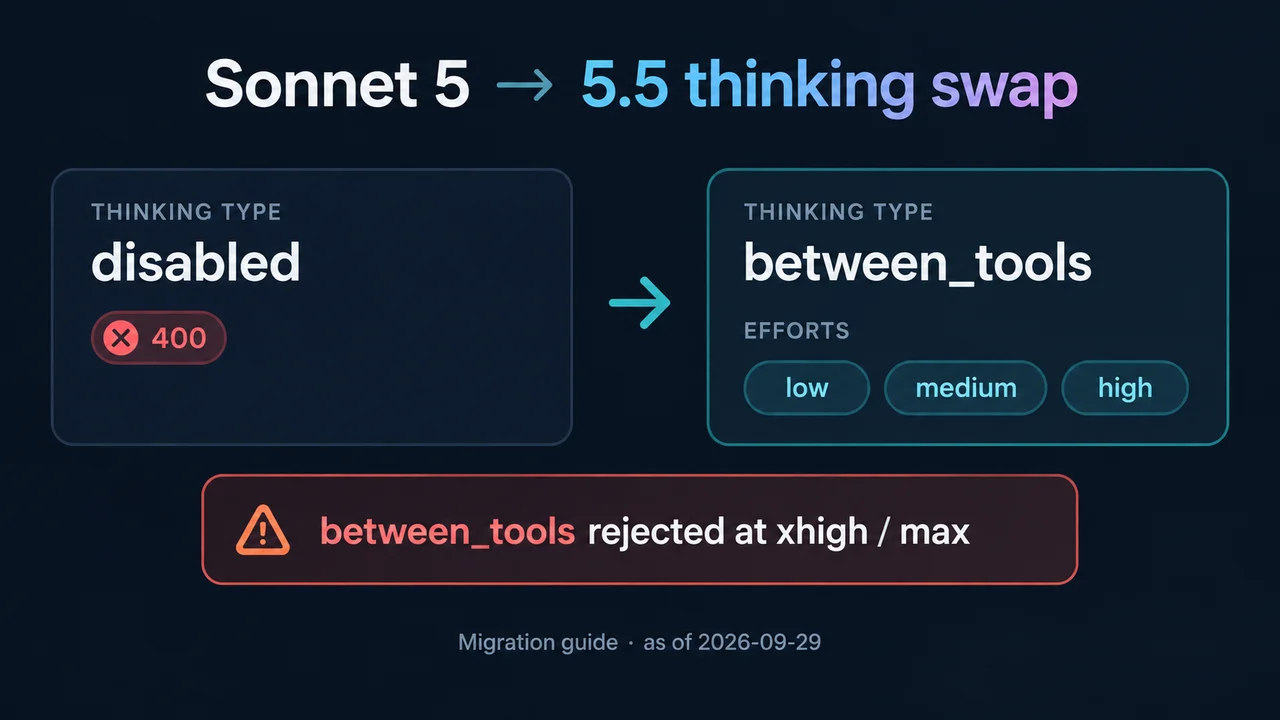
Anthropic shipped Claude Sonnet 5.5 on Sep 28, 2026 as the faster mid-tier complement to Opus 5.5 (Opus itself landed Sep 22). The list price matches Sonnet 5 at $2 per million input tokens and $10 per million output tokens as of 2026-09-29 (pricing may change), while Anthropic reports 30%+ faster generation and up to 30% less cost per task through fewer tokens - vendor-reported, not an independent bake-off. Default to Sonnet 5.5 for well-scoped coding, bug fixes, and polished docs. Escalate to Opus 5.5 when the work needs sustained open-ended judgment. Migrating from Sonnet 5 means swapping thinking: disabled for between_tools and recalibrating effort. This is a routing card, not another Opus price-war remake.
In short
- Model id
claude-sonnet-5-5; list $2 in / $10 out (cache read $0.20) as of 2026-09-29 - may change - Anthropic-reported: 30%+ faster and up to 30% less cost per task vs Sonnet 5 (same $/MTok)
- Sonnet: well-scoped everyday tasks, Fast latency, API default effort
high, apps/Code default Medium - Opus 5.5: open-ended judgment, $4/$20, Moderate latency, thinking always on, API default
medium - Migration killers:
disabledreturns 400; usebetween_toolsathighor below;computer_toolset_20260801on Claude API / Google Cloud - Free plan: Sonnet Yes, Opus No on Anthropic pricing - do not assert Free default is 5.5 without primary wording
- Not a remount of the Sep 22 Opus / Sol / Luna price story
How do Sonnet 5.5 and Opus 5.5 differ on paper?
Start with the published cards, then decide where each model belongs in your stack.
| Dimension | Sonnet 5.5 | Opus 5.5 |
|---|---|---|
| Model id | claude-sonnet-5-5 | claude-opus-5-5 |
| List $/MTok (as-of) | $2 / $10 | $4 / $20 |
| Latency class | Fast | Moderate |
| Anthropic role | Well-scoped everyday work, bugs, docs/slides/spreadsheets | Complex open-ended sustained judgment |
| Thinking | Adaptive; can use between_tools at high or below | Adaptive always on; cannot disable |
| API default effort | high | medium |
| Apps/Code default | Medium (Sonnet product page) | Not re-sourced here |
| Context / max out | 1M / 128K | 1M / 128K |
Primary surfaces: the Claude Sonnet 5.5 launch page, the Sonnet 5.5 platform overview, the Opus 5.5 overview, and Claude pricing (prices may change). Cache reads are listed at $0.20 per MTok for both models on the pricing table as of this write-up - still subject to change. For a directory overview of Claude as a product line, see the Claude tool page.
Pin the model ids in your client config now: claude-sonnet-5-5 and claude-opus-5-5. The Sonnet id has no date suffix on the Claude API style surface. Bedrock uses the anthropic.claude-sonnet-5-5 form per Anthropic's overview.
When should you route each workload to Sonnet 5.5 vs Opus 5.5?
Use Anthropic's own role language, not a single vendor Terminal-Bench number, as the routing spine.
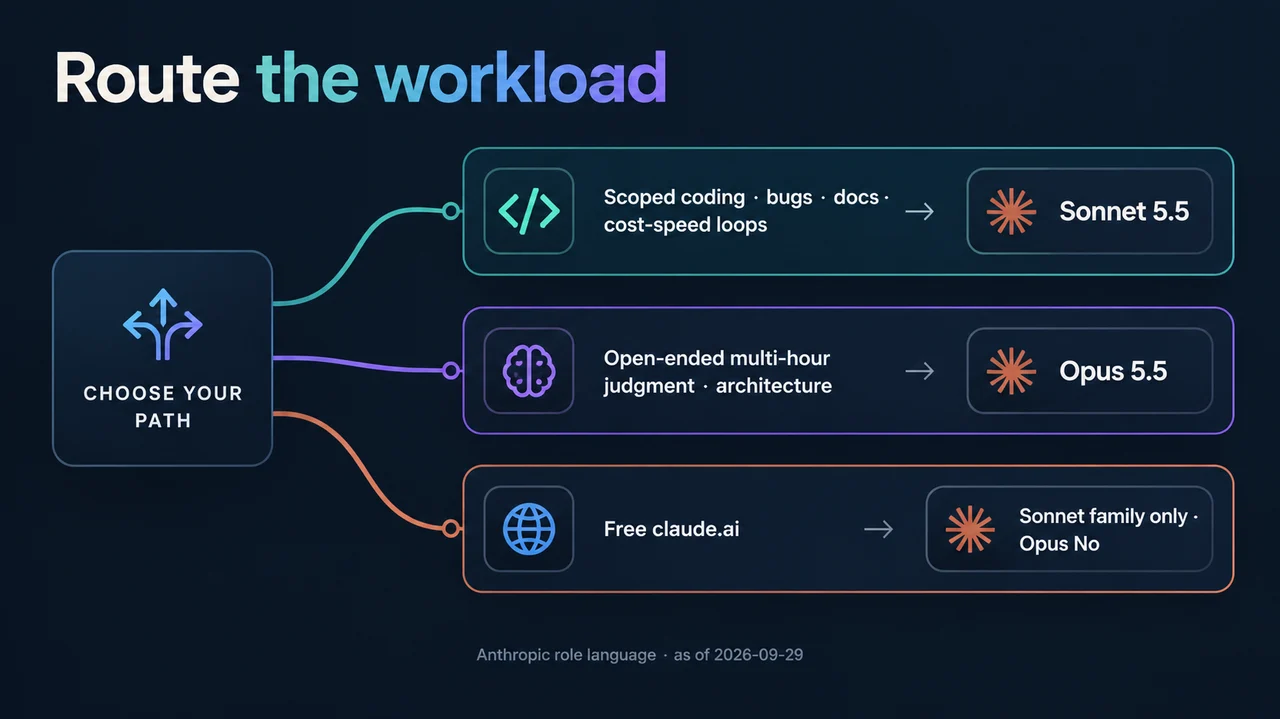
- Scoped coding agents, iterative bug fix, docs/slides/spreadsheets, and cost/speed-sensitive loops to Sonnet 5.5. Start at Medium in Claude apps / Claude Code; on the API, start around
mediumand move tohighwhen agentic work gets harder. - Open-ended, multi-hour judgment, architecture-setting, or “sustained judgment” class to Opus 5.5.
- Free claude.ai to Sonnet family is available; Opus is not on Free (pricing matrix). Escalate to paid or API for Opus.
- Hardest long-horizon agentic work to Anthropic prompting still points to Opus over Max-effort Sonnet.
- Do not treat Anthropic's product-page Terminal-Bench comparison (Sonnet 70.6% vs Opus 66.4% on that table) as proof Sonnet replaces Opus everywhere - label those tables Anthropic-reported. CursorBench, GDPval-AA, and similar product-page numbers belong in the same bucket: useful for orientation, not a substitute for your own eval harness on your own tasks.
For a broader cross-vendor routing checklist, see how to pick the right AI model for every task.
For Sep 22 Opus list-price context only (not this article's lead), see our earlier Opus 5.5 price-war roundup.
What breaks when you migrate from Sonnet 5 to 5.5?
The migration guide is the checklist to run before you flip production traffic.
- Swap the model id to
claude-sonnet-5-5(no date suffix on the Claude API / Google Cloud / Microsoft Foundry style id). - Replace
thinking: {"type":"disabled"}with{"type":"between_tools"}athighor below. Keepingdisabledreturns 400. - Forced
tool_choiceofanyortoolreturns 400. Useautowithstrict: true(on Bedrock, auto without strict per the guide). - Computer use on Claude API and Google Cloud must move to
computer_toolset_20260801. Sendingcomputer_20251124there returns 400. Bedrock may still sendcomputer_20251124per the migration table - follow the platform column. - Thinking blocks are conversation-bound. Sonnet 5.5 does not read Opus / Fable / Mythos thinking blocks from other models.
- Longer notes between tool calls may arrive as progress
thinkingblocks. UIs that only streamtextcan go quiet - usedisplay: "updates"(beta) orbetween_tools. - Non-default
temperature/top_p/top_kreturn 400. Advisor tool options narrow; more refusal categories appear, and server-side fallback can retry somecyber/frontier_llmtriggers on Sonnet 5. - Re-run your effort sweep. Levels are recalibrated; there is no fixed map from Sonnet 5 settings. Treat migration day as a controlled bake-off: same synthetic tasks, both model ids, logged effort, latency, and tool-call success - then promote the winner for each workload class.
How should effort levels change your agentic coding defaults?
For Sonnet 5.5 specifically (Effort docs and Prompting Claude Sonnet 5.5):
| Level | When Anthropic says start here | Watch-outs |
|---|---|---|
low | Chat / latency-sensitive | May skip verification on coding |
medium | Apps/Code default; well-specified agentic coding | Raise to high when agentic gets harder |
high | Claude API default | Move up from medium for harder agentic |
xhigh / max | Only where evals show a quality gain | Much longer thinking; between_tools rejected; Max can over-review (vendor-reported steering notes) |
Also set max_tokens with room for thinking (thinking counts even when omitted). For agentic coding, Anthropic suggests 128,000 plus streaming so long replies do not truncate mid-tool loop. Per-message effort (beta) helps preserve cache across turns, but it does not combine with between_tools - pick one control surface for a given request path.
If you are wiring multi-agent loops in Claude Code, our Claude Code Projects orchestration explainer is useful context - still route the model choice with the table above.
What should you treat as marketing vs primary-card facts?
Keep these buckets separate when you brief stakeholders.
Primary-card facts: model ids; list $/MTok (may change); latency classes; effort defaults; migration 400s; Free matrix Sonnet Yes / Opus No; Sonnet 5.5 live on Claude apps.
Anthropic vendor-reported (label as such): 30%+ faster; up to 30% less cost per task; Terminal-Bench / CursorBench / GDPval-AA product-page tables; customer quotes; Max over-review session-cost anecdote.
OPEN / do not assert: Free-plan default is Sonnet 5.5. Sonnet 5's launch used Free/Pro default wording; the Sonnet 5.5 primary page does not. Confirm Free gets Sonnet access and that 5.5 is live on apps - stop there unless Anthropic publishes default language.
Not this article: Haiku 5.5 deep dive (roadmap “coming weeks” only); Opus vs Sol/Luna price war as the lead; independent TTFT millisecond tables. If someone asks for an independent speed number, point them back to Anthropic's qualitative Fast vs Moderate classes until you measure your own p50/p95.
Optional secondary paraphrase only: TechCrunch's Sep 28 Sonnet 5.5 write-up.
FAQ
When should I pick Sonnet 5.5 at Medium effort vs Opus 5.5 at Medium for the same coding agent?
Prefer Sonnet 5.5 at Medium for well-specified agentic coding and cost/speed loops. Escalate to Opus 5.5 when the same agent must hold open-ended architecture or multi-hour judgment. Matching effort names does not equal matching roles - Anthropic still positions Opus as the judgment flagship.
Why does between_tools return 400 at xhigh or max?
Anthropic only accepts between_tools at low, medium, or high. At xhigh or max you keep adaptive thinking and must drop between_tools. Use those higher levels only when your own evals show a quality gain worth the extra thinking time.
Do Free claude.ai users get Sonnet 5.5, and is it the Free-plan default?
Free includes the Sonnet family and excludes Opus on Anthropic's pricing matrix, and Sonnet 5.5 is live on Claude apps. Anthropic's Sonnet 5.5 primary does not state “Free default” the way Sonnet 5's launch did. Treat Free Sonnet access as confirmed; leave Free-default claims OPEN until Anthropic publishes that wording.
When does Anthropic say Max effort on Sonnet 5.5 hurts more than it helps?
Reserve xhigh and max for measured quality gains. Prompting notes that Max can over-review and spawn extra reviewer work; Anthropic's own testing claimed roughly a one-third session-cost cut when steering against that - label that vendor-reported, and prefer medium then high for everyday agentic coding.
Computer use: when must I switch to computer_toolset_20260801 vs keeping computer_20251124?
On Claude API and Google Cloud, Sonnet 5.5 expects computer_toolset_20260801, and computer_20251124 returns 400. Bedrock may still send computer_20251124 per the migration table. Follow the platform column, not a single global rule.
How do cyber and biology safeguards change everyday coding vs high-risk security work?
Everyday coding mostly sees more refusal categories and possible server-side fallback to Sonnet 5 on some cyber / frontier_llm triggers. For high-risk security or bio work, treat Sonnet 5.5's cyber safeguards as first-class for the Sonnet class and still run named policy review - do not read Anthropic's product language as a silent “safer by default” guarantee.