
At the Supercomputing conference, Q.ANT paired its newest photonic chip with an AMD GPU (an ordinary graphics chip) and ran a large language model on the pair. DatacenterDynamics reports it was a first with optics, which raises a fair question: what is a photonic chip?
It is a chip that uses light instead of electricity. For AI, it either does a neural network's multiply-and-add math with beams of light, or it carries data between ordinary electronic chips, the job IBM and NVIDIA give it.
A language model that ran partly on light
The chip in that demo is the NPU Gen 2+, the newest generation of what Q.ANT calls its Native Processing Unit (NPU). At the conference, Q.ANT coupled it with an AMD GPU to run a large language model, the kind of AI behind chatbots.
Notice the word paired. The light chip did not run the model on its own.
Q.ANT says the NPU works as a co-processor alongside CPUs and GPUs. A co-processor is a helper chip: it takes on some of the work while ordinary chips handle the rest. The report does not say which parts of the model ran on light.
Still, sit with that picture for a second. Light, the same stuff coming out of your desk lamp, helped run an AI model. So how can light do math at all, and is this the future of AI chips or a clever trick?
What is a photonic chip?
A photonic chip is a chip that works with photons, the tiny packets that light is made of, where an ordinary chip works with electricity.
Start with the chips you already own. IBM's explainer puts it plainly: "Digital computers store information as voltage shifts that switch between ones and zeros." Picture a huge crowd of tiny switches, each one flicking on or off.
Light-based systems work another way. They "use light to carry data in a beam's intensity or phase." Intensity just means brightness.
Phase is about timing. Light travels as a wave, and phase says where that wave is in its rise and fall at a given moment. So a number can ride on how bright a beam is, or on how its waves line up.
Here is the big idea. In optical computing, IBM says, the computation happens through the way the light is shaped and directed. The chip is more like a maze of tiny channels and splitters, built so that light comes out the far end carrying the answer.
That is why people get excited. If the maze does the math, the answer is ready the moment the light comes out.
How light does AI math: the flashlight and tinted glass
At the heart of an AI model is one simple move, repeated many times: multiply some numbers, then add up the results. Its math name is vector-matrix multiplication, which means multiplying a list of numbers by a grid of numbers. The University of Pennsylvania (Penn) calls it "a core mathematical operation in the development and function of neural networks."
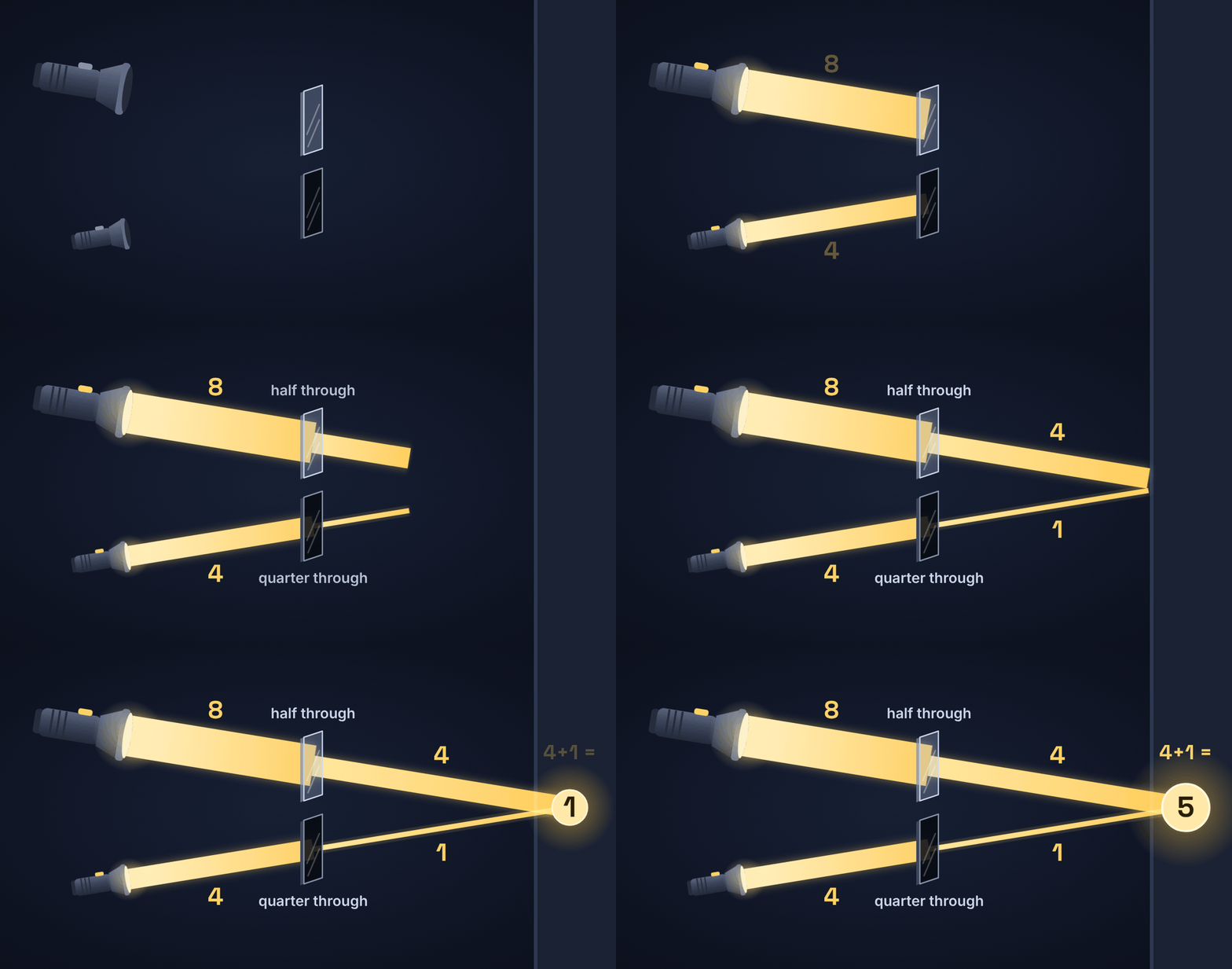
Here is an analogy, not a blueprint of any real chip. Picture two flashlights shining at a wall, one at brightness 8 and one at brightness 4. Those are your two input numbers.
In front of each flashlight sits a pane of tinted glass. The first pane lets through half the light, so 8 becomes 4. The second lets through a quarter, so 4 becomes 1.
Each pane just did a multiplication. Now aim both beams at the same spot. Brightness adds up, so the spot glows at 4 plus 1, which is 5.
You just worked out 8 times a half, plus 4 times a quarter, without a calculator. Add more flashlights, panes and spots, and you have a full vector-matrix multiplication. The tints are what AI people call weights: the numbers a model learns in training.
Real chips play the same game with cleverer tools. Penn's team varies the height of the silicon so that light scatters in specific patterns. Penn says this lets the chip do math at the speed of light.
On Penn's chip, light flows in, and the light that flows out encodes the answer.
MIT's chip takes another route. It first encodes a neural network's numbers into light. Then an array of programmable beamsplitters (tiny tunable parts that split and mix beams), first shown in a 2017 paper, does the matrix multiplication.
IEEE Spectrum (an engineering magazine) sums up the two main strategies. Some chips scatter light in set patterns, like Penn's. Others send beams through a mesh of channels where they interfere, meaning the waves overlap and boost or cancel each other.
The payoff is in what the chip gets to skip. Ordinary electronics work through these sums line by line, IEEE Spectrum notes. With Penn's design, Nader Engheta says, "one does not need to store the intermediate-stage information in a memory."
The flashlight picture stops being true in two places. Real chips steer light with patterns and overlapping waves, not tinted glass. And it only covers multiplying and adding, while AI also needs a step that light finds hard.
Why bother with light? Speed and heat
People chase light for two payoffs: speed and less heat. IBM's explainer sums it up: "Because photons move so fast and create almost no heat, the result is faster and cooler."
Start with speed. MIT says its chip performs key computations in less than half a nanosecond. A nanosecond is one billionth of a second.
Then energy. Taichi is a photonic chip built by researchers at China's Tsinghua University. By the researchers' own findings, it is more than 1,000 times more energy efficient than NVIDIA's H100 (a powerful electronic GPU), IEEE Spectrum reports.
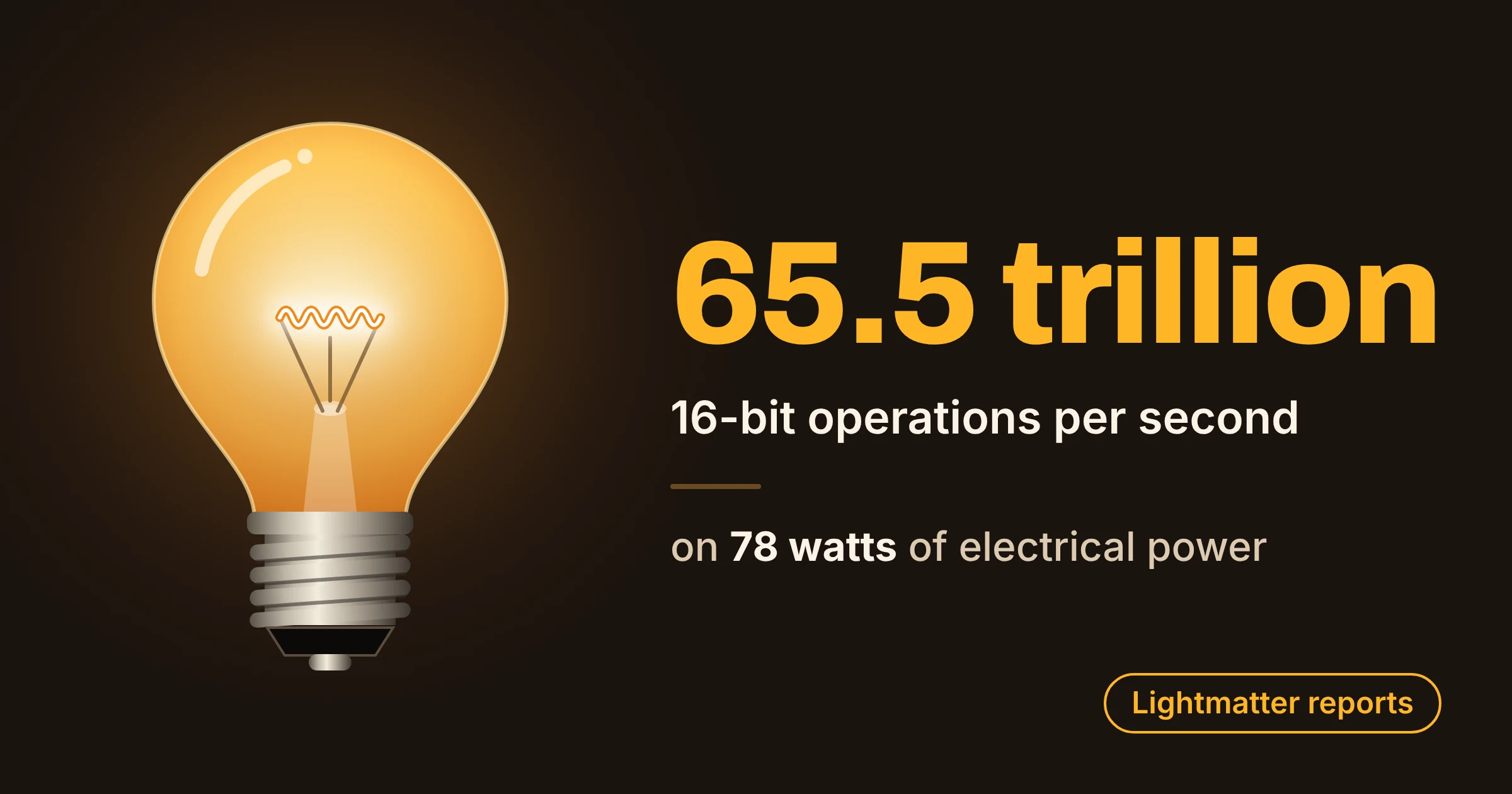
Then raw output. The photonic computing company Lightmatter reports that its processor performs 65.5 trillion 16-bit operations per second. Think of each operation as one small math step on a number stored with 16 binary digits.
It does this on 78 watts of electrical power plus 1.6 watts of optical power. That is about the draw of one bright old-style light bulb. Q.ANT goes further on heat: it says doing the math in light eliminates on-chip heat generation and cooling requirements.
Hold on to one caveat. Every number here comes from the team that built the chip, not from an independent test that put a light chip and a GPU on the same job. And Taichi comes with a catch of its own.
Energy is the payoff that reaches you, even if you never see a data center. Every AI answer runs on electricity somewhere, and our comparison of how much energy AI uses per prompt puts the vendors' own figures side by side.
The catch: light is bad at making decisions
Light is great at multiplying and adding, but an AI model also needs steps where it decides what to pass on, and those are hard to do with light.
What is the decide step?
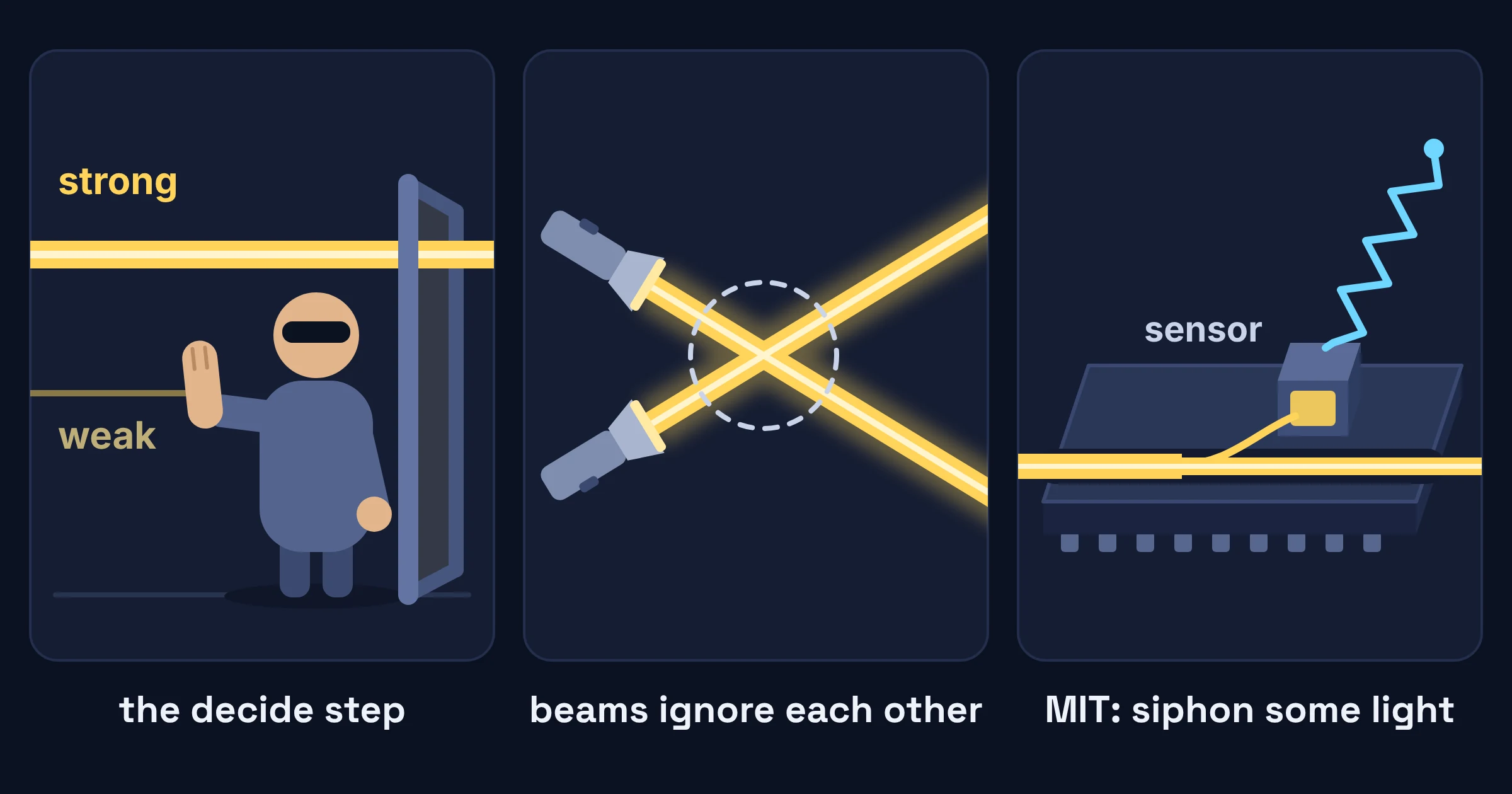
Between rounds of multiply-and-add, a neural network runs nonlinear steps. A nonlinear step does more than scale a number up or down. A common one works like a bouncer: weak signals get turned away, strong ones get through.
MIT notes that there are some types of neural network computations a photonic device cannot perform. Those have required off-chip electronics or other workarounds that hamper speed and efficiency.
Why is that so hard for light?
MIT's Saumil Bandyopadhyay explains: "Nonlinearity in optics is quite challenging because photons don't interact with each other very easily." Two flashlight beams can cross in a dark room, and each carries on as if the other were not there.
That is great for adding. It is terrible when one beam needs to decide what happens to another.
How did MIT get around it?
The MIT team built small units that combine electronics and optics right on the chip. They do the deciding step by siphoning off a small amount of light to photodiodes (tiny sensors that turn light into an electrical signal).
Are the answers exact?
Not quite. IEEE Spectrum notes that current photonic chips experience unavoidable errors.
Describing the field, Lightmatter wrote that no photonic chip had yet achieved the precision practical AI needs. Precision means how exact each number stays.
Is the chip the whole machine?
Often not. Tsinghua's Lu Fang cautions that the Taichi chip, though compact and energy-efficient, relies on many other systems, "taking up almost a whole table." A tiny, thrifty chip can still need a table full of gear around it.
Two jobs for light in AI: doing math vs moving data
When you read about photonic chips in AI data centers, first ask which job the light is doing. Some chips use light to do the math, and others use it only to move data between ordinary electronic chips.
IBM is firmly in the second camp. "We're not using light to do computation," says IBM Research's Jean Benoît Héroux. "We're using light to send data at very high density for AI applications."
That matters because every bit of data that moves through a data center costs energy. Héroux's team watches picojoules per bit, a measure of how much energy it takes to move data.
A picojoule is a trillionth of a joule, a tiny unit of energy. Héroux says they are around 5 to 10 picojoules per bit today, and the goal is to get below 1.
NVIDIA works on this side too. It unveiled Spectrum-X and Quantum-X silicon photonics networking switches, the traffic hubs that pass data between GPUs. NVIDIA says the switches use 4x fewer lasers to deliver 3.5x more power efficiency.
| Kind of chip | What carries the signal | Where the math happens | Examples | Number to watch |
|---|---|---|---|---|
| Ordinary electronic chip | Electricity, as voltage switching between ones and zeros | In electronic circuits, line by line | The AMD GPU in Q.ANT's demo, NVIDIA's H100 | The yardstick the others are compared with |
| Light doing the math | A light beam's brightness or phase | In how the light is shaped and steered | Q.ANT, Lightmatter, Microsoft, MIT, Penn, Taichi | Precision, the barrier Lightmatter names |
| Light moving the data | Light, travelling between electronic chips | Still in the electronic chips | NVIDIA's photonics switches, IBM's optical data links | Picojoules per bit: IBM is at about 5 to 10 and aims below 1 |
A headline about photonic chips in AI data centers could mean either of the bottom two rows. Check which one before you get excited.
What is real today and what is still a lab demo
These projects sit at very different stages. Here is what each one showed and how its own source describes it, as of November 2026.
- Penn's chip: lab experiment. The scientists tested chips that calculate with matrices as large as 3 by 3. That is a grid of just nine numbers, a small test of the idea.
- MIT's chip: lab demonstration. It reached more than 96 percent accuracy in training tests and more than 92 percent during inference (running a trained model), which MIT calls comparable to traditional hardware. It was made with the same factory processes that produce CMOS chips (the standard kind of computer chip).
- Tsinghua's Taichi: lab result. It has 13.96 million parameters, the numbers a model learns. In a handwriting recognition test it scored 91.89 percent accuracy, which IEEE Spectrum calls comparable to its electronic counterparts.
- Lightmatter's processor: more than a prototype, the company says. It puts six chips in one package and runs well-known AI models such as ResNet (for images) and BERT (a language model). Developers program it with standard tools like PyTorch and TensorFlow. Lightmatter says its accuracy approaches that of conventional 32-bit digital systems, and that it "isn't merely a lab prototype." The announcement gives no price or sale date.
- Microsoft's analog optical computer: small prototype. The analog optical computer (AOC) combines analog electronics with three-dimensional optics. It aims to speed up AI inference and combinatorial optimization, which means picking the best option from a huge number of combinations. IBM's article notes the prototype is limited in size. Hardware tests used 256 weights for some problems, and up to 4,096 with time-multiplexing (reusing the same hardware in quick turns).
- NVIDIA's photonics switches: announced, and they move data only. When NVIDIA announced them in March 2025, it said the Quantum-X Photonics InfiniBand switches were expected to be available later that year.
- Q.ANT's NPU Gen 2+: shown working, sales planned. It helped run a large language model next to an AMD GPU at the conference. Q.ANT plans to offer commercial systems combining its Gen 2 and Gen 2+ processors in the second half of 2027.
Back to the conference: will light replace GPUs?
Not according to the people building these chips, at least not yet. Q.ANT pitches its NPU as a co-processor alongside CPUs and GPUs, which is exactly the role it played at the conference.
Lightmatter writes that photonic processors may initially serve as specialized accelerators for AI workloads. In plain words: helpers for certain jobs, not replacements.
The biggest promises are still promises. IBM's article reports that future versions of Microsoft's optical computer could be more than 100 times as energy-efficient as today's GPUs, though that remains theoretical. Microsoft Research's Francesca Parmigiani is frank about it: "We're still at small scale, but this is an important first step."
So what is worth watching? Whether Q.ANT's commercial systems arrive in the second half of 2027 as planned. Whether MIT's chip, built with standard chip-factory processes, really can be manufactured at scale, as MIT News says it could.
And whether anyone runs an independent test with a light chip and a GPU on the same job. Until then, treat every speed and energy number as the builder's own.
Next time you see a light-speed AI chip headline, ask two questions. Is light doing the math, or just moving the data? And is it a lab result, or something a company will actually sell?
Today, photonic chips are real and getting better. They work as helpers and data highways, not GPU replacements.