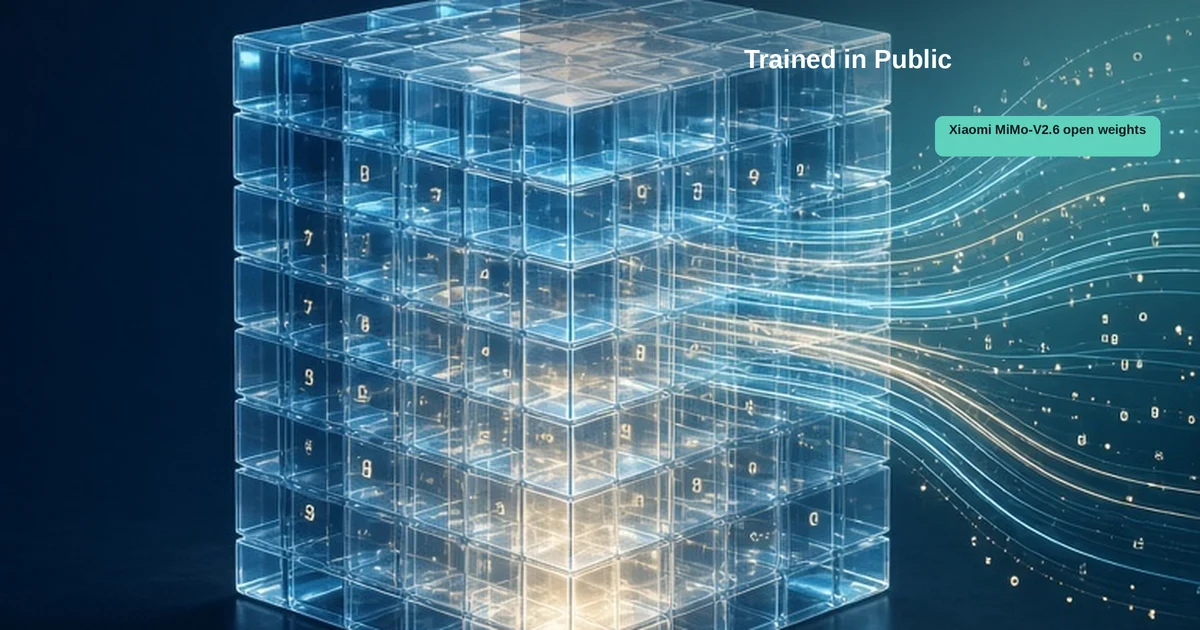
Xiaomi just did something no US frontier lab has done: it trained a trillion-parameter model in front of a live audience. Between September 15 and 20, 2026, anyone could open a dashboard and watch the RL post-training of MiMo-V2.6 tick up a public cost counter in real time. When the runs stopped, the two public counters read $2,620,670 for the Pro run and $854,044 for the Flash run - $3,474,714 combined - and then Xiaomi shipped the results as open weights under MIT.
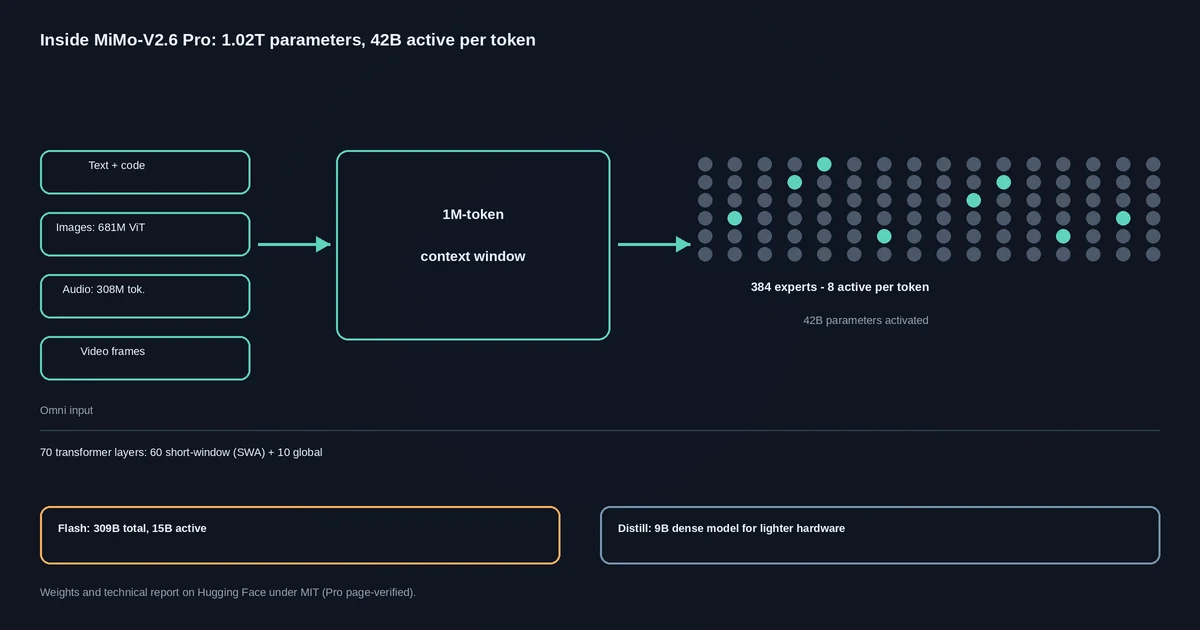
Three checkpoints landed on Hugging Face on September 21-22: MiMo-V2.6-Pro-RL (1.02T total parameters, 42B activated, 1M-token context), MiMo-V2.6-Flash-RL (309B / 15B), and MiMo-V2.6-Distill-Qwen-9B (a 9B dense model distilled for agentic-RL research). The two RL models handle text, image, video, and audio in one model.
The independent check first: Artificial Analysis confirms the Pro model at 46 on its Intelligence Index - the top open-weights spot in its comparison class, and roughly a point behind GPT-5.6 Sol per press coverage. But here is the honest part: that single AA number is the only independently confirmed score. Everything else in Xiaomi's benchmark table - the 89.9 on Terminal Bench 2.1, the 94.0 on CyberGym - is Xiaomi reporting on Xiaomi. We will keep those two things separate throughout.
In short:
- Three MIT-licensed checkpoints shipped: Pro-RL at 1.02T/42B and Flash-RL at 309B/15B - both with 1M-token context and omni input and output - plus the 9B dense distill.
- The method is called "You Only RL Once": one mixed RL run covering coding, general, visual, and cybersecurity tasks, with on-policy distillation afterwards.
- The RL post-training cost $3.47M combined, counted live on a public dashboard - out-of-memory crashes and restarts included.
- The one independently confirmed score: AA Intelligence Index 46, number one among open weights. The rest of the table is vendor-reported.
- Self-hosting Pro takes roughly 2TB of BF16 weights across two nodes; Flash needs about 600GB; the 9B distill runs on a single node.
- The catch: 46 is the open-weights ceiling, not the closed frontier, and the GitHub links for the promised RL framework and environments have not surfaced yet.
What shipped: three checkpoints and one MIT license
The release is three models with the same license and very different sizes:
| Model | Size | Context | Role |
|---|---|---|---|
| MiMo-V2.6-Pro-RL | Sparse MoE, 1.02T total / 42B activated | 1M tokens | Flagship RL checkpoint |
| MiMo-V2.6-Flash-RL | Sparse MoE, 309B total / 15B activated | 1M tokens | Efficiency checkpoint |
| MiMo-V2.6-Distill-Qwen-9B | 9B dense, BF16 | - | SFT of Qwen3.5-9B on MiMo-generated data, "a starting point for open research in agentic RL" |
One license nuance worth getting right: the Pro-RL repository's raw README metadata literally reads license: mit, and Artificial Analysis independently lists MIT for the Pro model. The MIT licensing for Flash and the 9B distill comes from the official announcement, so treat those two as vendor-stated rather than page-verified.
Alongside the open weights, Xiaomi launched a hosted-only tier: MiMo-V2.6-Pro-UltraSpeed, claimed at up to 20x faster, available through the API and the new MiMo Desktop app only - no open weights for that variant. The announcement also promises a technical report PDF, 7K+ RL task environments, an end-to-end RL framework, and composable mini-harnesses. The technical report link is confirmed on Hugging Face; the GitHub URLs for the environments and framework are still unlocated.
The method: You Only RL Once
Instead of a pipeline of separate fine-tuning stages, Xiaomi ran one mixed RL pass across coding, general, visual, and cybersecurity tasks. The details from the model card: fully async GRPO at 1,568 prompts with 16 rollouts per step, Groupwise Agentic Grading combining GRS and GAR rubric-based rewards, an "Aligned RL" cold start from self-correction, and MOPD2 - multi-prefix, multi-teacher on-policy distillation - applied after RL. The 9B distill is the visible output of that last stage.
Omni I/O in one model
Both RL models share the same input stack: a 681M-parameter MiMo ViT for vision (28 layers, 24 with sliding-window attention plus 4 full), a 308M AudioTokenizer with 20 RVQ codebooks plus a 127M audio patch encoder, and a 5-layer EAGLE-style speculative decoder that predicts 7 tokens per pass. The Pro model itself runs 70 layers (60 sliding-window, 10 global attention) with a hidden size of 6,144, routing among 384 experts of which only 8 activate per token. The same encoders feed text, image, video, and audio into a shared 1M-token context window.
What did the $3.47M RL livestream actually show?
The public dashboard is the part of this release that no US frontier lab has matched. Both runs are stopped now, but the page still shows the trainer's own logs, verbatim.
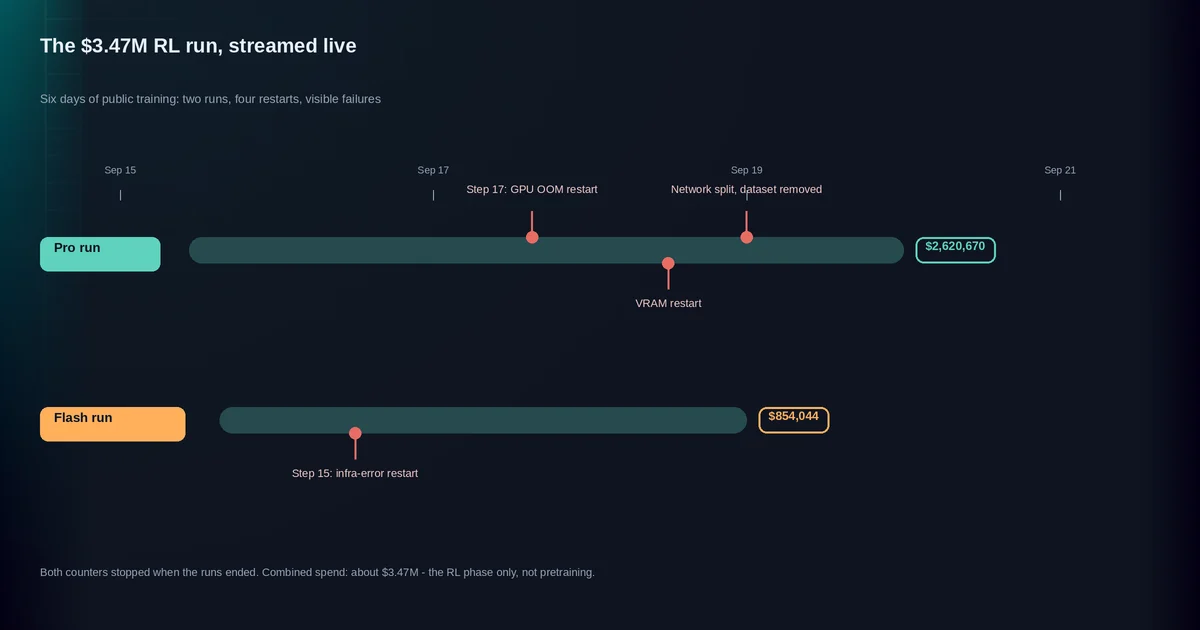
The facts from the counters: the Pro run started September 15, 2026 at 10:32 UTC and ran 5 days, 7 hours, and 29 minutes to step 30, costing $2,620,670. The Flash run started the same day at 15:16 UTC and stopped September 19 at step 30, costing $854,044. Combined: $3,474,714. The Pro run processed 75B tokens across 753k samples; Flash processed 81.4B tokens over the same 753k samples. A single Pro step took roughly 6 hours 26 minutes, and press coverage during the run estimated a burn rate around $432K a day.
One caveat before anything else: this is RL post-training cost only. Pretraining is not on the counter, so $3.47M is not the price of building MiMo-V2.6 from scratch.
What went wrong on camera
The dashboard's notices feed documents the failures without spin, in Xiaomi's own words:
- "the pro run restarted at step 17 due to a GPU OOM issue caused by expert load imbalance. we have adjusted the training parallelism strategy."
- "there was a network connectivity issue between the pro training cluster and the grader deployment. we have restarted the run. we also removed the cyber dataset from the upcoming pro run, since we observed some bad patterns in the rollout logs."
- "we restarted the flash run from step 15. reason: a type of infra error on one of datasets was not correctly detected over the past ~3 hours."
- "the mimo-v2.6-pro run is restarting due to a vram issue on one node."
Late in the run, the team also "filtered out tasks that are relatively easy for the current pro model." That is normal curriculum behavior, but it is notable that we know about it only because the process was public.
Why the livestream is the real story
No US frontier lab streams a live cost counter mid-run. The operational exposure alone - admitting a network split, an undetected infra error, and a mid-run dataset removal - is the kind of information that normally never leaves a training cluster. The dashboard also shows what the run was actually made of: at step 30, the Pro batch was 65.8% code, 19.5% visual, 11.3% general, and 3.4% chat, with cyber at 0% after removal, drawn from 25 data sources across roughly 11,180 active environments for Pro and 38,694 for Flash. Team lead Fuli Luo, formerly at DeepSeek, went further in his own post: the run's research innovations and engineering challenges "surpass those of DeepSeek R1, which I was partly involved in."
Skepticism got airtime too. Hacker News commenters noted the dashboard numbers could reset or replay on page refresh, questioning authenticity. The dashboard remains viewable, and both counters' arithmetic is at least internally consistent - but there is no third-party audit of the totals.
How good is MiMo-V2.6, and how much of it can we trust?
Start with the number that has independent backing: Artificial Analysis puts MiMo-V2.6-Pro at 46 on its Intelligence Index (v4.3.2, ten evals), first of 114 models in its comparison class. Press coverage adds the context: a ~20-point jump over MiMo-V2.5-Pro's 26, roughly 6th overall including closed models, and about a point behind GPT-5.6 Sol. AA's own notes describe the model as "notably fast, however somewhat verbose" - $0.13 per Intelligence Index task at 129.7 tokens per second.
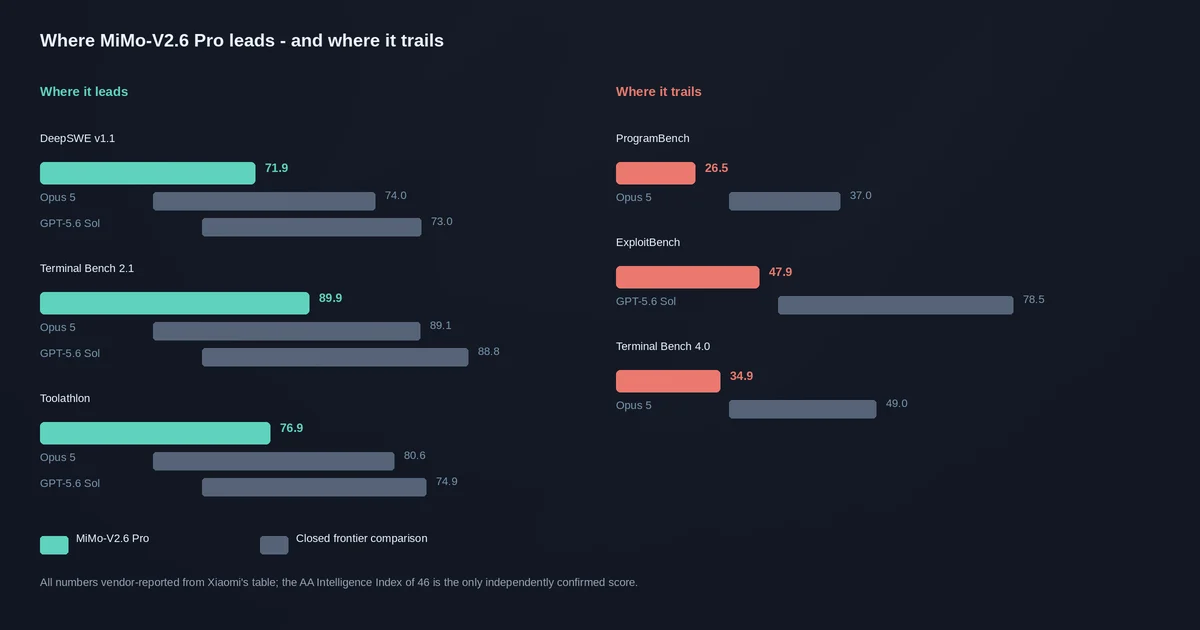
The full vendor table from the model card, labeled accordingly - these are Xiaomi's own reported numbers, not independent re-runs:
| Benchmark | MiMo-V2.6 Pro | Flash | MiMo-V2.5 Pro | Claude Opus 5 | GPT-5.6 Sol |
|---|---|---|---|---|---|
| DeepSWE v1.1 | 71.9 | 67.9 | 19.0 | 74.0 | 73.0 |
| Terminal Bench 2.1 | 89.9 | 87.6 | 65.2 | 89.1 | 88.8 |
| Terminal Bench 4.0 | 34.9 | 28.8 | 1.5 | 49.0 | 39.9 |
| AutomationBench v1.0.6 | 53.1 | 52.3 | 16.0 | 50.3 | 45.8 |
| Toolathlon-Verified | 76.9 | 73.6 | 49.1 | 80.6 | 74.9 |
| GDPval-AA 2.1 | 1673 | - | 1107 | 1708 | 1588 |
| Agents' Last Exam | 31.6 | 27.6 | 13.2 | 31.6 | 30.8 |
| OSWorld-Verified | 82.0 | 80.8 | - | 83.4 | 83.0 |
| CyberGym | 94.0 | 95.1 | 40.0 | - | - |
| ExploitBench | 47.9 | 25.3 | 16.6 | 70.0 | 78.5 |
Even the DeepSWE number has a spread worth knowing about. The vendor's final table says 71.9; Xiaomi's own RL dashboard final says 72.57 (mini-swe-agent, avg of 3 runs); mid-run, at step 10, it sat at 63.72. The score moved as training progressed - and both sources are Xiaomi-run, so the dashboard corroborates the magnitude but not independently.
The gaps the table itself shows are the honest spine of this release: ProgramBench 26.5 against Claude Opus 5's 37, ExploitBench 47.9 against GPT-5.6 Sol's 78.5, and Terminal Bench 4.0 at 34.9 against Opus 5's 49. Competitive programming, offensive security, and harder terminal work are where the model trails the closed frontier - by margins the vendor published itself.
What does it take to self-host a trillion-parameter MoE?
MIT licensing is commercially frictionless, but it means nothing if you cannot field the hardware. The Pro model's 1.02T parameters at BF16 work out to roughly 2TB of weights before any KV cache - a derived estimate, but the official serving recipes confirm the scale. The recommended SGLang cookbook assumes two nodes with 8+ GPUs each (--tp 16 --dp 2 --ep 16 --moe-a2a-backend deepep) with EAGLE speculative decoding; the vLLM recipe uses --tensor-parallel-size 8. Recommended sampling is temperature 1.0 with top_p 0.95, and the model is also available through OpenRouter.
Flash is the practical tier for teams with one large cluster: about 600GB of BF16 weights. The 9B distill runs on a single node with a recent SGLang build and --reasoning-parser mimo. One gap: no official quantized checkpoints were found in the model cards, so budget for BF16 or rely on community quants at your own risk.
If open-weights releases like this are your thing, we broke down what Grok 4.6 changes for xAI's model line in a recent analysis, and covered the open-source CLI tools reshaping how developers work with LLMs as the two landscapes converge.
What does MiMo-V2.6 cost to use?
On the API side, Xiaomi says prices are unchanged from V2.5 - reported, not independently verified: Flash at ¥1 per million input tokens and ¥2 per million output; Pro at ¥3 input and ¥6 output. Artificial Analysis independently confirms the dollar figures and performance: Pro at $0.435 per million input tokens, $0.87 per million output, a blended $0.18 per million, and a 99% cache discount, serving at 129.7 tokens per second with a 17.58-second time-to-first-answer.
Xiaomi claims the API costs one-twentieth to one-sixtieth of comparable closed models - vendor framing, so weigh it accordingly. Press comparisons with Kimi K3 and Qwen3.8 Max rest on thin data, mostly AA-index placement and one mid-run DeepSWE figure, so treat any head-to-head there as open rather than settled.
Pricing note: figures above are in Chinese yuan and US dollars as reported on September 22, 2026, and may change. Check the official MiMo API pricing before committing.
What are the honest limits of the release?
- 46 tops the open-weights class, but it is not the frontier - about a point behind GPT-5.6 Sol and 6th overall per press framing, in a class whose median is 18. Exceptional among open weights, not above the closed ceiling.
- The benchmark table is single-vendor. Terminal Bench 2.1 at 89.9 and CyberGym at 94.0 have no independent re-run anywhere.
- The comparison set is vendor-picked: it leads with agentic, terminal, and cyber benchmarks and quietly shows large deficits on ProgramBench, ExploitBench, and Terminal Bench 4.0.
- The hardware barrier is real: a 1T-parameter MoE is a two-node, expert-parallel commitment.
- The livestream has ended, and the dashboard's authenticity was publicly questioned on Hacker News.
- The omni claims are card-level documentation - no independent multimodal eval exists.
What is solid: three MIT-licensed checkpoints on Hugging Face - the Pro repo page-verified MIT, Flash and the distill vendor-stated per the official announcement - a dashboard-counted $3.47M, an AA-confirmed index score of 46, and a technical report PDF confirmed on Hugging Face. The promised 7K+ environments and RL framework are announced but their GitHub URLs remain open. That is a stronger evidentiary base than most open-weights launches - and the livestream format, whatever its imperfections, set a transparency precedent no US frontier lab has matched.
If you want to see how MiMo-V2.6 compares against other models you can actually deploy, browse the Toolbit AI directory for related tools and model profiles.
FAQ
Is the $3.47M the full cost of building MiMo-V2.6?
No. The dashboard counters cover RL post-training only - the runs from September 15 to 20. Pretraining is not included in that figure, so the total cost of developing the model is necessarily much higher.
What's the difference between Pro-RL, Flash-RL, and Distill-Qwen-9B?
Pro-RL is the flagship at 1.02T total / 42B activated parameters. Flash-RL is the efficiency tier at 309B / 15B. Distill-Qwen-9B is a 9B dense model - an SFT of Qwen3.5-9B on MiMo-generated data, positioned as a starting point for agentic-RL research.
Is the RL livestream still running?
No. The Pro run stopped September 20 and the Flash run stopped September 19, both at step 30. The dashboard remains viewable with its notices feed intact.
Do quantized versions of MiMo-V2.6 exist?
No official quantized checkpoints were found in the model cards. Community-made quantizations may exist, but none are verified here, so plan around BF16 for now.
How does it compare with Kimi K3 and Qwen3.8 Max?
Only thin press data exists - AA-index placement and one mid-run DeepSWE figure. No verified side-by-side comparison has been published, so treat the question as open.