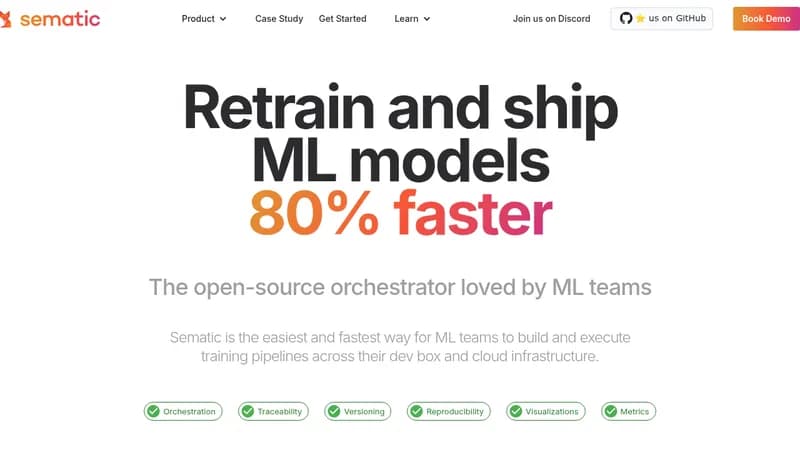
Sematic is an open-source continuous machine learning platform designed to help ML teams build and execute training pipelines from their local development environment to cloud infrastructure. It provides end-to-end Python pipelines that are tracked, reproducible, and visualized. The platform emphasizes a Python-first declarative orchestration approach, allowing users to define pipelines using Python functions without YAML templating or DSLs. Key capabilities include orchestration, traceability, versioning, reproducibility, visualizations, and metrics. Sematic supports arbitrary complex dynamic DAGs with looping, conditional branching, and nesting. It integrates with existing ML libraries, cloud tools, observability services, and productivity tools via a plug-in model. Users can iterate seamlessly between local dev boxes and Kubernetes clusters, as Sematic packages local environments at runtime and ships them to the cluster. The dashboard persists inputs and outputs of all steps, enabling visualization of dataframes, models, configuration dataclasses, images, metrics, and plots. Users can rerun pipelines from the UI, cache results, and implement fault tolerance.
Key Features
- Python-first declarative orchestration: Define pipelines using Python functions with decorators.
- End-to-end pipelines: Sequence data processing, model training, and evaluation for continuous learning.
- Traceability and versioning: All step inputs and outputs are persisted and visualizable.
- Seamless iteration: Run code locally on small data, then at scale in the cloud without changes.
- Integrations: Plugs into existing ML, cloud, observability, and productivity tools.
Who It’s For
- ML Engineers
- Data Scientists
- Infrastructure and Platform Engineers