Made a song entirely with an AI generator like Suno and sent it to Tidal through a distributor (the service that delivers your tracks to streaming apps)? Since June, a track like that has earned no royalties on Tidal. Starting December 9, Tidal says it will remove it.
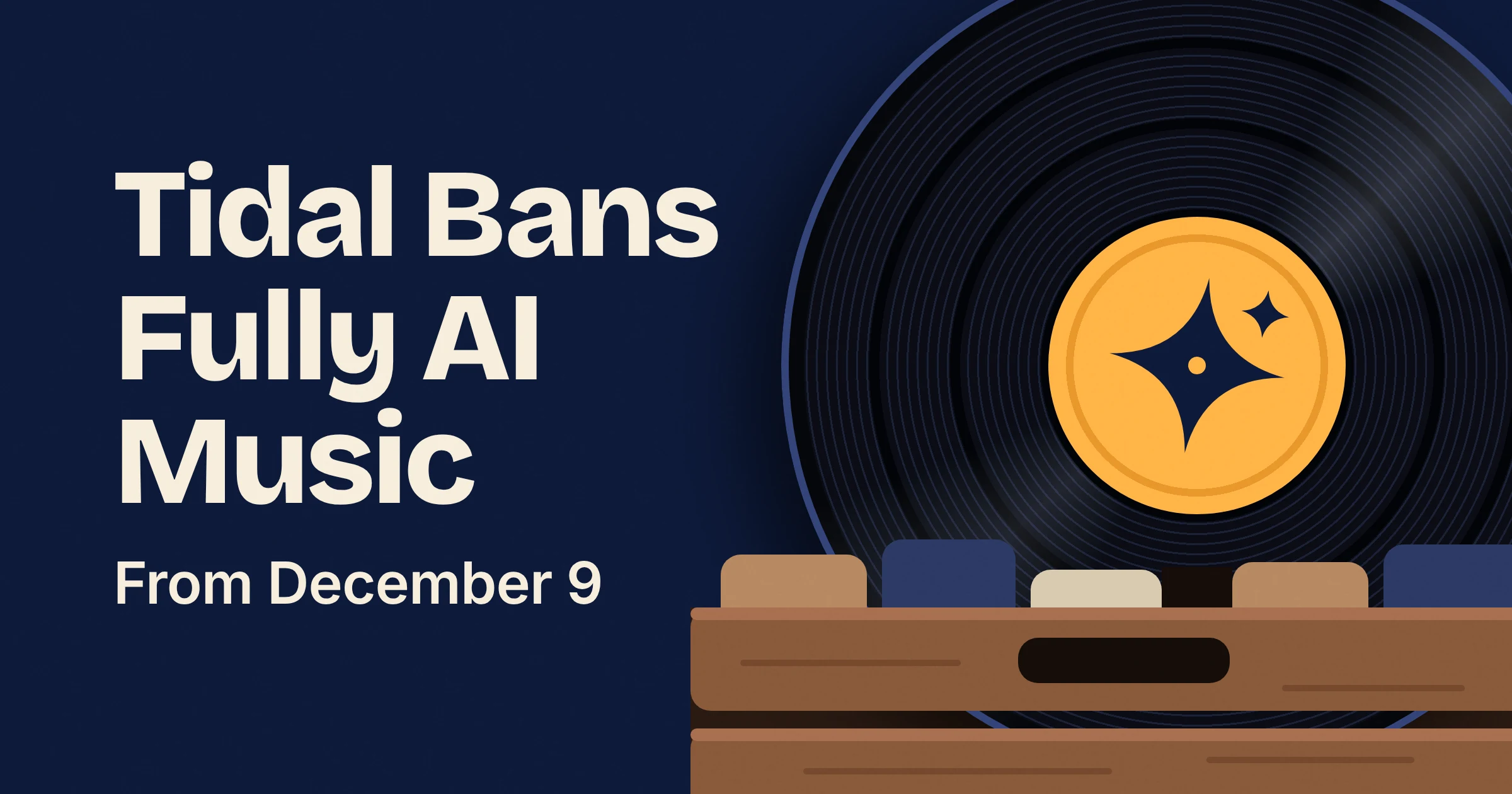
So, does Tidal ban AI music? Yes: starting December 9, Tidal will reject and remove any wholly AI-generated track, but songs made with AI help that are not fully AI-generated are still allowed.
What Tidal announced on November 24
On November 24, Tidal said it will ban songs generated fully by AI and remove the ones it already carries. TechCrunch reports that the removals start on December 9. Until then, the rule is announced but not yet in force.
The ban works at two doors. New wholly AI-generated tracks get turned away when they arrive. Ones already in the catalog get deleted.
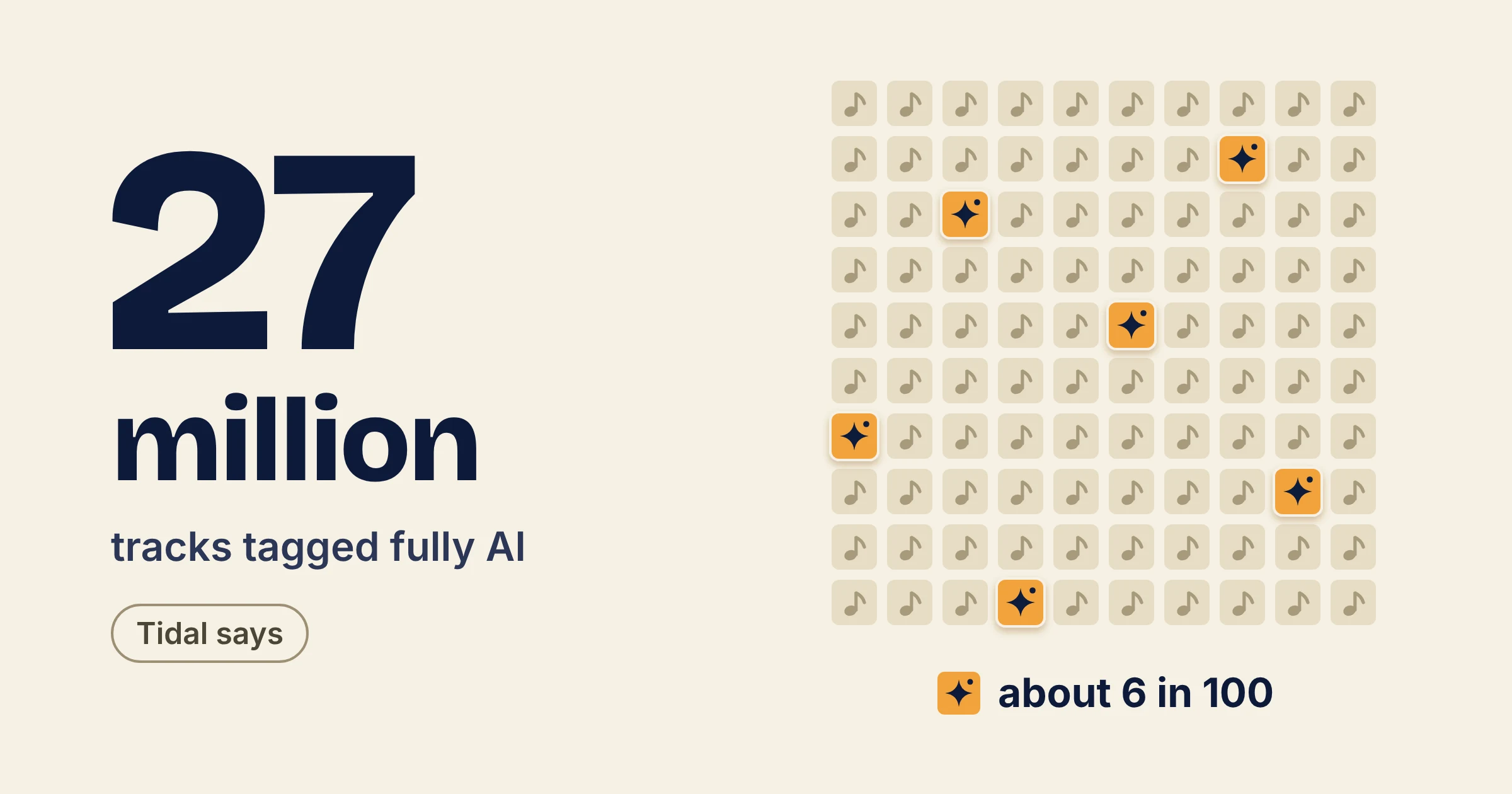
The size is the surprise. Tidal says about 27 million tracks in its catalog are tagged as fully AI-generated. That is 6.3% of all the music on Tidal, or about six songs in every hundred.
Engadget, citing Tidal platform lead Robert Anderson, puts the expected deletions at about 29 million tracks.
Hardly anyone will miss most of them. Tidal says 96% of its AI-tagged tracks got zero streams in the last three months.
New uploads are the other half of the job. With the new rules in place, Tidal expects to reject roughly 80,000 to 85,000 tracks a day. That is close to one track every second, all day long.
Anderson calls it a first: "We are the first DSP to do so, and we encourage our peers to follow suit." DSP is industry shorthand for a streaming store.
TechCrunch is a little more careful. It calls Tidal one of the first major platforms after Bandcamp to ban AI music outright.
From no royalties to removal: the dates that matter
Tidal tightened its rule in two steps: first it cut off the money, then it announced it would pull the songs. Here is the order of events.

- Earlier: the music platform Bandcamp says music "generated wholly or in substantial part by AI is not permitted on Bandcamp."
- June: in Tidal's June post, it adds an AI badge next to music it detects as wholly AI-generated. Those songs earn no royalties and can't be sold directly to fans.
- The last 90 days: more than 43% of all tracks delivered to Tidal are detected as wholly AI-generated.
- November 24: Tidal announces the ban.
- December 9: rejections and removals begin.
Separately, Tidal says it has already taken down more than 65,000 AI tracks automatically. Those songs were suspected of posing as real artists by using their names.
Why not stop at the June rule? TechCrunch reports that cutting royalties did not prove enough of a deterrent. The 43% figure shows it: almost half of new deliveries were still fully AI.
In its post explaining the ban, Tidal grants that "not all songs catch on immediately, and artists should have time to build their fanbases." Its own numbers suggest most fully AI tracks were not catching on at all. Remember, 96% of them had zero streams in three months.
Fully AI or AI-assisted? Where the line sits
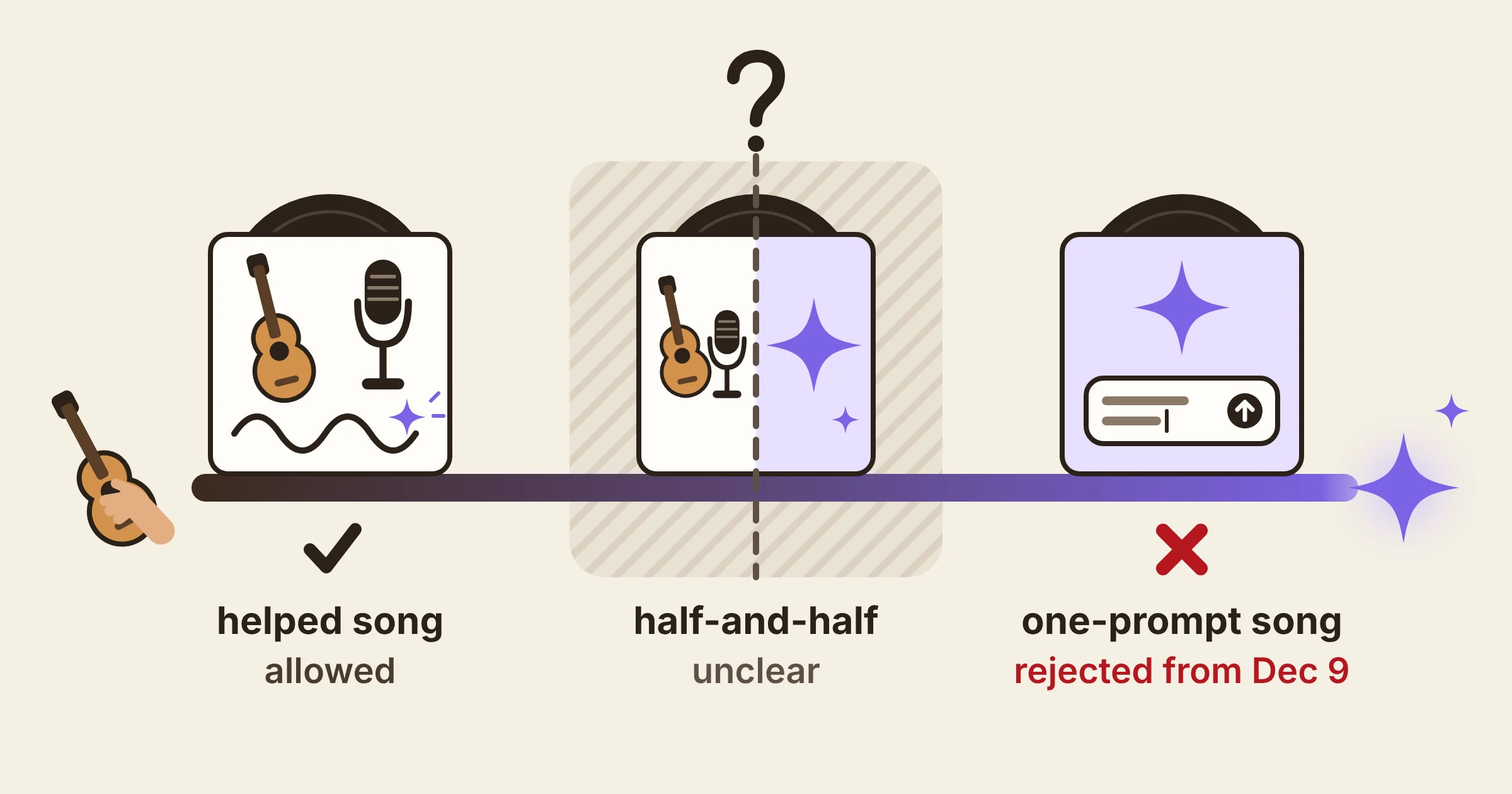
Fully AI-generated songs go, songs where AI only helped can stay, and the hard part is the middle.
Think of a school's rule on essays. Running spellcheck is fine. Handing in an essay a chatbot wrote for you is not.
Tidal's version: it will still accept songs made with AI assistance that are not fully generated. As Music Business Worldwide puts it, music assisted by AI tools is allowed, as long as it is not their sole output.
Picture three made-up songs.
The one-prompt song: you type upbeat synth-pop about summer rain into Suno and upload the full track it returns, vocals and all. That is wholly AI-generated, so from December 9 Tidal rejects it. This is the common case: Tidal says 94% of the tracks carrying its AI badge are attributed to Suno.
The helped song: you write the lyrics, sing them and play the guitar. An AI tool cleans up a noisy vocal take. AI helped, but it did not make the song, so this sits on the assisted side of the line.
The half-and-half song: Suno makes the whole backing track, and you write new lyrics and sing over it. Is that assisted, or mostly made by AI? Nobody outside Tidal knows yet.
Tidal's AI policy page defines AI-generated music as music that is "wholly or substantially generated by generative artificial intelligence." It also says the AI tag will expand to substantially AI-generated music as detection gets more reliable. But Tidal has not published where assisted ends and substantially generated begins.
Tidal's support page adds a hint of caution. It says Tidal limits the actions it takes, because AI detection still has limits. It also wants to avoid false positives, meaning human-made songs wrongly flagged as AI.
In school terms, ghostwritten essays are banned, but nobody has said how much help counts as ghostwriting.
How does Tidal detect AI music?
Tidal uses two checks: what a song's paperwork says, and what a detector finds in the audio.
The first check is the label. Every track reaches Tidal with metadata, the details that travel with a song, like its title, artist and how it was made. Tidal will reject a delivery if that metadata says it was made solely with AI tools.
Tidal is also banning distributors from delivering 100% AI-generated tracks. Its policy page says Tidal expects distributors to flag AI content before it arrives, and will begin to enforce that.
The second check is software. Tidal says the enforcement runs on technology from Ircam Amplify, its AI detection partner.
A statement quoted by Music Business Worldwide credits that tech with "a market-leading false positive rate below 0.02%." In plain terms, fewer than two in every 10,000 human-made songs would be wrongly flagged.
That is the vendor's own figure, not an independent test. Detector scores deserve a second look, as our comparison of AI image detectors and content credentials shows for pictures.
This is where the school analogy stops working. A teacher can read every essay. Tidal faces tens of thousands of new tracks a day, so it leans on labels and detection software.
What if your song is flagged by mistake?
If Tidal wrongly marks your song as AI-generated, the one published route is to contact Tidal Support. Here is what Tidal's support page lays out, plus a tip of our own.
- Contact Tidal Support. The page says: "If you believe your content was incorrectly identified as AI-generated, please contact Tidal Support."
- Be ready to show how you made the song. Tidal says it "may review additional information about the creation process" as part of its review.
- Gather your proof. Think project files, stems (the separate vocal, drum and guitar tracks), lyric drafts and early demos. In essay terms, these are your rough drafts.
Tidal has not said whether this route will change once removals begin on December 9.
Tidal vs Spotify, Deezer and Bandcamp on AI music
Tidal now sits at the strict end with Bandcamp, while Spotify and Deezer let fully AI-generated songs stay. TechCrunch calls the approach of larger platforms like Spotify and YouTube Music milder. Here is how the four compare.
| Service | Fully AI-generated songs | Labels and filters | How it spots AI |
|---|---|---|---|
| Tidal | No royalties since June; rejected and removed from December 9 (announced) | AI badge on music detected as wholly AI-generated | Distributor metadata plus Ircam Amplify's detector |
| Spotify | Treated the same as all other music, whatever tools made it | Artists can share how they used AI, in a beta feature | Artist disclosure, so a missing AI credit does not mean no AI was used |
| Deezer | Allowed, but kept out of algorithmic recommendations and editorial playlists | A toggle to filter out AI music is planned | Its own detection tools, which it also supplies to other services |
| Bandcamp | Not permitted, wholly or in substantial part | Not needed, since these songs are not allowed | Can remove any music on suspicion of being AI-generated |
Spotify's newsroom post says vocal impersonation is only allowed when the copied artist has authorized it. In September 2025, Spotify also said it had removed over 75 million spammy tracks. Bandcamp strictly bans using AI to impersonate other artists or styles.
Deezer says it plans to let users block fully AI-generated music from its search results by the end of 2026.
Deezer's numbers also flip an easy assumption. Fully AI-generated tracks made up more than 44% of its daily deliveries. Yet they account for just 1% to 3% of all streams there.
Lots of AI songs arrive, and very few people play them. That matches Tidal's zero-stream figure.
If you make music with AI: a checklist before December 9
A few steps now can save a song later, and most of them come down to labels and proof.
- Ask your distributor how it labels AI. Tidal will reject any delivery whose metadata says a track was made solely with AI tools.
- Check that your label is accurate. If AI only helped, make sure your release is not marked as made solely with AI. If AI made the whole song, expect Tidal to turn it away.
- Keep your files. Save project files, stems and lyric drafts for every release. They are your proof if Tidal flags a song and you dispute it.
- Know that Tidal Upload follows the same rules. Tidal's policy page says music sent through Tidal Upload is held to the same standards as the rest of the catalog.
- Don't expect Spotify-style treatment. Spotify treats all music equally, whatever tools made it. On Tidal, a fully AI song is out from December 9.
What Tidal has not said yet
Some big questions are still open, and Tidal's own policy page has not caught up with the ban.
- No updated policy. The AI policy page still talks about tagging fully AI-generated songs, not removing them. It says the tag will grow to cover substantially AI-generated music, but it does not mention the ban.
- No clear line. There is no published test for when assisted becomes substantially generated.
- No new appeal route. The contact-support route was published before the ban, and Tidal has not said if it will change.
- No word on the details. Tidal has not said whether AI-assisted songs will carry a label, what happens to Tidal Upload tracks fans already bought, or whether artists get notice before removal.
Until Tidal fills those gaps, the safe move is simple. If a song is generated start to finish by an AI tool, plan for it to leave Tidal from December 9. If AI is one tool among yours, keep proof of how you made the song and label it honestly with your distributor.