
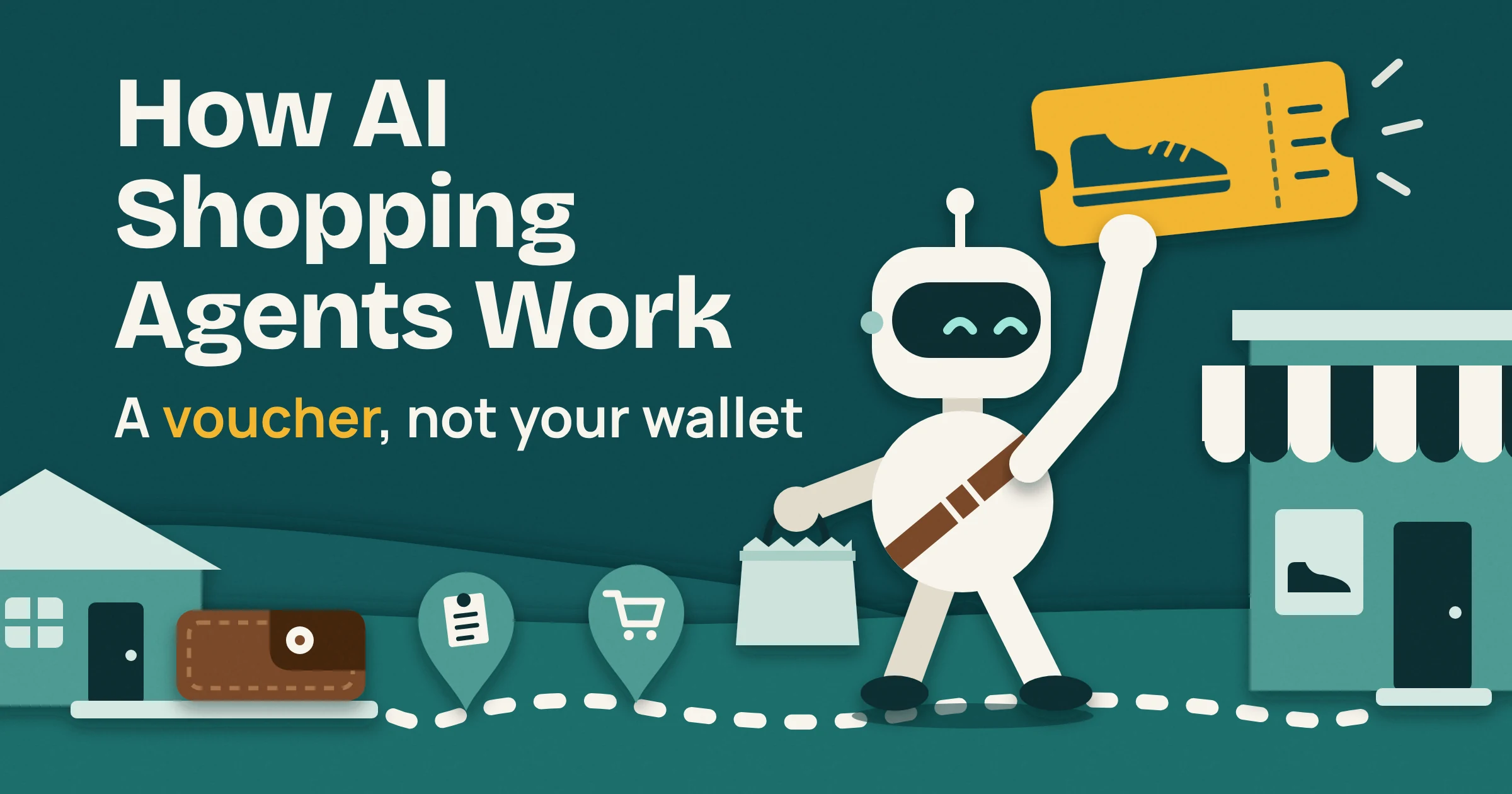
Picture a shopper we'll call Maya (she's invented, but her errand is a classic). She types one line to her AI assistant: Find me white running shoes in my size, under my budget, and buy them. By lunch the order is placed, and the agent never saw her card number.
So how do AI shopping agents work? An AI shopping agent records your request, finds the item, shows you a cart to approve, then pays, often with a stand-in token instead of your card number. Here's everything that happened in between.
Morning: you ask, and the agent writes down what you meant
Before an AI shopping agent buys anything, it turns your words into a written instruction. Unlike a chatbot, it doesn't just answer; it does the job (here's why AI agents are replacing chatbots). Think of it as an errand-runner who writes your list down first and carries a single-use voucher, not your wallet.
Google points out that payment systems mostly assume a human is clicking buy on a trusted screen. An agent that pays on its own breaks that assumption, so the system needs proof of what you wanted.
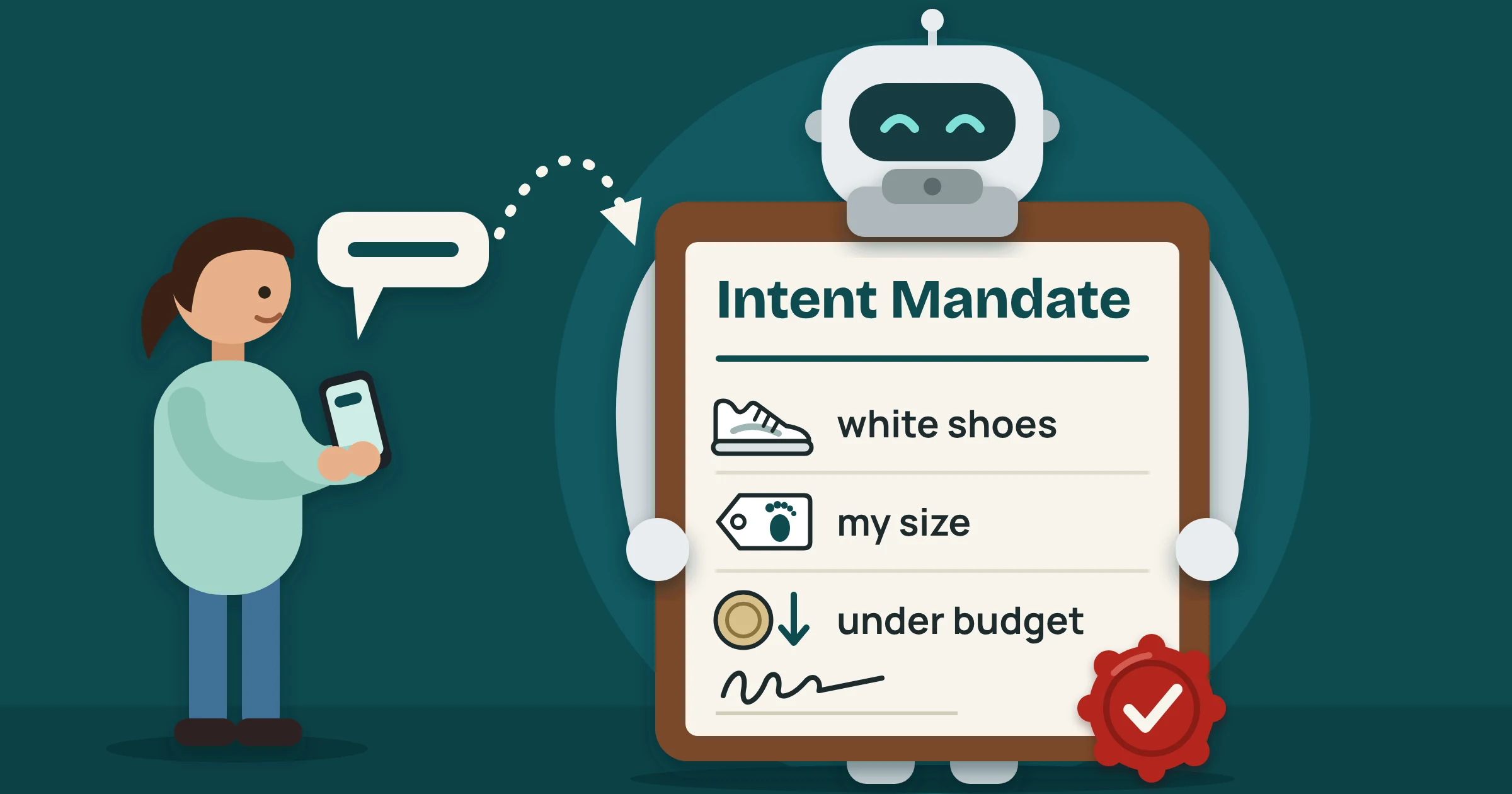
Google's fix is the Agent Payments Protocol (AP2). A protocol is a shared set of rules that different companies' systems agree to follow, and Google built this one with payment and tech companies. In AP2, Maya's request becomes an Intent Mandate: a digitally signed note that proves what she asked for and can't be quietly changed.
Here's a fun twist. Google's own example of an Intent Mandate is almost Maya's errand word for word: a request for new white running shoes.
The more detail Maya gives, the less the agent has to guess. Google's price tracking works the same way: you name the item down to the size, the color and how much you want to spend. A clear note is your first safety step.
Mid-morning: the agent goes shopping
The agent's next job is to search a mountain of products and keep only the few that match Maya's note. And the mountain is huge: Google says its Shopping Graph, which powers shopping in AI Mode on Google Search, holds more than 50 billion product listings. Nobody could scroll through that in a lifetime.
So who decides what shows up first? For ChatGPT, OpenAI said in September 2025 that product results were "organic and unsponsored, ranked purely on relevance to the user." Put simply, back then no store could pay to sit at the top of the list.
Someone still pays, though, just later. When OpenAI launched ChatGPT's Instant Checkout (a Buy button inside the chat), it said stores pay a small fee on completed purchases and the service is free for shoppers. In that setup, the money moves when a sale happens, not when a store buys a better spot.
The errand-runner doesn't only browse websites, either. Google has also started letting US shoppers ask it to call stores on their behalf. Yes, your errand-runner can pick up the phone.
Lunchtime: the cart, the yes, and what agentic checkout means
Agentic checkout means the agent fills in the checkout for you, but you give the final yes. This is the step where Maya stays in charge.
Here's roughly what lands on her screen. It's a made-up mock-up, not any one app:
- Item: white running shoes, her size, from [store name]
- Total: [the exact price]
- Ship to: [her saved address]
- Pay with: [her chosen card]
- Button: Approve
Each real agent asks for this yes in its own way. At launch, OpenAI said ChatGPT's Instant Checkout works like this: you tap Buy, then confirm the order, shipping and payment details. It said users "explicitly confirm each step before any action is taken."
Google promises "We'll always ask for your permission first," and buys only after you confirm the purchase and shipping details. Meta says its Muse agent checks with you before sensitive actions like making a purchase.
That yes does more than close a pop-up. In Google's AP2, Maya's approval signs a Cart Mandate, an unchangeable record of the exact items and price. Google's goal, in its own words, is "ensuring what you see is what you pay for."
OpenAI's ChatGPT Wallet does something similar. You review the items, the total and the card, then approve. Each approval creates a record of the purchase you allowed.
So if the final bill doesn't match the cart, there's a record of what you agreed to. A human check before anything risky is the same idea behind AI agent guardrails and approval tools.
The handoff: a voucher, not your wallet
Here's the clever part: the agent pays without ever holding Maya's card number. Instead it carries a token, a stand-in code that takes the place of real card details.
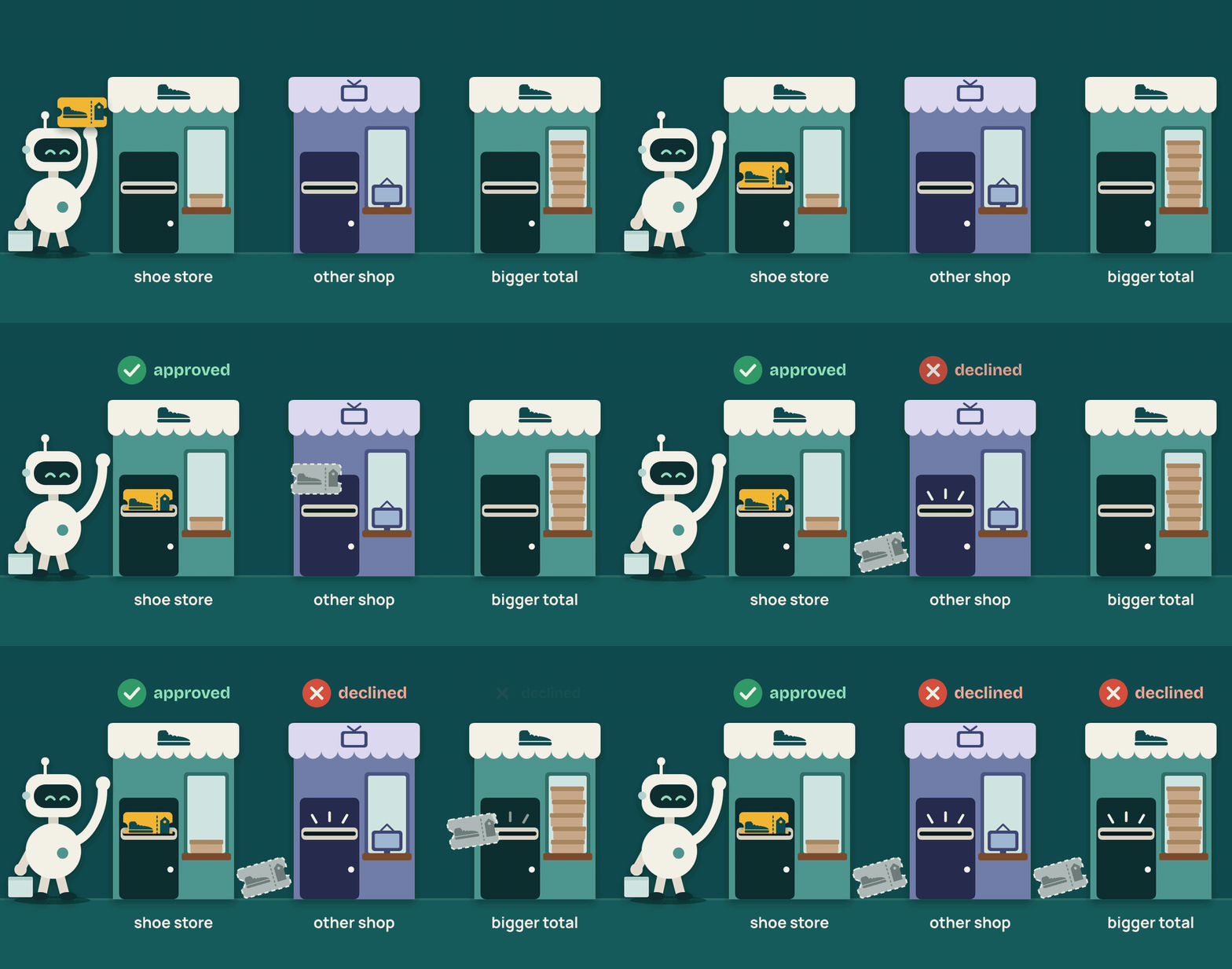
Picture the voucher you'd hand an errand-runner: good at this one shop, for this one amount. That's close to the Shared Payment Token that Stripe described when ChatGPT's Instant Checkout launched. Stripe said each token is scoped to a specific store and cart total.
Stripe also said the token works without exposing the buyer's payment details. In that launch design, ChatGPT passes it to the store through an API (the plug that lets two companies' software talk).
A tiny worked example: if Maya paid this way, her token would be tied to one shoe store and her exact cart total. If someone copied it and tried it at another shop, or for a bigger amount, it wouldn't be approved. OpenAI said at launch that these payment tokens are only authorized for specific amounts and specific merchants.
Other companies shape the voucher a little differently:
- Meta's Muse can pay with Link by Stripe, whose wallet for agents makes a one-time-use card "so your real card details stay hidden." Meta says Muse "has no visibility into people's passwords or payment methods."
- OpenAI's ChatGPT Wallet gets a payment token from the payment network after you approve. OpenAI calls it "a substitute for the user's actual card details."
- Mastercard's Agent Pay adds Agentic Tokens, built on the token technology Mastercard already uses.
The store also gets less of your data. For Instant Checkout, OpenAI said only the information needed to complete the order is shared with the store.
If a voucher like Stripe's leaks, the damage stops at one store and one total. A leaked password has no such limit.
At the store's door: the agent shows its ID
Before a store accepts an agent's order, it wants to know the agent is a real shopper's helper and not a bad bot. That question got urgent fast. Visa says, citing Adobe data, that AI-driven traffic to US retail websites jumped more than 4,700% in a single year.
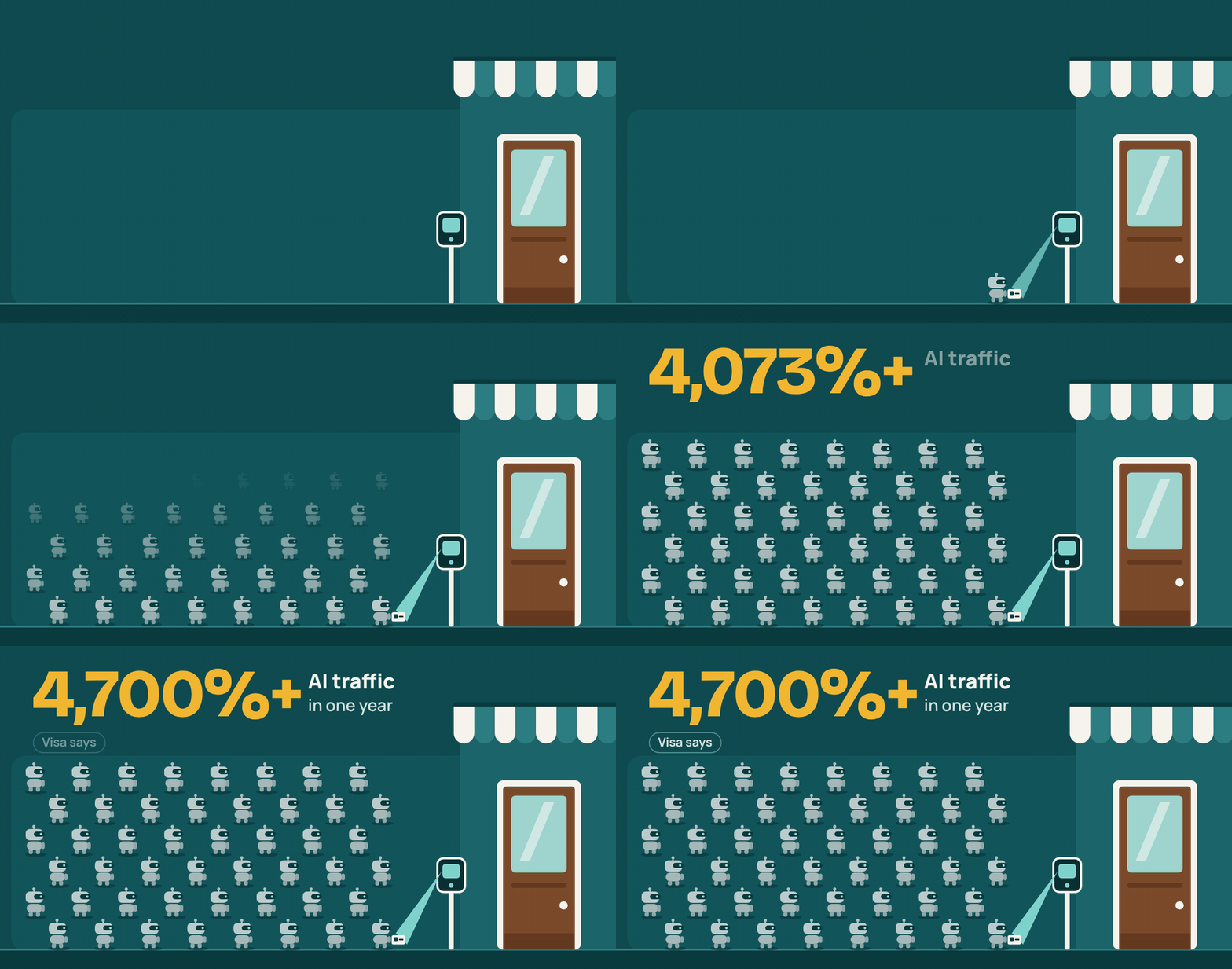
That's not a typo. Traffic grew to dozens of times its old size.
Visa's answer is the Trusted Agent Protocol, developed with Cloudflare. It lets a trusted agent carry three kinds of signals to the door:
- Intent: a sign it's a known agent there to shop. Visa says this helps tell trusted agents apart from malicious bots.
- Recognition: data showing whether the shopper already has an account with the store, or has dealt with it before.
- Payment: if the agent chooses, payment data that fits the store's preferred way to check out.
Mastercard is heading the same way. It said its Agent Pay program will require trusted AI agents to be registered and verified. That was a plan in Mastercard's announcement, so treat it as a direction to watch.
Even a verified agent doesn't get the last word. The store does. In OpenAI's launch description of Instant Checkout, ChatGPT sends the order details to the store's own systems using the Agentic Commerce Protocol.
That's an open standard (a public rulebook any company can use) that Stripe built with OpenAI. The store then accepts or declines the order and runs the payment through its usual payment company.
So the agent is the messenger, not the cashier. You're still buying from the shop itself.
Overnight: rules you set in advance
Some errands can't wait for you, so AP2 is also designed to let an agent act on rules you sign ahead of time. Google's example is concert tickets you want the moment they go on sale.
In that case, you sign a detailed Intent Mandate upfront. It sets the rules: price limits, timing and other conditions. Once those conditions are met, the agent can create the Cart Mandate on your behalf, with no tap needed.
Back to Maya. Say she'd rather wait for a sale. Her overnight rule might read: Buy these shoes in my size if the price drops below my budget this week. That's the same kind of detail Google's price tracking asks for: size, color and the most you'll spend.
One rule is worth knowing by name. With agentic checkout in Google Pay, "If the price goes up, the purchase won't go through, and you won't be charged."
Fully hands-off buying is still on the way at OpenAI. The company says it expects that, over time, people will be able to hand purchases entirely to their agent by setting clear limits. That's a plan, not a switch you can flip today.
When it goes wrong, and who says no to agents
Agent shopping still has rough edges, and a few big names are openly wary of it.
What if the agent buys the wrong thing?
Start with the store. For returns or missing orders, Google's help page says to contact the merchant where you bought the goods. ChatGPT Wallet works the same way: you buy directly from the business.
OpenAI says Wallet users keep their card's existing rewards and protections for eligible disputes. Our ChatGPT Wallet guide to eligibility and refunds covers who to contact.
Here's where the errand-runner picture stops fitting. When a human runner messes up, you know whom to blame. Google lists "determining accountability if a fraudulent or incorrect transaction occurs" as one of the problems AP2 should help solve.
So who answers for an agent's mistake is one of the big questions AP2 is meant to help settle.
Why would a good purchase get declined?
Sometimes the fraud checks get nervous. OpenAI says Wallet's payment tokens work with existing checkouts, but "risk systems may still flag legitimate purchases." Risk systems are the software that screens each payment for fraud, so a decline isn't always a sign of trouble.
Why are some companies saying no?
Their worry is agents that carry your wallet, meaning your login, instead of a voucher. Skift reports that United Airlines is the first US airline to explicitly say it will restrict third-party AI agents.
In comments reported by The Record, United said "Sharing account credentials with personal, third-party, AI assistants can expose sensitive information." It added that these tools may lead to "unintended purchases, account changes, or use of MileagePlus miles."
A big bank is wary too. The Record reports that Bank of America cautioned users to "never share user IDs and passwords with agents." That's a warning, not a ban.
Notice that both warnings are about handing over logins. That's exactly the wallet the voucher system is built to keep at home.
Which AI shopping agents can you use today?
Three of these options are available now or rolling out, each with real limits. The last row, ChatGPT's Instant Checkout, shows only what OpenAI described at launch, so check ChatGPT for where it stands today.
| Option | Who and where | How you say yes | What it pays with |
|---|---|---|---|
| ChatGPT Wallet | Rolling out first through dots, for US ChatGPT Pro subscribers aged 18 and older with eligible US-issued cards | Review items, total and card, then approve | A payment token in place of your card details |
| Google agentic checkout | Select merchants in supported countries; first rolled out on Search and AI Mode with eligible US merchants | Google asks first; you confirm purchase and shipping | Your chosen Google Pay payment method |
| Meta Muse | Started rolling out in the US on iOS, Android and muse.ai | Muse checks with you before buying | Can use a one-time-use card from Link by Stripe |
| ChatGPT Instant Checkout (launch description) | At launch: products that support it, single-item purchases only; current status not confirmed | At launch: tap Buy, then confirm order, shipping and payment | At launch: a Stripe token tied to one store and one cart total |
A good shopping agent works like a trusted errand-runner carrying a single-use voucher. Before you let one buy, run three checks:
- Do you see the final cart before money moves?
- Does it pay with a token or a one-time card, not your saved login?
- Does a price rise cancel the order?
Then start small. Try it first on something cheap and easy to return, like socks, before you trust it with a sofa.
These availability details come from the companies' own pages, checked in November 2026, and they change often.