Introduction
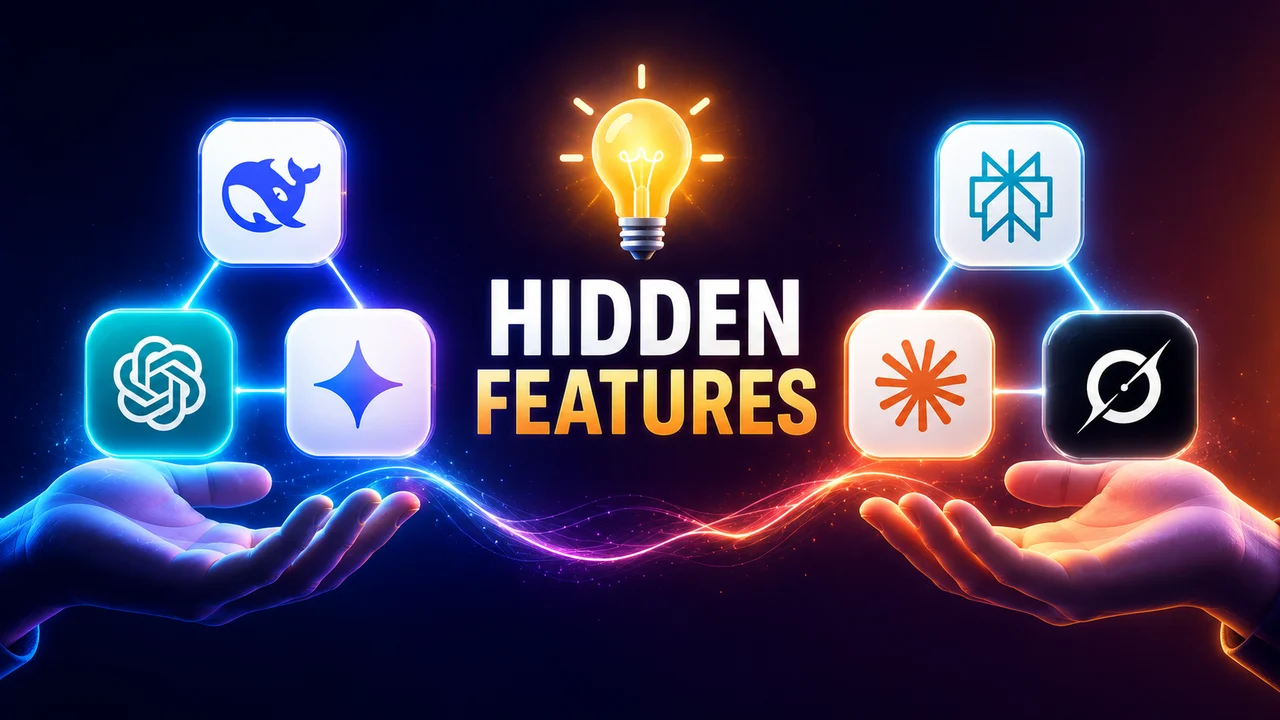
Everyone knows ChatGPT can write, Gemini lives in your inbox, Claude codes, Perplexity searches, Grok lives on X, and DeepSeek is the free one. That's not this list. These are the settings buried a few clicks deep in each one that most people never find the kind of thing you only stumble onto after months of daily use, or never at all.
The Secret Features in the Top 6 AI Tools
1. ChatGPT: The Buried Settings
ChatGPT's most useful features aren't in the chat window at all they're sitting quietly in Settings, where most people never think to look. Memory in particular is one users either ignore completely or nuke entirely the first time it says something wrong, when the actual fix is far more precise than that.
- Editable memory - prune specific memories instead of wiping the whole thing
- Canvas - a side-by-side editing surface for iterating on a doc or code, separate from the chat itself
- Connected Apps (Settings → Connected Apps) - link Google Drive or OneDrive so ChatGPT reads your real files instead of you pasting them in
- Archived chats - hide old conversations from your sidebar without deleting them (Settings → Archived Chats)
2. Gemini: The Settings You Have to Turn On First
Gemini's real advantage is that it's already sitting inside Gmail, Docs, Sheets, and Meet but a surprising number of its best tricks are switched off by default, and there's no prompt anywhere telling you to turn them on.
| Feature | The part most people miss |
|---|---|
| Ask Gemini side panel | Tag other files with @ inside the panel. it reads them too, not just the open document |
| Gems | Save a persona once (a specific role, tone, expertise) instead of re-typing it every session |
| Workspace Studio | Chains several tasks into one standing workflow not a one-off answer, an automation that keeps running |
| Sheets formula writer | Describe the formula in plain English, including nested logic, and skip the syntax search entirely |
| Take Notes for Me | Turn this on in Google Meet and Gemini auto-captures key points and action items into a Doc attached to the calendar event |
3. Claude: Built for More Than One-Off Chats
Claude's best features assume you're coming back that a chat today connects to work from last week, not that every conversation starts from a blank slate. Most people never set that connective layer up, and end up re-explaining the same context over and over instead.
- Projects - upload a style guide, past work, or reference material once, and every chat inside that Project pulls from it automatically instead of starting from zero
- Inline artifact editing - instead of asking for a full regenerate, highlight the exact part of a document or piece of code Claude built and type just the change you want
- Persistent storage in Artifacts - trackers, games, and small tools built as Artifacts can now save data across sessions, so they don't reset every time you reopen them
- MCP connectors - link Gmail, Google Drive, Slack, and dozens of other services so Claude can read and act on your real accounts, not just talk about them
- Real downloadable files - ask directly for a .docx, .xlsx, .pptx, or .pdf and Claude generates the actual file, not just a plain-text description of one
The easiest one to try today: open a Project, upload three or four real reference documents, and ask the same question you'd normally ask in a fresh chat. The difference in relevance is immediate.
4. Perplexity: Turning Search Into a Command Line
Most people treat Perplexity as a search engine with citations and stop there. The real power users have quietly turned it into something closer to a research workspace a place with memory, scheduling, and real output formats, not just a single search box.
- Focus Modes-switch between modes like Academic (peer-reviewed sources) and Social (real-time community sentiment) to change what kind of sources it searches, not just how it answers
- Spaces - a persistent project folder with its own files, standing instructions, and preferred model, so a research topic doesn't need re-explaining every time you open it
- Scheduled searches - set a recurring query once (say, a weekly competitor check) and let it run automatically instead of manually re-searching
- Create Files & Apps - ask it to build an actual report, table, or simple dashboard instead of settling for a wall of chat text
5. Grok: Built Around What's Happening Right Now
Grok's edge isn't reasoning depth it's timing. Its best features are built around whatever's happening on X right this second, and around plugging into the rest of your work so it isn't limited to conversation alone.
- Ask Grok on any post - highlight a post on X, tap the share menu, and select "Ask Grok" for instant context on exactly that post, no copy-pasting required
- Connectors - link Microsoft 365, Google Workspace, Notion, GitHub, or Linear so Grok can read and act on real files instead of just talking about them
- Custom Skills - save a specific, repeatable task once and re-run it daily instead of retyping the same request every morning
- The Think Mode trade-off - visible step-by-step reasoning is genuinely useful for problem-solving, but it isn't free of cost. Some third-party evaluations, including Vectara's public hallucination leaderboard, have found reasoning mode performing worse on certain summarization tests than the non-reasoning mode. Results vary by benchmark and task, so it's worth testing on your own use case before leaning on Think Mode for long-document summaries
- DeepSearch - a deeper research mode that pulls from live X posts alongside the open web, built for questions a static training cutoff can't answer
6. DeepSeek: More Unlocked Than People Expect
DeepSeek gets treated like a free ChatGPT clone, which undersells what's actually available underneath most of it because it's open-weight, not because it copied anyone.
- The DeepThink toggle - sits right above the input box. Leave it off for quick answers; switch it on and the model shows its work step by step, which noticeably improves results on math, debugging, and multi-step planning. Most people never touch it either way.
- A genuinely unlocked free tier - file uploads, long documents, and extended chat history are all open without a paywall, unlike most competitors that gate this behind a subscription.
- Drop-in API compatibility - DeepSeek's API accepts the same request format as OpenAI's SDK, and even offers a separate endpoint compatible with Anthropic's SDK format, so switching an existing project over is often a one-line base-URL change.
- Self-hosting - because the models are open-weight, teams that need full data control can run DeepSeek entirely on their own infrastructure instead of depending on the hosted chat app at all.
If there's one thing worth remembering: DeepSeek's real advantage isn't the chatbot, it's that almost everything behind it is open enough to rebuild somewhere else.
Comparison
| ChatGPT | Gemini | Claude | Perplexity | Grok | DeepSeek | |
|---|---|---|---|---|---|---|
| Best hidden feature | Editable memory | Workspace Studio | Persistent Projects | Slash commands | Ask Grok on any post | Drop-in API compatibility |
| Needs setup first | Rarely | Almost always | Minimal | Rarely | Rarely | Rarely |
| Strongest for | Personalized, freeform work | Automated, file-native work | Long-running, context-heavy work | Fast, structured research | Real-time, social context | Open, self-hostable control |
Final Verdict
All six reward five minutes of digging more than any prompting trick ever will. ChatGPT and Claude both reward personalization memory and Projects follow you into every conversation. Gemini and Grok reward setup their best tricks stay hidden until a toggle or connector is switched on. Perplexity sits in between, ready the moment you learn its shortcuts exist. DeepSeek is the outlier: its biggest advantage isn't a feature you turn on, it's that the whole thing is open enough to take somewhere else entirely.
Sources & Official References
- ChatGPT: https://chatgpt.com/
- Google Gemini: https://gemini.google.com/
- Claude: https://claude.ai/
- Perplexity: https://www.perplexity.ai/
- Grok: https://grok.com/
- DeepSeek: https://chat.deepseek.com/
Reflects each company's own settings and documentation as of July 2026. Feature availability varies by plan, region, and rolls out gradually settings menus change often, so check each provider's official site above for the current version before you go looking for a specific toggle