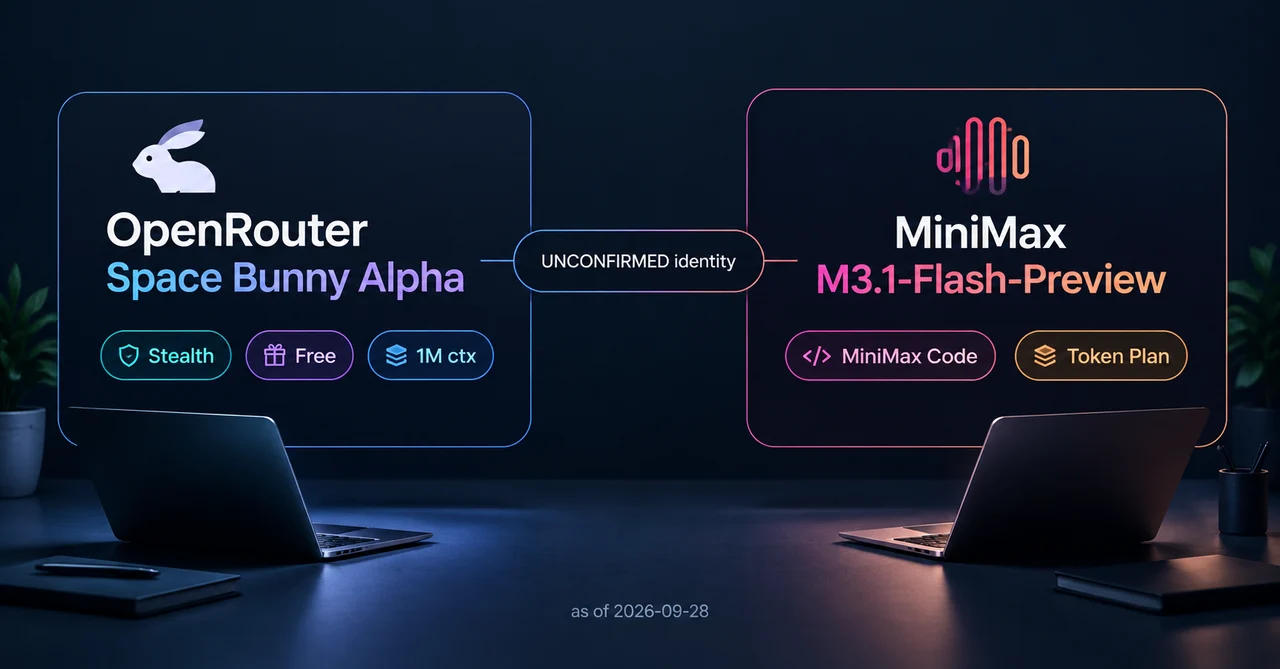
OpenRouter listed a free stealth coding model, Space Bunny Alpha, on Sep 23, 2026. It shows a 1M-token context window, five mandatory reasoning efforts, and Free pricing as of 2026-09-28 (pricing may change). Four days later MiniMax announced M3.1-Flash-Preview on MiniMax Code and Token Plan with overlapping public traits. Community tokenizer tests point at the MiniMax family - unconfirmed. Builders should read the two surfaces separately: map confirmed listing and API fields, quote retention carefully, run a short non-sensitive eval while Free lasts, and wait for a named card before shipping a production default.
In short
- OpenRouter
stealth/space-bunny-alpha: 1M context, max completion 524,288, Free / $0 as of 2026-09-28 (may change), effortslow/medium/high/xhigh/max, defaultmax, reasoning mandatory - MiniMax M3.1-Flash-Preview: announced Sep 27 on MiniMax Code + Token Plan; promo double check-in credits Sep 28-Oct 7 UTC+8 + quota resets - no formal release-notes card or public $/M in this research
- Identity MiniMax = Space Bunny: UNCONFIRMED (tokenizer + trait overlap = reported clues only)
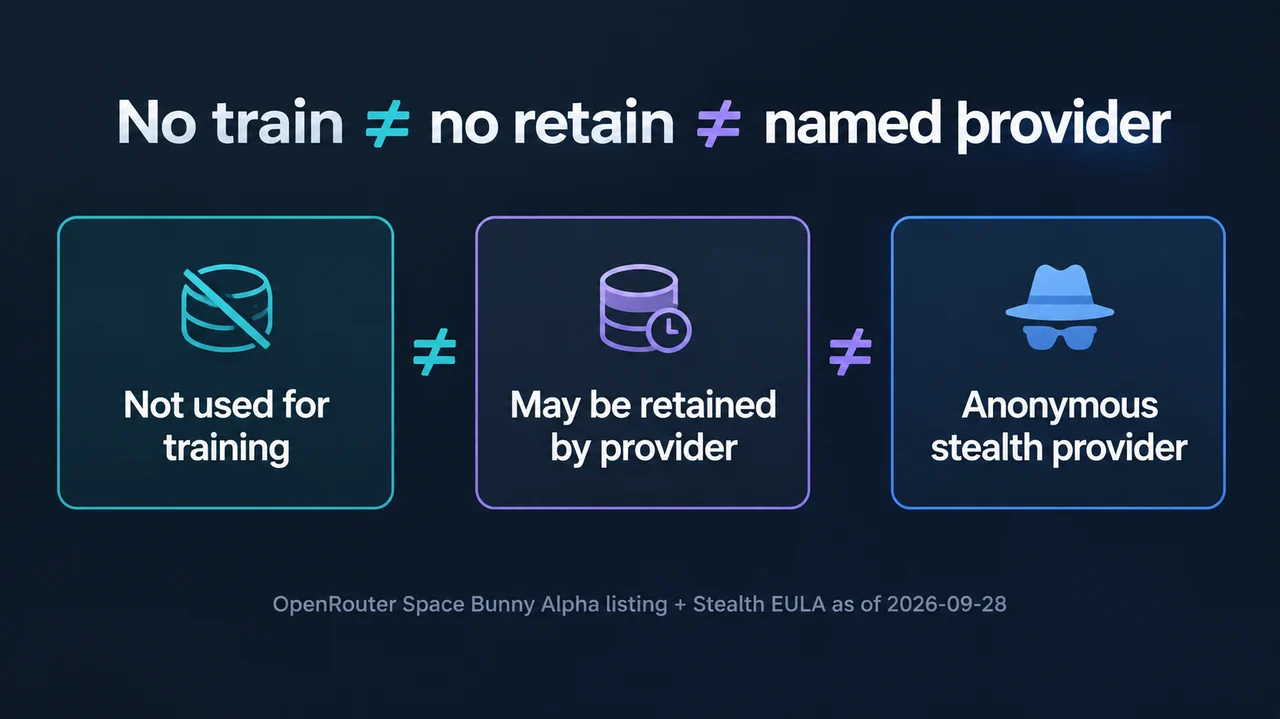
- Listing: prompts and completions may be retained by the provider but are not used for training; Stealth EULA still shares User Content with an anonymous provider
- Free ~week ending ~Sep 30 is community / OpenCode-reported; OpenRouter
expiration_dateis null - re-check the listing daily - Stealth fits disposable bake-offs; named cards (or MiniMax’s named product path) fit shipping defaults
What does OpenRouter actually publish for Space Bunny Alpha?
Start with what the listing and Models API actually say, not what the community hopes the model is.
Confirmed fields as of 2026-09-28:
| Field | Confirmed value |
|---|---|
| Model id | stealth/space-bunny-alpha |
| Released | 2026-09-23 (API created ≈ 14:48 UTC) |
| Role | Anonymous third-party stealth; OpenRouter routes only |
| Context | 1,000,000 tokens |
| Max completion | 524,288 tokens |
| Pricing | Shown Free / prompt + completion 0 (may change); expiration_date: null |
| Reasoning | Mandatory; efforts low, medium, high, xhigh, max; default max |
| Modalities | Inputs text / image / video to text out |
| Tools | Tools + tool_choice; response_format (JSON without schema enforcement per listing FAQ) |
The OpenRouter Space Bunny Alpha listing is the surface to pin in eval notes. If you need a directory overview of the gateway itself, the OpenRouter tool page is a soft companion - not a substitute for the stealth listing fields above.
Pin the model id in your client. Record Free / 0 as an as-of snapshot, not a contract. Prefer the Models API spellings for effort (medium, not secondary shortcuts like “med”).
What did MiniMax confirm for M3.1-Flash-Preview?
Treat MiniMax as a separate surface. Do not fold these bullets into Space Bunny facts.
On Sep 27, 2026, MiniMax’s agent account announced that M3.1-Flash-Preview debuts on MiniMax Code for everyday development work, as quoted by PromptBlueprints and Startup Fortune. The same announcement window also stated the preview live on Token Plan.
MiniMax-stated promo perks (credit amounts unspecified - invent none):
- Daily double free credits check-in Sep 28-Oct 7 (UTC+8)
- Token Plan quotas reset when M3.1-Flash-Preview goes live
Gaps that still matter for ship decisions:
- No entry on MiniMax’s public models release notes as of 2026-09-28 (latest language-model note still MiniMax M3, Jun 1, 2026)
- No public per-token API price, Hugging Face weights, or vendor benchmark card found for M3.1-Flash-Preview in this research pack
Soft-pedal long-term cost. Any Free or perk mention is as-of and may change. Double credits and quota resets are useful for trying the preview; they are not a substitute for a published $/M or an SLA. For a named MiniMax directory entry (not this preview’s missing card), see the MiniMax tool page.
Which identity claims are still unconfirmed?
REPORTED / UNCONFIRMED only. Neither MiniMax nor OpenRouter has named Space Bunny’s stealth provider.
Community reports (notably CellCog’s Space Bunny Alpha write-up, which grades tokenizer probes and OpenCode free-week framing):
- Tokenizer probes matching the MiniMax family (multiple accounts; various perfect-score grades reported) - consistent clues, not a company name
- Trait overlap (1M context, mandatory thinking, five effort tiers) - a hint, not identity
- LuminaBench-style “leaves stealth Wed Sep 30” / deployment-return anecdotes - single-source prediction; cannot verify from outside
Treat MiniMax M3.1-Flash-Preview and OpenRouter Space Bunny Alpha as two separately documented surfaces until a lab or OpenRouter names them. Tokenizer “proof” should never flip a procurement decision by itself.
What does “retained but not used for training” mean for your code?
Quote the listing carefully. OpenRouter’s Space Bunny page states that prompts and completions for this model may be retained by the provider but are not used for training; all other use is governed by the Stealth Model Terms.
Under the Stealth Program EULA (updated September 14, 2026):
- Stealth models are free for a limited period; availability is not guaranteed; they may be removed without notice
- Listings indicate whether the stealth provider intends to use User Content for training; Space Bunny’s listing currently says training does not apply
- User Content may still be collected by OpenRouter and shared with an anonymous Stealth Provider; OpenRouter may not disclose that provider’s identity
- Training sublicense applies only where the listing discloses training use
- Acceptable-use rules bar children’s data, health, financial, and other sensitive categories on stealth models
OpenRouter’s provider logging docs matter here too: opting out of providers that train does not erase retention when training is already disclaimed but retention is allowed.
Product shorthand: no train is not the same as no retain, and neither is a named counterparty. For proprietary code or secrets, prefer a named MiniMax Code / Token Plan path (or wait) over an anonymous stealth endpoint. A bake-off on synthetic bugs is a different risk class than pasting a private monorepo, CI secrets, or customer data into a stealth id.
Do not apply OpenCode “zero retention” route claims to OpenRouter stealth/space-bunny-alpha. Those claims, when they appear in community write-ups, refer to a different route. Quote the OpenRouter listing and Stealth EULA for this model id, and ignore borrowed retention slogans from other stacks.
How should you run a short eval before the free window ends?
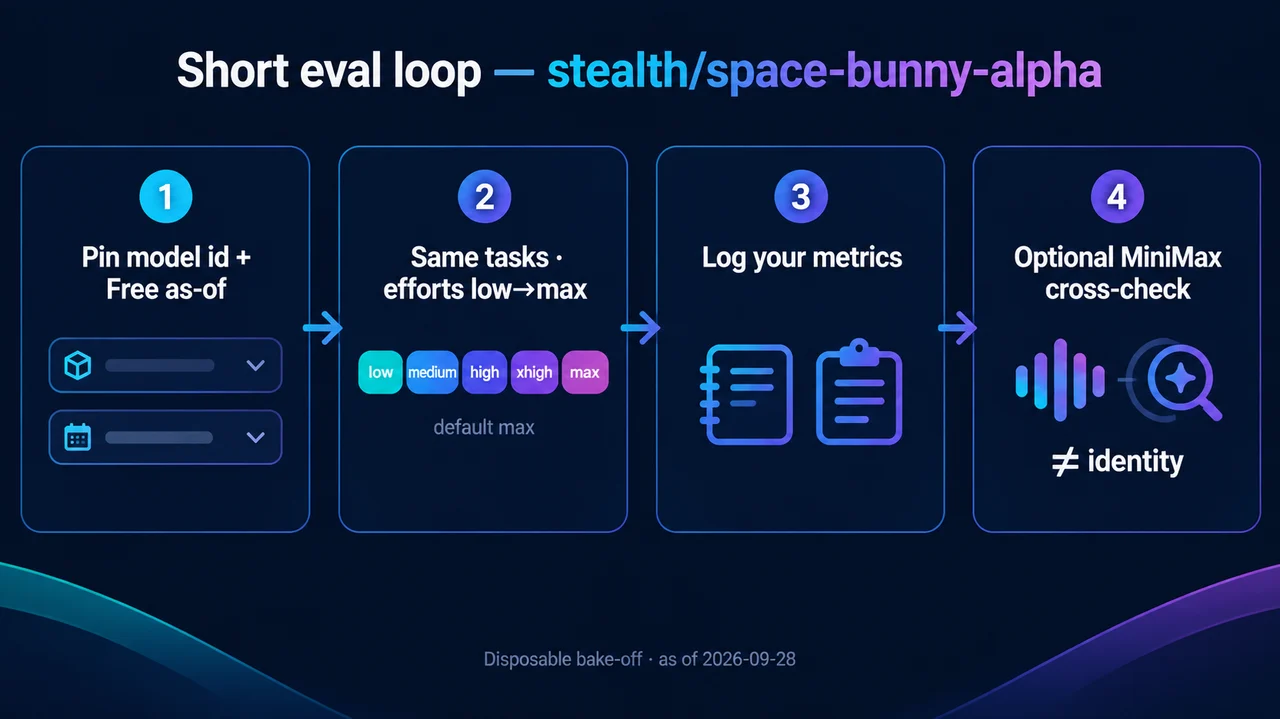
Use non-sensitive prompts only. The goal is a short, comparable bake-off you can throw away - not a production migration. Treat ~Sep 30 as a reported OpenCode / community clock, not an OpenRouter-hard expiration_date. If the listing still shows Free tomorrow, that is an as-of fact; if it flips, your notes should already say pricing may change.
- Read the listing banner and Stealth EULA before any real-repo paste; decide your retention tolerance.
- Pin model id
stealth/space-bunny-alpha. Record Free / 0 as-of and that it may change. - Sweep the same task set across
lowtomediumtohightoxhightomax. Log latency, token burn, and tool-call success yourself - do not invent milliseconds from tertiary blogs. - Keep eval prompts synthetic or public fixtures. No customer PII, no secrets, no regulated data.
- If you already have MiniMax access, parallel the same tasks on MiniMax Code / Token Plan M3.1-Flash-Preview for quality only. A quality match is not identity proof.
- Capture the OpenRouter listing (and MiniMax Code chrome if you can) for your own notes.
- Hard stop: if you need a named DPA, published $/M, or vendor benchmarks, wait (next section).
- Calendar: re-check the listing price daily through the window.
Think of the bake-off as a short loop you run yourself - not a pre-filled latency scoreboard:
When should you wait for a named model card instead of shipping on stealth?
Wait - or use MiniMax’s named product surfaces only - when:
- You need contractual identity of the model provider (procurement or security review)
- Workloads include sensitive code, credentials, or regulated data
- You need published $/M tokens, rate-limit SLAs, or vendor benchmarks (still missing for M3.1-Flash-Preview in this pack)
- You are shipping a production default that must survive stealth delist or price flip
- A tokenizer “proof” would change a buy decision - fingerprints remain unconfirmed
Stealth eval is for cheap, disposable bake-offs. Named cards are for shipping defaults. If your team’s security review needs a counterparty name on paper, Space Bunny Alpha cannot give you that today - and MiniMax’s Code / Token Plan posts are still not a full models release-notes card for M3.1-Flash-Preview. Keep the eval artifacts; postpone the default. If you are choosing among named coding models more broadly after the stealth window, see How to Pick the Right AI Model for Every Task - a separate playbook that does not resolve stealth identity.
FAQ
Does OpenRouter’s “opt out of providers that train” setting protect my Space Bunny prompts?
No - that setting only targets providers that train on inputs. Space Bunny’s listing already disclaims training while still allowing the provider to retain prompts and completions, and the Stealth EULA still lets User Content be shared with an anonymous stealth provider. If retention itself is unacceptable, do not paste proprietary code into this endpoint - use a named product path or wait.
Which reasoning_effort values does stealth/space-bunny-alpha accept, and what is the default?
OpenRouter’s Models API lists low, medium, high, xhigh, and max. Reasoning is mandatory, and the default is max. Prefer those API spellings over secondary shortcuts such as “med,” and log which effort you used when you compare quality or cost.
When does the free preview end - and what should I assume if OpenRouter still shows Free with no expiration date?
Treat ~Sep 30 as an OpenCode / community-reported clock, not an OpenRouter-hard end date. As of 2026-09-28, OpenRouter still shows Free with expiration_date: null. Re-check the listing daily, and assume price or availability may change without notice under the Stealth EULA.
Should I run the same bake-off on OpenRouter stealth and MiniMax Code, or pick one surface?
Use both only if you already have MiniMax access and want a quality cross-check on identical non-sensitive tasks. A quality match is not identity proof. If you only need a disposable Free bake-off, OpenRouter alone is enough.
If tokenizer tests match MiniMax, is that enough to pick MiniMax as my vendor of record?
No. Fingerprints and trait overlap are community-reported clues. Procurement, DPAs, and shipping defaults need a named card or MiniMax’s own product surface - not an inferred stealth identity.
Do Token Plan quota resets and double check-in credits tell me what M3.1-Flash-Preview will cost after the promo?
No - promo perks are not a published post-promo price. They are limited-time MiniMax-stated offers (Sep 28-Oct 7 UTC+8 double credits; quota resets on go-live) without credit amounts or a public per-token $/M. Soft-pedal long-term cost until MiniMax publishes a card or API price; pricing and perks may change.