

Pick Playwright's test agents if you already run Playwright. Pick Meticulous or QA Wolf if nobody owns QA, Tricentis Tosca for regulated enterprise teams, and mabl if triage eats your week. Then ask one question of any of them: when healing kicks in, does the test fail closed or fail open?
The intentional-change test below checks that in an afternoon.
Quick picks: the best AI website testing tool by team
- Best for small teams on Playwright: Playwright test agents. First-party planner, generator and healer agents. The healer may skip a test it thinks is broken.
- Best for teams with no QA: Meticulous or QA Wolf. Meticulous tests your frontend from a recorder script, with no tests to write. QA Wolf runs open-source Playwright tests at $1 per web run.
- Best for regulated enterprise: Tricentis Tosca. Self-healing Mode marks every healed entry in the execution log.
- Best for triage-heavy teams: mabl. Runtime Recovery keeps the test marked failed by default.
- Add to any of them: Chromatic. Visual diffs that never heal and can block the merge.
Compared at a glance: healing, fail mode, price, code
Prices and behavior come from each vendor's own pages, checked October 21, 2026.
| Tool | Healing type | Fails open or closed | Pricing model | Code ownership |
|---|---|---|---|---|
| Playwright test agents | Healer agent run by your coding agent | Closed if CI alerts on skips: pass, or skip if it judges the feature broken | Open-source framework; your agent's model usage | Your repo |
| Meticulous | Recorder script, replayed sessions; no test authoring | Not documented; ask in the demo | No public price; demo booking only | Not stated; ask |
| QA Wolf | AI maintenance, plus human QA engineers on Coverage as a Service | Not documented; ask the vendor | $1 per web run, $2 per mobile or desktop run (5 minutes each) | Open-source Playwright and Appium |
| mabl | Runtime Recovery during execution | Closed by default: "still marked failed" | Quote-based; cloud runs use credits, 500 per month to start | Inside mabl |
| Tricentis Tosca / Testim | Similar-control matching, smart locators | Open, flagged: run continues, healed entries marked | No price on page; check vendor page | Inside Tricentis |
| Chromatic | None (visual diffs) | Closed: non-zero exit code on changes | Free $0 (5,000 snapshots); Starter $179/month; Pro $399/month | Your stories and tests |
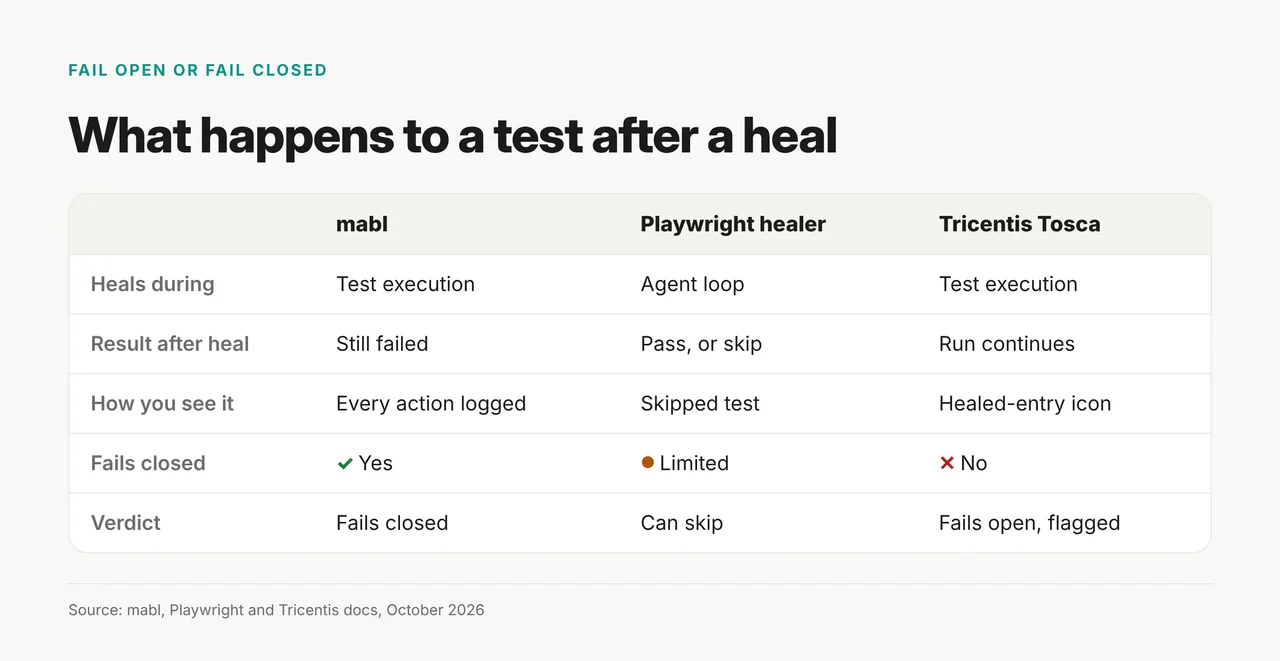
In short: mabl fails closed by default, Playwright's healer can return a skip instead of a pass, and Tosca continues and flags the heal.
How we chose: fail mode first, features second
We ranked tools on four questions a dev lead can check before signing anything.
- Does a heal stay visible? A heal log, an icon or a status the reviewer sees.
- Does healing touch assertions? It should repair how a test finds an element, never what it asserts.
- Is the default fail-closed? A recovered test should not silently count as a pass.
- Who owns the code and the bill? Exportable tests and a pricing model you can forecast.
We read vendor docs and pricing pages. We did not run these tools hands-on for this guide.
Self-healing is locators, then fallbacks, then AI re-identification
Self-healing is usually three layers stacked on each other, and only the last one involves a model.
Locators that don't break. Bind to an element's role and accessible name, not CSS classes or DOM depth. A renamed utility class or an extra wrapper div then breaks nothing. Much of what gets sold as healing is this. If your suite is full of div.col-3 > span:nth-child(2), rewrite selectors before you buy anything.
A fallback chain. List several candidate locators in priority order. The framework tries each until one matches exactly one element, then logs the winner. It's cheap, deterministic and auditable. The log matters: a suite that recovers silently has stopped testing.
AI re-identification. When every static candidate fails, a model reads the current page and a description of the element. It proposes a new locator. Good implementations confirm it matches exactly one element before trusting it.
The boundary: healing repairs how a test finds an element. It must never repair what the test asserts. If expect(total).toBe(99.00) fails, that is a finding about your checkout math.
Healing hides breakage when it fails open
A fail-open healer turns a deliberate product change into an invisible pass. Say a product decision replaces "Delete account" with "Request deletion". The old test should fail so a human confirms the new flow. A healer that binds to the nearest-looking element converts that decision into a green check.
Teams that run healing in production tend to land on four rules:
- Never heal assertions. Only locators, waits and data setup.
- Never auto-apply heals on the gating run. Propose the patch in a PR for a human to approve.
- Treat a change of intent as a failure. "Delete account" and "Deactivate account" are different flows. If the healed element's role or label differs from the original, flag it instead of applying it.
- Treat a missing element as a finding. A removed button needs a red test, not a substitute.
mabl's Runtime Recovery shows the safe default. It launched with Active Coverage on April 23, 2026, per mabl's own post. Recovery runs during execution and logs every action. In the default "zero risk" mode, mabl says "the test is still marked failed until the team decides to trust it further." Ask every vendor the same question: does your healer fail open or fail closed?
Run the intentional-change test in an afternoon
The intentional-change test is three commits against a demo app, scored on four outcomes. Use a non-critical app with decent happy-path coverage, and make one change per commit:
- Cosmetic churn. Rename a button's CSS classes and wrap it in an extra container.
- Intentional copy and flow change. Rename "Sign in" to "Log in" and move the submit button.
- Behavioral removal. Delete a button or input, or change what clicking it does.
Run each candidate tool against all three. Sort every result into one of four outcomes:
- Healed correctly. Cosmetic churn heals, or never breaks. Role-based locators often survive with no AI at all.
- Failed correctly. The removal produces a loud failure with a clear cause. A tool that heals across it fails the exam.
- Healed wrongly. The test passed, but the trace shows a different flow. This is the outcome you are hunting.
- Failed noisily. An intentional change gives a confusing failure. Not dangerous, just maintenance cost.
| Change | What a good tool does | What a dangerous tool does |
|---|---|---|
| CSS class renamed, wrapper added | Heals, or never breaks | Fails a pile of tests |
| Button renamed, relocated | Heals with a logged, reviewable diff | Silently rebinds, no trace |
| Feature removed | Fails loudly with a clear cause | Finds a "similar" element and passes |
| Expected value changed | Fails the assertion | Updates the expected value |
Aim for zero "healed wrongly". A tool that can't show its heal log, with before and after locators, asks you to trust a black box on your release gate.
Best for small teams on Playwright: Playwright test agents
Playwright's test agents are the default for teams with a Playwright suite. There are three: a planner, a generator and a healer. The planner explores your app and writes a Markdown test plan. The generator turns that plan into Playwright tests, checking selectors against the live app. The healer replays failing steps, inspects the current UI and suggests patches.
Setup is one command, npx playwright init-agents --loop=vscode. The docs also list --loop=claude, --loop=codex and --loop=opencode. The agents run inside your coding agent, the same way agents reach tools over MCP. So the tests stay in your repo.
The detail that matters is the healer's documented output: "a passing test, or a skipped test if the healer believes that functionality is broken." A skip is visible. It's closer to fail-closed than a silent pass.
- Pros: first-party, no new vendor, tests stay in your repo, a skip path for broken features.
- Cons: a skip can still slip through CI if you don't alert on skips. Treat generated tests as PRs.
- Cons: the generator's sample output uses role-based locators with accessible names, so pages without roles or labels likely heal badly, and the fix is in your markup.
- Price: Playwright is open source; the cost is your coding agent's model usage.
Best for teams with no QA: Meticulous or QA Wolf
Meticulous and QA Wolf both move test upkeep off your calendar. Meticulous does it with recorded sessions, QA Wolf with per-run pricing and, optionally, its own engineers.
Meticulous sells "Automated Frontend Testing Without Writing Tests." You add a recorder script to your frontend environments, and it replays recorded backend responses. It raised a $15 million Series A on July 15, 2026, led by Chemistry. Coverage of the round names customers such as Notion, ElevenLabs, Dropbox, Wiz and LaunchDarkly. No price is listed; every call to action books a demo.
QA Wolf charges $1 per web run and $2 per mobile or desktop run, per its pricing page. Each run covers up to 5 minutes, and longer tests bill in 5-minute blocks.
There are "no AI credits or token bills," you can add as many people as you like, and a monthly spending limit caps pay-as-you-go. New teams get free runs. Tests are "Open source Playwright and Appium (no vendor lock-in)." Coverage as a Service "embeds full-time QA engineers with your team"; that tier is quoted by sales. On that tier a QA engineer, not a similarity score, decides whether a removed feature is a bug. Compare it to the cost of hiring a QA automation engineer.
- Pros: Meticulous needs no test authoring. QA Wolf has a forecastable per-run price and open-source tests.
- Cons: Meticulous is frontend-focused with no public price, and its heal behavior isn't documented. You don't choose what Meticulous asserts, so it suits UI-heavy frontends better than tests that encode business rules. QA Wolf's per-run bill grows with suite size and run frequency.
- Price: Meticulous, check vendor page. QA Wolf, $1 per web run as of October 21, 2026.
Best for regulated enterprise: Tricentis Tosca and Testim
Tosca suits teams that need an audit trail more than a fast pilot. The Tosca 2026.1 documentation describes a Self-healing Mode: "Tosca then tries to find a similar control in the system under test." Then "the test execution continues without being interrupted by errors."
That is fail-open, but flagged. A self-healing icon marks the affected ExecutionEntries, and the ExecutionLog's Detail column shows the healed objects. A compliance reviewer can find every heal, as long as someone looks.
Testim, Tricentis's other product, sells "smart locators" that "understand your app, identify elements, and automatically self-heal." It targets custom web, mobile and Salesforce apps.
- Pros: heals are marked in the log; covers Salesforce.
- Cons: runs continue past a heal, so review is on you. No public pricing.
- Price: not on the page. Check vendor page.
Best for triage-heavy teams: mabl
mabl fits teams that want a managed platform with fail-closed defaults. Runtime Recovery works around obstacles during execution and logs every action. The test stays failed until you decide to trust that kind of recovery. For triage, Active Coverage also adds conversational failure analysis: you ask why a run failed, and mabl "investigates iteratively, forming hypotheses and fetching evidence as the conversation develops." Through Atlassian Rovo, teams can also trigger runs and investigate failures from Jira.
Pricing is "customized and quote-based," per mabl's pricing page. Cloud runs consume credits, with a starting allotment of 500 credits per month. Local and CI runs are unlimited, and there is a 14-day free trial.
- Pros: the safest healing default we found in vendor docs; unlimited local and CI runs.
- Cons: quote-based pricing; cloud runs draw down credits.
- Price: quote-based; 14-day free trial. Check vendor page.
Add a layer that refuses to heal: Chromatic
Chromatic pairs with any pick above because it never heals. It runs visual tests and, per its CI docs, "will return a non-zero exit code when there are changes." Results show up as PR status checks you can make required.
It sets up with Storybook, Vitest, Playwright or Cypress. Chromatic's pricing: Free is $0/month with 5,000 snapshots, Chrome only. Starter is $179/month with 35,000 and adds Safari, Firefox and Edge. Pro is $399/month with 85,000; Enterprise is custom.
Pair a healing E2E layer with a non-healing visual layer. The visual check catches what healing absorbed.
Not covered here
Applitools, Katalon and testRigor are not covered in this guide. For testRigor, see its Toolbit page.
How to choose by team profile
Match the tool to who will own the tests.
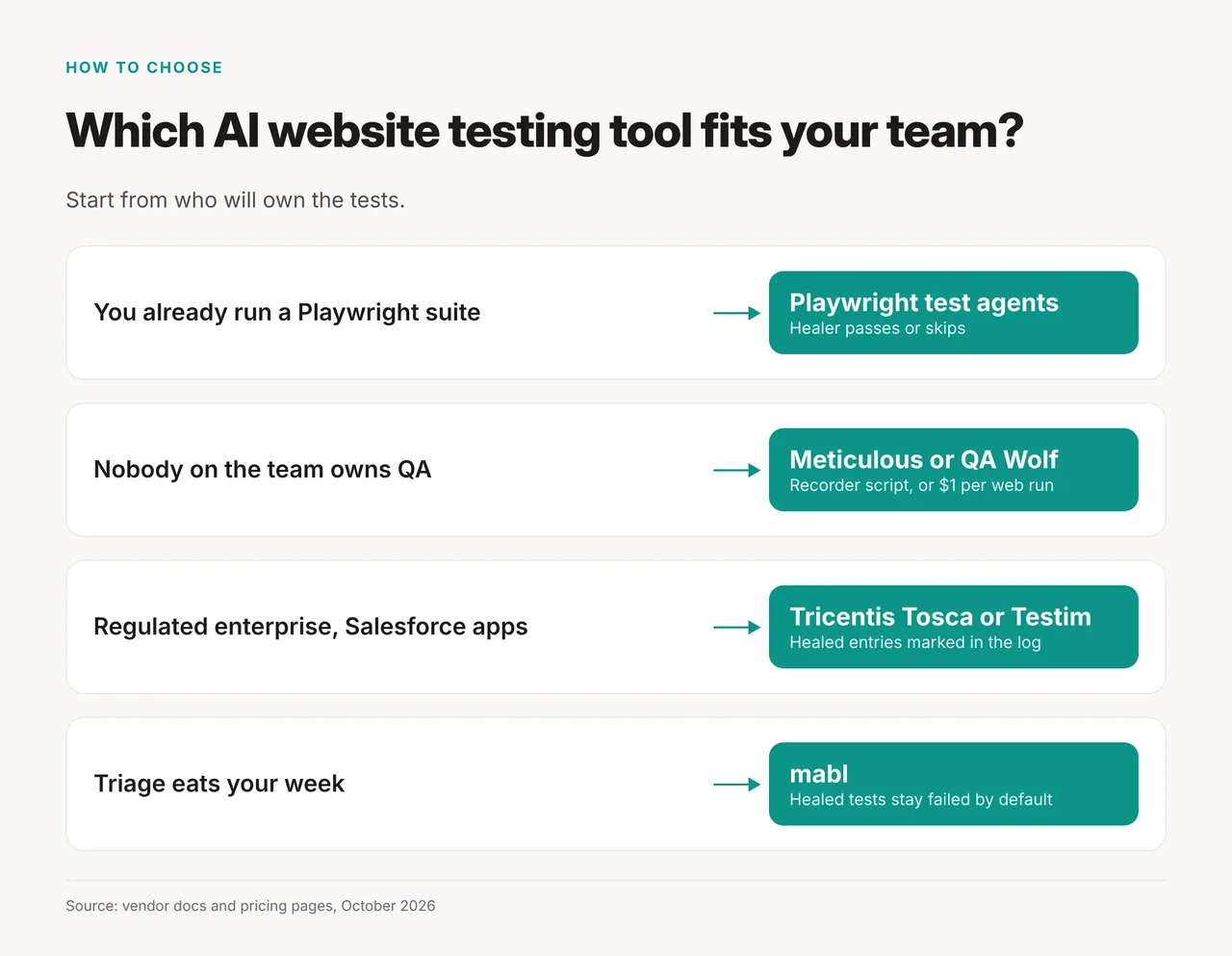
- Small team, strong engineers, Playwright suite: Playwright test agents plus a locator cleanup. Add Chromatic if visual bugs have shipped. Coding agents such as Cursor or Windsurf can drive the agents.
- No dedicated QA, fast frontend: Meticulous if you want zero authoring, QA Wolf if you want open-source Playwright and per-run billing.
- Regulated enterprise, Salesforce in the stack: Tosca or Testim, with someone assigned to review healed entries.
- Drowning in triage, budget but no headcount: mabl, or QA Wolf's Coverage as a Service.
Then run the intentional-change test on your top two before you sign.