Can you use Claude Code or OpenAI Codex to reverse engineer your own device? Yes, with caveats. Neither vendor's written policy bans reverse engineering a device you own. Anthropic's Usage Policy says it does not prohibit security research "on systems you own or operate," and an OpenAI engineer said "there is no prohibition against reverse engineering with codex."
The catch is that both tools run automatic cyber safeguards, and those can still refuse the work. Some Codex users also report account restrictions. So how you scope the job matters as much as the policy text.
On November 10, 2026, 404 Media reported that AI companies were cracking down on "reverse engineer anything." People who used Claude Code and Codex on smart TVs, baby monitors and other devices they own described running into safety checks and account restrictions.
Below, you'll find each vendor's own wording side by side, what a block does and doesn't mean, how the two verification programs work for individuals, and what to send support if you're stuck.
What do Anthropic's and OpenAI's policies say about reverse engineering your own device?
As of November 2026, neither vendor's policy names "reverse engineering a device you own" as allowed or banned. Anthropic's Usage Policy does carve out security research on systems you own or operate, as long as it complies with applicable law. OpenAI's usage policies ban compromising someone else's system, and an OpenAI engineer has said Codex has no reverse engineering prohibition.
Here is the official wording, compared line by line:
| Question | Anthropic (Claude, Claude Code) | OpenAI (Codex, ChatGPT, API) |
|---|---|---|
| Is work on systems you own covered? | Yes. The policy "does not prohibit security research, testing, or tool development conducted on systems you own or operate," if the activity complies with applicable law | Not named in the usage policies. An OpenAI engineer said "there is no prohibition against reverse engineering with codex" |
| What is clearly banned? | Discovering or exploiting vulnerabilities "without authorization of the system owner." Also building persistent unauthorized remote access tools, "including firmware modifications or hardware implants" | "Destruction, compromise, or breach of another's system or property, including malicious or abusive cyber activity" |
| Does a block mean you broke the rules? | No. A block "does not by itself indicate a violation of the Usage Policy" | No. An additional-check notice "does not by itself mean OpenAI has determined that you violated our Usage Policies" |
| What can happen if they suspect a violation? | Anthropic may warn, throttle, limit, suspend or terminate access | Breaking or circumventing rules and safeguards "may mean you lose access" or face other penalties |
| Public response to the recent blocks | Anthropic has not publicly explained the Claude refusals | The engineer called the blocks "mostly accidental" and said "it's getting fixed" |
You can read the full texts in Anthropic's Usage Policy and OpenAI's usage policies.
Does checking what your smart TV sends home count as hacking?
Under both policies, the key question is whose system you're touching. Logging the traffic your own TV sends out is work on a device you own. Probing the manufacturer's servers on the other end is work on someone else's system, and both policies draw the line there.
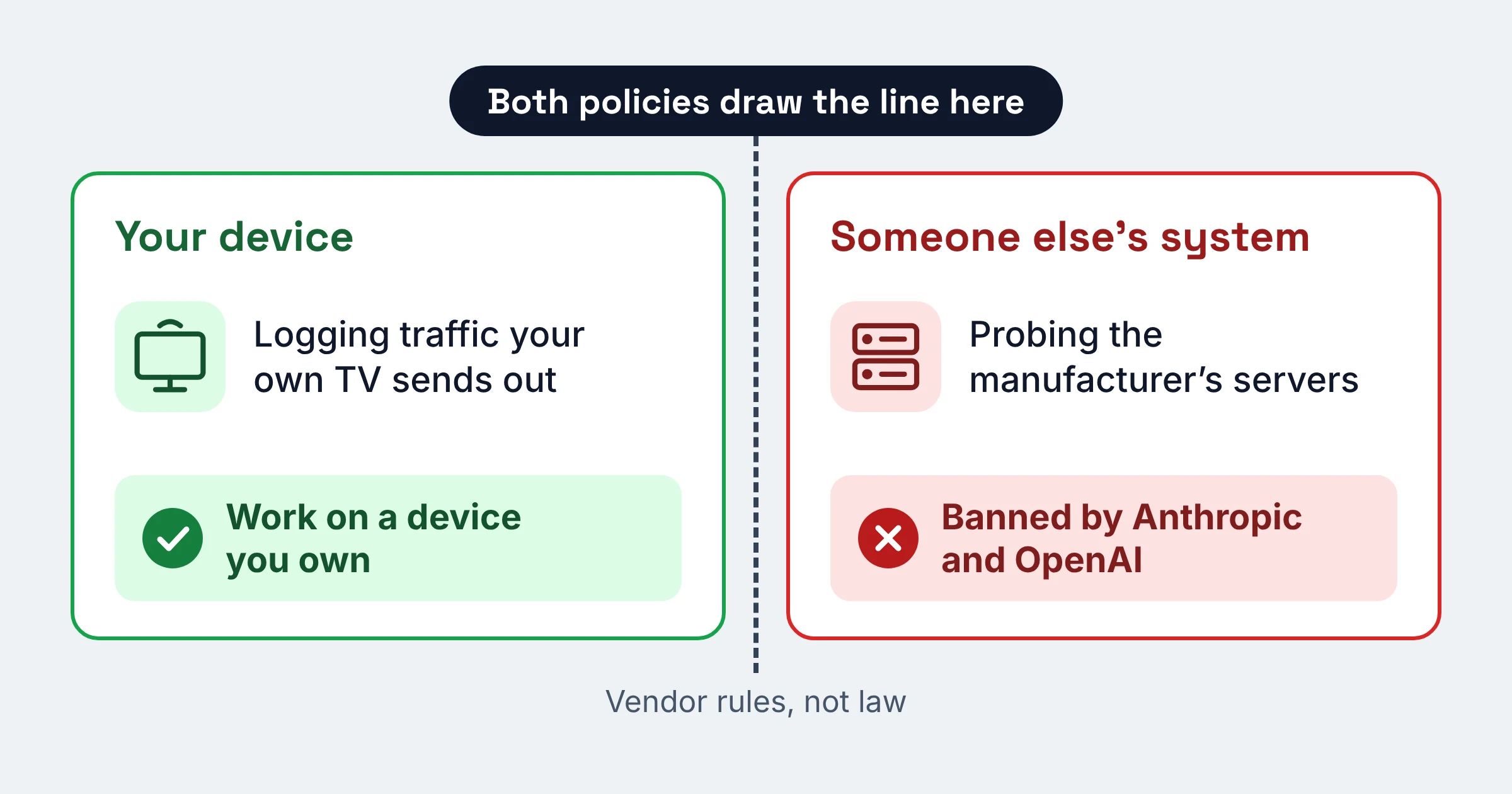
One more caution: these are vendor rules, not law. Questions about your device's license terms or local law fall outside both policies, and this guide isn't legal advice.
Why do Claude Code and Codex refuse reverse engineering requests?
The blocks come from automated cyber safeguards. Security researcher Matt Brown told 404 Media that every reverse engineering block he had seen matched the "cyber" category. The OpenAI engineer blamed "difficult decision boundaries."
Think of an airport scanner that flags a screwdriver in your carry-on. It can't tell a hobbyist from a burglar. Decompiling code and hunting for weak spots are the same skills an attacker uses, so a classifier (an automatic filter that scores each request for risk) sometimes treats your weekend project like an intrusion.
Anthropic admits this happens. Its Cyber Verification Program page says users may still see "some model refusals and classifier blocks for allowed security work" while it reduces false positives. Firmware work also sits close to a real red line: Anthropic's policy names "firmware modifications" in its ban on persistent unauthorized remote access tools.
If you're new to the agent itself, start with this overview of what Claude Code can do and what it costs.
Does a refusal or safety check mean you broke the rules?
No. As of November 2026, both Anthropic and OpenAI say in writing that a block or extra check does not by itself mean you violated their policies. A refusal is the safeguard being cautious, not a verdict on you.
That isn't a free pass, though. Anthropic may act if it suspects a violation, and OpenAI warns that "breaking or circumventing our rules and safeguards" can cost you access. Retrying the same request in disguise after a block could look like circumvention.
Can you get banned for asking an AI agent to decompile firmware?
It has happened to some users, but only on one side so far. As of November 2026, reported account bans concern only OpenAI's Codex, according to VPN Lab's coverage. Claude Code reports are refusals, not bans.
Other users told 404 Media they were warned or restricted after asking Codex to analyze hardware or even their own code. These are individual accounts shared through the media, not a published list. OpenAI has not said how many accounts were affected or whether banned users will get them back.
Claude isn't risk-free either. Anthropic's policy keeps the option to suspend or terminate access on suspicion. The difference is that no Claude bans tied to this story have been reported.
Can a hobbyist apply for Claude's Cyber Verification Program or OpenAI Daybreak?
Yes, both programs accept individuals as of November 2026. Anthropic offers the Defense Access tier of its Cyber Verification Program (CVP), and OpenAI offers Daybreak Blue. Both require a paid plan.
Neither program page says it is meant for home-gadget tinkering. Read the requirements before you assume you qualify.
| Requirement | Claude CVP: Defense Access | OpenAI Daybreak Blue (individuals) |
|---|---|---|
| Who can apply | Individuals "such as independent researchers, open-source maintainers, and bug bounty hunters." Individuals can apply only for Defense Access | Individuals at least 18 years old |
| Plan | Paid Claude plan; not available on the Free plan | An eligible paid plan |
| Account security | From December 15, 2026: phishing-resistant MFA (sign-in protection that fake login pages can't steal), and no static or long-lived API keys | Advanced Account Security plus at least one FIDO2 hardware security key. A software or synced passkey doesn't count |
| Your data | Data retention is required for everyone enrolled | Not covered in the pages we reviewed |
| Review | Target of two days | Reviewed before access is enabled; approval is not automatic |
| Region | Not stated | Not available in every region |
| Does it name reverse engineering? | No. It covers security operations, incident response, malware analysis, detection engineering, and vulnerability triage and validation | Reverse engineering is listed among authorized offensive testing work. Blue approval doesn't include Daybreak Red |
| Best for | Paid Claude users whose security work keeps getting blocked | Codex users who own a hardware key and work in a supported region |
The rules come from Anthropic's CVP help page and OpenAI's Daybreak overview. The pages we reviewed tie both programs to a paid plan; we didn't find a separate program fee listed.
One gap to watch: OpenAI places reverse engineering in the offensive testing list, and the tier open to individuals, Blue, doesn't include Daybreak Red. The pages don't say clearly if Blue covers a pure reverse engineering project, so ask before you count on it.
What doesn't verification promise?
Verification lowers friction. It doesn't remove it. Here's what each vendor says you won't get:
- Claude CVP: some refusals and classifier blocks can still happen for allowed work.
- Daybreak, approval only: approval alone doesn't turn on reduced refusals. In Codex, the Daybreak toggle must be on, because "requests use standard safeguards when the toggle is off."
- Daybreak, scope: it doesn't remove all safeguards or refusals, and it doesn't authorize activity outside systems you own or are explicitly permitted to test.
- Daybreak, appeals: OpenAI's troubleshooting page says support cannot override a verification decision.
How do you scope a request so it's less likely to trip a cyber check?
OpenAI's help page gives two pieces of advice. Use a narrower scope with only the context needed to explain your goal. For cybersecurity work, focus on a defensive outcome "such as identifying, preventing, or remediating a security issue."
OpenAI is also blunt about the limits: "Changing the wording does not change whether a request is allowed." Clear framing helps the model understand legitimate work. It is not a way around a block.
Here's a before and after for a baby monitor you own:
Before (broad, attacker-shaped):
Decompile this firmware and find every way to break into the device.
After (narrow, owned, defensive):
I own this baby monitor and use it on my home network. My goal is privacy: I want to know which outside servers it contacts so I can block unwanted traffic on my router. Below is a traffic log I captured from my own network. List each destination and what it most likely does. I'm not touching the manufacturer's servers.
The second version states ownership, gives one defensive goal, and includes only the data the task needs. Use it as a template: swap in your device, your goal, and your evidence.
What should you do if Codex blocks you or your account is restricted?
Contact OpenAI support with the four details listed on OpenAI's help page about additional safety checks. Expect no guaranteed outcome: as of November 2026, OpenAI hasn't said whether banned accounts will be restored.
Here's a copy-ready ticket built from OpenAI's list:
Subject: Safety check on analysis of a device I own

1. Exact safety message:
   "[paste the message word for word]"
2. Model and surface:
   [model name], used in Codex (or ChatGPT / the OpenAI API)
3. Date, time and time zone:
   [date], [time], [time zone]
4. Brief, redacted task description:
   Analyzing network traffic from a smart TV I own to see which
   servers it contacts, so I can block unwanted data sharing on
   my home router. No third-party systems were tested.
Keep the task description short and strip out anything private. If you were rejected for Daybreak itself, remember that support can't overturn that decision.
On Claude, Anthropic points people whose security work gets blocked to the CVP. Anthropic says you may need it if Claude blocks work "such as validating exploits or running authorized penetration tests."
Should you keep going, apply for verification, or stop?
Your goal and your device decide the answer. If it's your own device and your goal is defensive, the policies are on your side. If the work touches anyone else's system, stop.
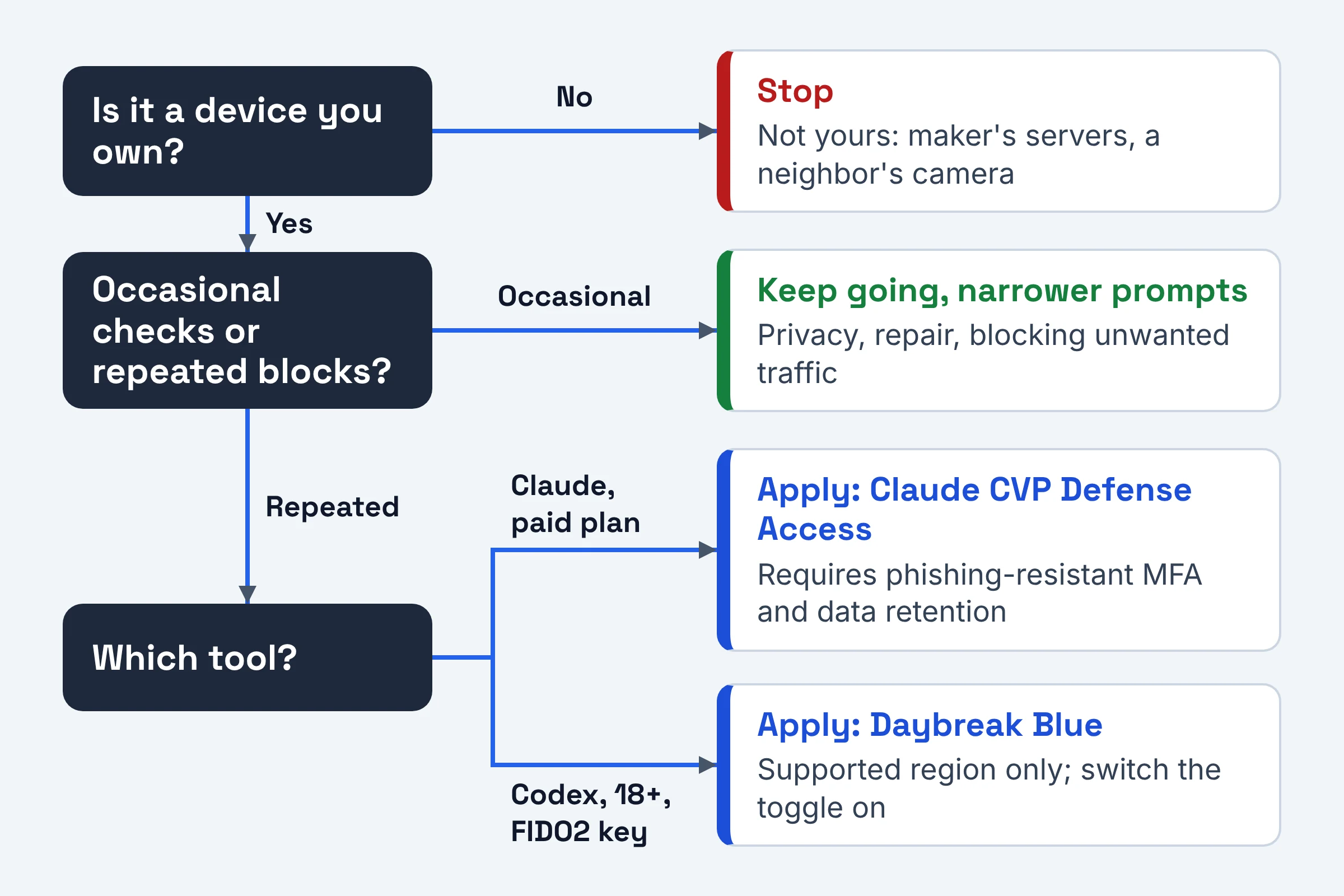
Keep going with narrower prompts if:
- the device is yours and the goal is privacy, repair or blocking unwanted traffic;
- you only hit occasional checks, not repeated ones.
Apply for Claude CVP Defense Access if:
- you're on a paid Claude plan and blocks keep interrupting your work;
- your task looks like malware analysis or vulnerability triage;
- you accept the data retention rule and can set up phishing-resistant MFA.
Apply for Daybreak Blue if:
- you're 18 or older, on an eligible paid plan, and own a FIDO2 hardware key;
- Daybreak is available in your region;
- you'll remember to switch the toggle on in Codex.
Stop if:
- the task involves the manufacturer's servers, a neighbor's camera, or anything you don't own;
- you're building persistent unauthorized remote access tools, including ones built through firmware modifications or hardware implants, which Anthropic's policy bans.
Your plan for today
- Write one sentence that states you own the device and names your defensive goal.
- Retry with only the files or logs that goal needs, then stop if the block repeats.
- Still blocked? File the support ticket above for Codex, or apply for the program that fits your tool.
Program requirements were checked on Anthropic's and OpenAI's help pages in November 2026; they change often.