On September 16, 2026, Google did something it has never done before: it opened Google Home to other companies' AI agents. The company announced early access to Home MCP, a server that turns your smart home into something any MCP-compatible agent can connect to, query, and control. "With Google Home MCP, any agent that supports calling MCP tools, such as Google Antigravity, Claude, Hermes, OpenClaw or others, can now interact with all of the devices and event history in the Google Home ecosystem, from your Google Nest doorbell and thermostat to your Works with Google Home (or Matter) light bulbs," wrote Taylor Lehman, Group Product Manager for Google Home & Nest.
It is a small feature announcement with a large meaning: the biggest smart home platform just adopted a protocol invented by Anthropic to let competitor AI agents touch its own hardware.
In short:
- Google Home is now an MCP server: agents can list homes, read device states, run actions, and read event history.
- Early access is open now (announced September 16, 2026) and rolls out over coming weeks to US English subscribers of Google Home Premium Advanced.
- Documented setup guides exist for Antigravity, Claude (Cowork), and OpenClaw. ChatGPT and Hermes are named in Google's post as example agents.
- Sensitive actions are walled off: unlocking doors is the only block Google has confirmed in writing. Garage and alarm limits are reported by media, not documented by Google.
- The setup requires a Google Cloud project and OAuth consent - roughly 15-30 minutes of clicking.
What Just Launched
Home MCP is a Model Context Protocol server that exposes your Google Home setup to external AI agents. If that sentence means nothing to you, think of it as a set of well-defined doors: an agent can knock on each one, ask a structured question, and get a structured answer. Google's announcement post frames it as "enabling your agent to interact with your home."
The rollout is deliberately gradual. Early access started September 16, 2026, in US English, and the feature reaches Google Home Premium Advanced subscribers over the coming weeks. That means even paying subscribers might not see it today; Google is staging the rollout.
The headline price detail: Premium Advanced costs $20 a month or $200 a year, and it is the tier that unlocks MCP access. Premium Standard ($10 a month) does not include it, per Google's developer documentation.
What Your Agent Can Actually Do
Google's MCP reference documents five tools an agent can call:
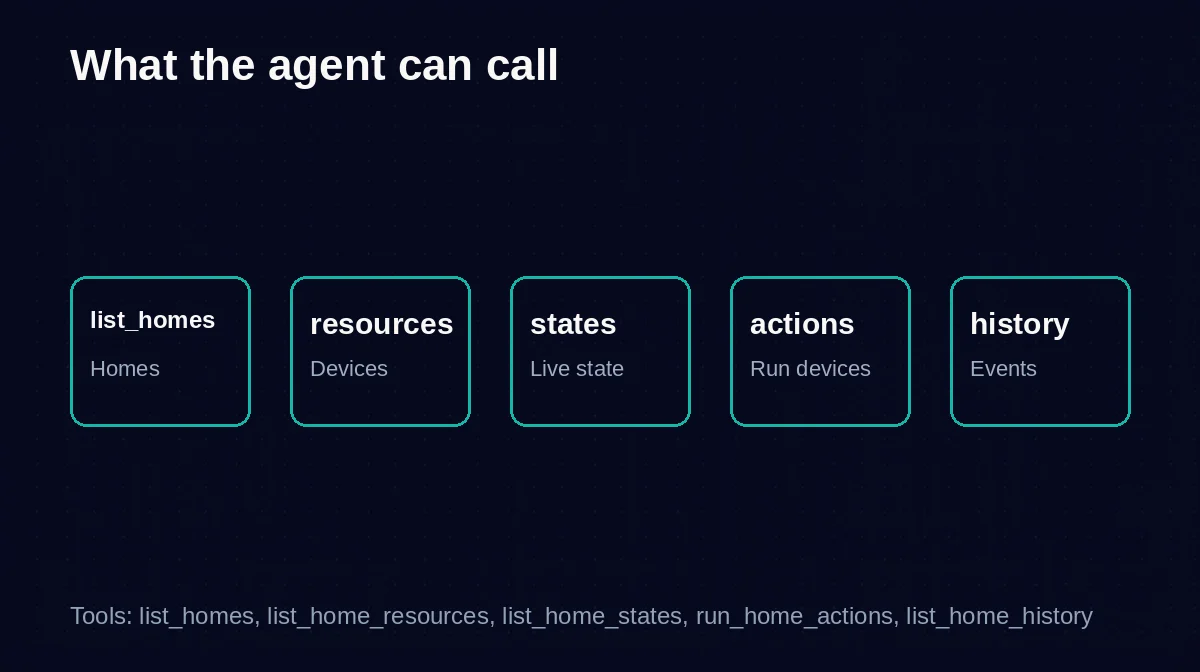
- list_homes gives the agent the list of homes it is allowed to see.
- list_home_resources lists the devices and automations in each home.
- list_home_states reads the current state of those devices (lights on or off, thermostat setpoints, lock status).
- run_home_actions executes changes: turn devices on, adjust settings, trigger automations.
- list_home_history reads event history, including camera and doorbell activity.
That last one is the one that matters most. Camera and doorbell history in an agent's context window is genuinely useful - "did anyone approach the front door while I was out?" becomes a question any connected agent can answer. It is also the one with the most obvious privacy weight, which Google addresses with the permission boundary described below.
What Your Agent Can't Do (and What Nobody's Sure About)
The catch is that "control" stops short of the dangerous stuff. Google's early access documentation confirms one blocked category in writing: unlocking doors. An agent can read that a lock is locked; it cannot flip it to unlocked.
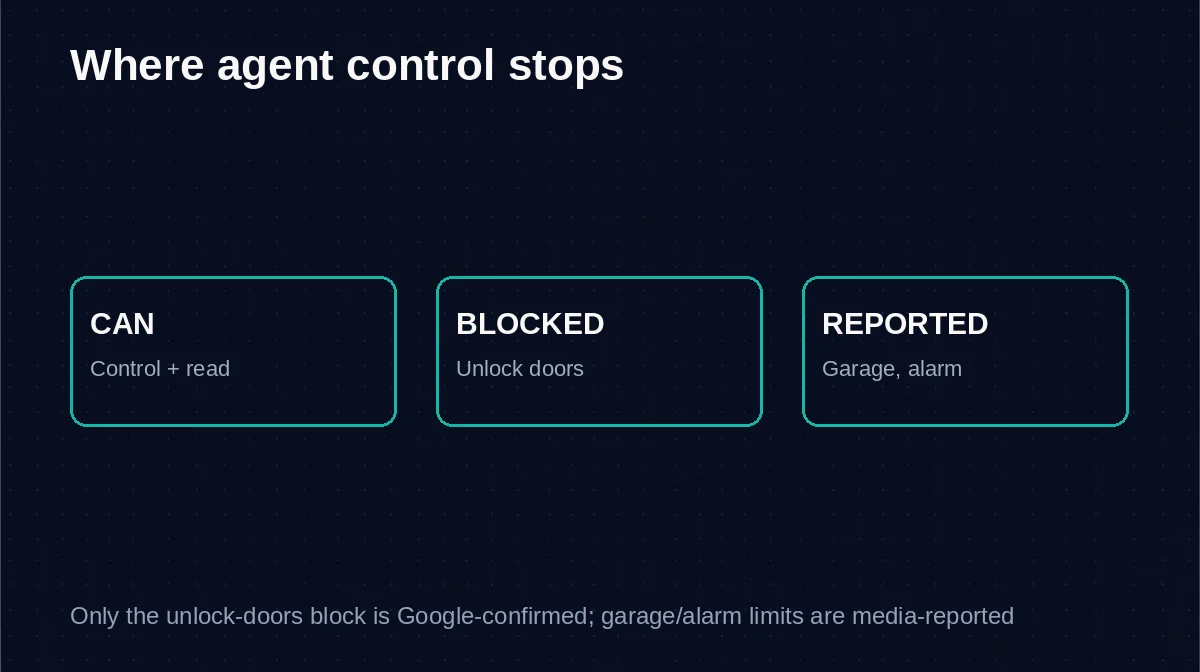
Beyond that, the picture gets murkier. Media coverage, including The Verge, reports that garage doors and alarm disarming are also off the table for agents. Google has not published an exhaustive list of blocked actions, so treat those two as expected limits rather than documented policy.
This distinction matters for how you trust the system. A hard, documented block on unlocking doors is a real safety rail. A reported-but-undocumented limit is a reasonable expectation, but it could change - in either direction - as Google iterates on early access.
How to Connect an Agent to Google Home
The setup is more than a toggle. Based on Google's developer docs, the flow is:
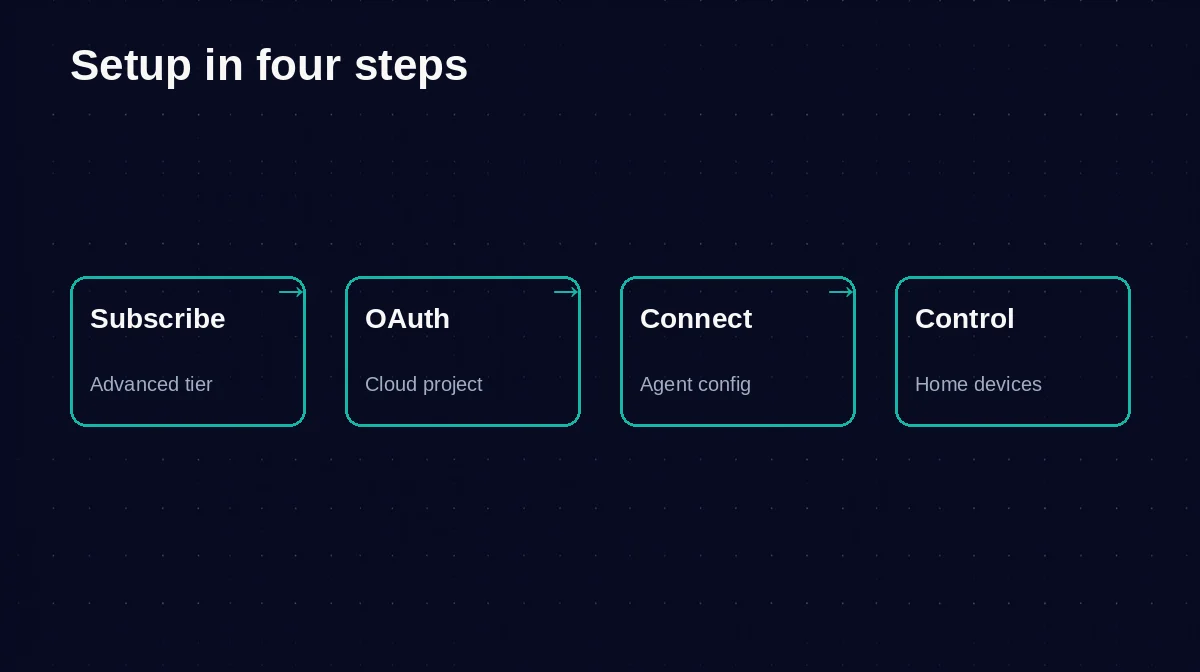
- Confirm your subscription. You need Google Home Premium Advanced ($20/month or $200/year) on the account that owns the home.
- Create a Google Cloud project. Home MCP runs through a project you set up in Google Cloud, with OAuth consent configured for the
home.platform.v2scope. - Configure your agent. Each documented client has a setup guide: Google's post links configuration walkthroughs for Antigravity, Claude (Cowork), and OpenClaw.
- Test with safe actions first. Turn a light on and off before you ask the agent anything about locks or cameras.
Where does it break? The most common early access complaint is OAuth redirect mismatches - if your agent's redirect URI does not exactly match what the Cloud project has, the consent screen fails. And if a tool call silently returns nothing when the pasted-prompt route misbehaves, that discrepancy is the first place to look.
Should You Actually Connect One?
The honest answer: it depends on how much you trust the agent and how much you value the convenience.
The capability map above is real utility - event history alone makes this more than a gimmick. But you are handing an LLM a live view of your home state and, if you connect cameras, a record of who came to your door. The sensible posture is to connect one agent you actually use, give it the least-privileged home (or a test home with dummy devices), and keep the blocked-actions list in mind.
There is also the protocol question. MCP is Anthropic's protocol, released November 2024, and it has become the de facto way AI tools expose capabilities to agents. When Google builds its own hardware around a competitor's protocol, that is the strongest signal yet that MCP has won the agent-tool interface war. Google adopting MCP to let Claude read your Nest doorbell history is the kind of industry convergence you can set your watch to.
And if you are watching from outside the US, or on the cheaper Premium Standard tier: no timeline yet. Google's announcement is US English only, with no published schedule for other regions or tiers.
The Bottom Line
Google Home MCP is a genuinely big deal wrapped in a small subscription-gated feature. The capability is real, the safety boundary is (mostly) clear, and the setup is a weekend-afternoon project for anyone already paying for the Advanced tier. For everyone else, it is a preview of how every platform will eventually talk to agents.
If you want to explore more AI agents and the tools they connect to, browse the Toolbit AI directory for agent-friendly tools and guides.
Pricing and plan details are as published by Google at launch in September 2026 and can change - confirm on the official site.
Frequently Asked Questions
Which AI agents can connect to Google Home through MCP?
Any agent that can call MCP tools can technically connect once you complete the OAuth setup. Google's announcement names Antigravity, Claude, Hermes, and OpenClaw as examples, and its documentation includes setup guides for Antigravity, Claude (Cowork), and OpenClaw. Media coverage, including TechCrunch, added ChatGPT to the wish list, but Google has not published a ChatGPT setup guide.
Does Google Home MCP cost extra?
No separate fee, but you need the top subscription tier. Google Home Premium Advanced costs $20 a month or $200 a year and is the documented prerequisite for MCP access. Premium Standard, at $10 a month, does not include it.
Can an MCP agent unlock my door?
No. Unlocking doors is the one action category Google has confirmed as blocked in its early access documentation. An agent can read lock status through list_home_states, but it cannot change a lock to unlocked.
Can it disarm my alarm or open my garage?
Probably not, but the answer is less firm. Media reports say garage doors and alarm disarming are excluded, yet Google has not published an exhaustive blocked-actions list. Treat those as expected limits, not official guarantees.
Is Google Home MCP available outside the US?
Not yet. Early access is US English only, with Google staging the rollout to Premium Advanced subscribers over the coming weeks. There is no published timeline for other regions or the Standard tier.
What is MCP, in plain terms?
MCP (Model Context Protocol) is an open standard, created by Anthropic in November 2024, that lets AI agents call external tools and data sources through one consistent interface. Instead of every agent learning every product's API, each product exposes an MCP server and any agent can connect.