

A Late Arrival to a Two-Horse Race
What Actually Launched
On August 5, 2026, Meta shipped its first dedicated AI coding agent, called Muse Code. It's built on a new model, Muse Spark 1.2, that Meta co-trained specifically to work with the agent. The product installs from a single terminal command, runs on macOS and Linux only, and is currently in public beta.
Why the Timing Matters
Until this launch, the terminal-based coding agent category had effectively been a two-horse race between Anthropic and OpenAI, with Google and a handful of startups trailing behind. Meta arriving now, more than a year after Anthropic and OpenAI started selling this exact kind of product, puts the company in the position of catching up rather than leading, and its answer to that gap is a pricing structure nobody else in the category has tried.
Who's Behind It
- Led personally by Alexandr Wang, Meta's Chief AI Officer, who heads Meta Superintelligence Labs
- Access runs through the same developer page that already hosts Meta's Muse Spark API, no separate signup
- Positioned explicitly as Meta's answer to Anthropic and OpenAI, not a side experiment
- Direct competitors named in coverage: Claude Code, OpenAI Codex, Google Gemini CLI
How It Stacks Up on Paper
| Muse Code | Claude Code | OpenAI Codex | Gemini CLI | |
|---|---|---|---|---|
| Parent lab | Meta | Anthropic | OpenAI | |
| Status | Public beta | Established | Established | Established |
| Platform | macOS, Linux | Cross-platform | Cross-platform | Cross-platform |
| Standout feature | Contributor-tier pricing | Repo-level reasoning | Broad ecosystem integration | Google Workspace ties |
| Market position | New entrant | Category leader | Category leader | Fast follower |
What Muse Code Actually Does
The Architecture
Muse Code isn't a single model answering one prompt at a time. It's built around several agents working a task simultaneously: several agents work at once, with implementation running in parallel while reviewers watch in the background. Under the hood, it uses an append-only local event log that can replay a session exactly, spawns parallel subagents into isolated git worktrees, and runs approvals plus an OS sandbox by default.
The Practical Specs
- 1 million token context window, enough to load a large codebase without aggressive chunking
- Terminal-based, macOS and Linux only, no Windows support at launch
- Also listed on OpenRouter, making it easy to A/B test against Claude- and GPT-based agents without a separate procurement process
- Rate limits: 3,000 requests and 4 million tokens per minute per team on the standard tier
The Persistent-Agent Pitch
Meta's engineering argument centers on one specific, long-standing criticism of coding agents: that they plateau or drift once past their initial burst of progress on a task. To counter that, Meta demoed sustained improvement over a 24-hour autonomous run, if that holds up outside Meta's own demos, it directly targets the failure mode that makes long, unsupervised agent sessions risky in practice. The replay-exact event log exists specifically to make long-running, unattended work auditable after the fact, not just fast in the moment.
The Pricing Structure, and the Catch
Two Tiers, One Very Different Trade
This is the part of the launch that's actually driving the conversation. Muse Code ships with two pricing tiers:
| Tier | Input | Output | Cached input | The trade |
|---|---|---|---|---|
| Standard | $1.25 per million tokens | $4.25 per million tokens | $0.15 per million tokens | Ordinary market pricing; Meta commits prompts aren't used for training |
| Contributor | $0.10 per million tokens | $0.20 per million tokens | Not separately listed | Up to a 20x discount, in exchange for letting Meta use your prompts and completions to train its models |
What That Actually Costs in Practice
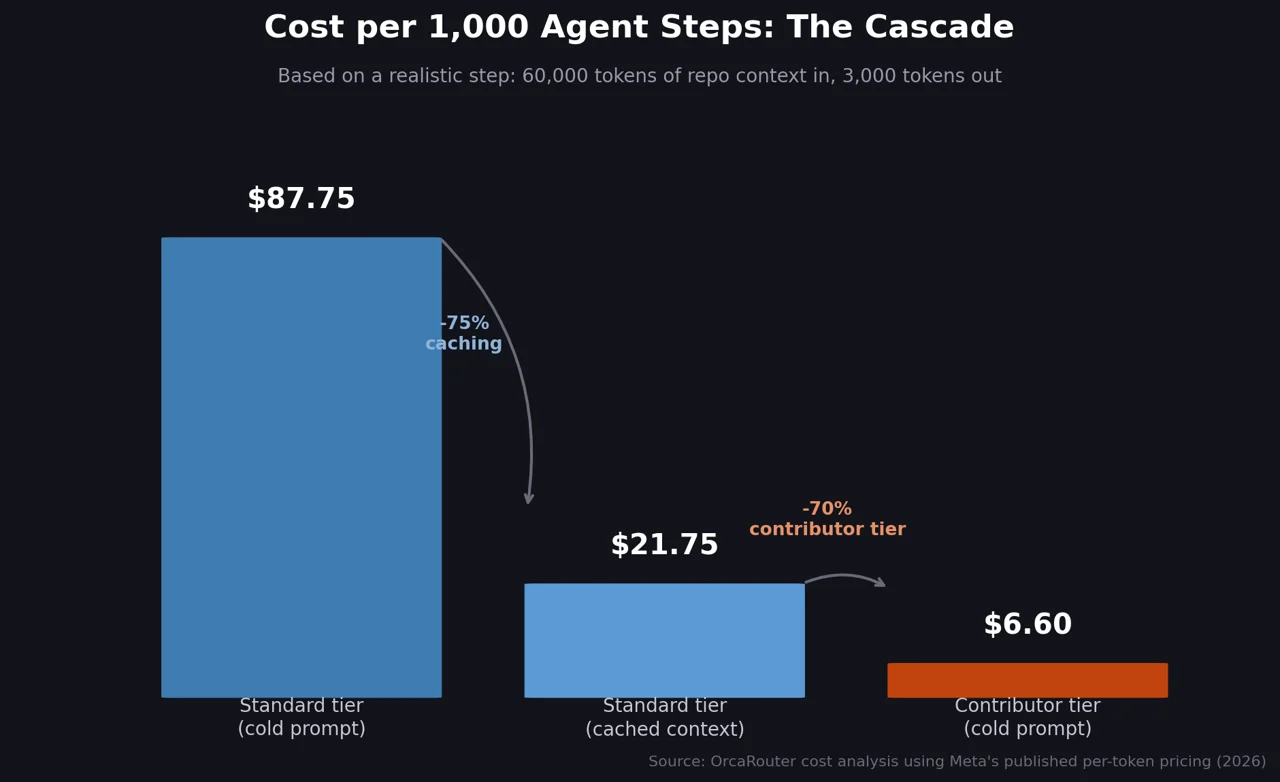
Run the math on a realistic agent step, 60,000 tokens of repository context in, 3,000 tokens of plan-and-patch output, and the gap becomes concrete rather than abstract: a cold prompt on the standard tier costs 8.8 cents per step, or $87.75 across a thousand steps. Once repository context hits the cache, that drops to $21.75 per thousand steps. On the contributor tier, the same cold-prompt step runs roughly $6.60 per thousand steps.
The Real Decision Isn't About Money
Here's the part worth sitting with: a terminal coding agent reads your entire codebase, that's its entire function. So the prompts flowing through the contributor tier contain your source, your internal APIs, your comments about why a workaround exists, and whatever test fixtures your repository happens to hold. For a side project or an open-source repository, that trade is close to free money. For anything with real intellectual property or client data inside it, it's a much harder call than the price difference alone suggests. Meta also states contributor access is rate-limited over a rolling five-hour window and only available in selected countries.
Why Meta Wants This Trade
This isn't just an aggressive introductory offer. Real-world, checkable coding data is scarce and more valuable than scraped or synthetic training data, precisely because code can be automatically validated in a way most text can't. Meta is applying the same playbook it's used for years with user-generated content on its consumer products, just aimed at developers this time.
The Benchmarks: Read Them Carefully
Where the Numbers Get Complicated
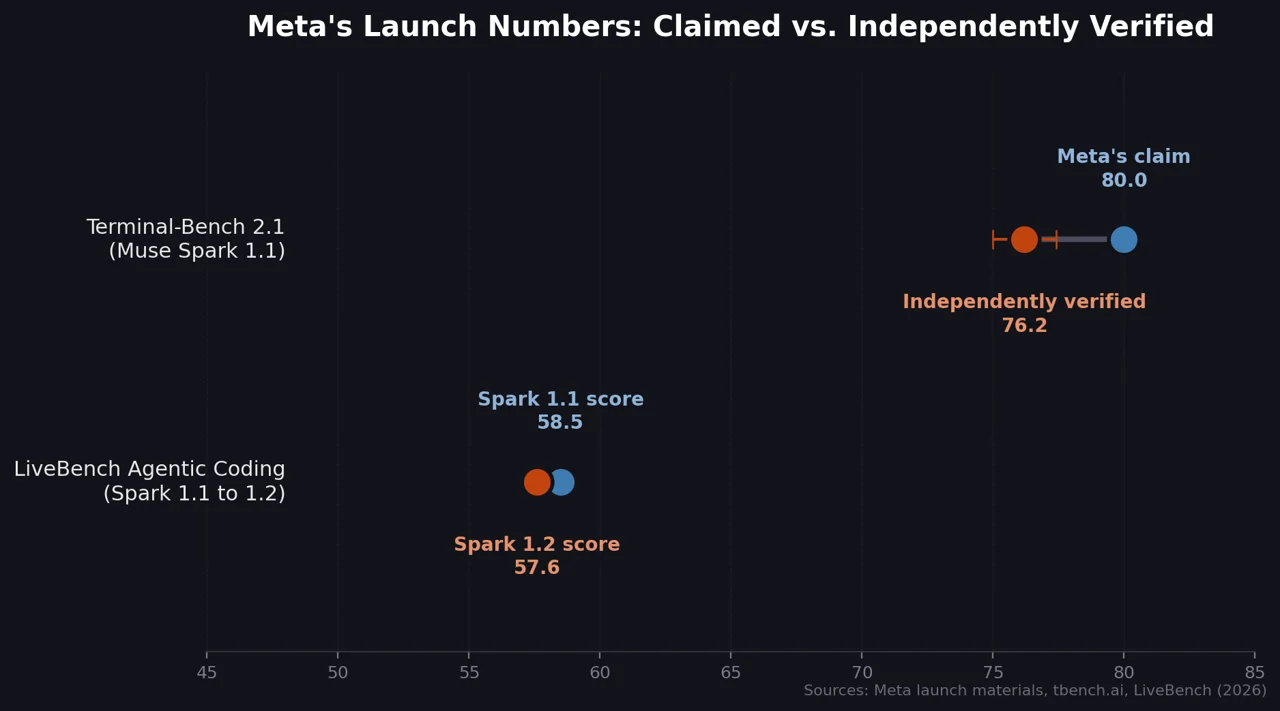
Meta claimed an 80.0% score on Terminal-Bench 2.1 for the prior Muse Spark 1.1 model. Independent verification from tbench.ai returned 76.2%, with a margin of error of ±1.2 points, meaning Meta's own claimed figure sits outside the upper bound of the independently verified range. That's not necessarily dishonesty, benchmark harnesses genuinely differ between vendors, but it's a real, measurable gap between what was claimed and what was reproduced.
A Score That Went Down, Not Up
More unusual: on LiveBench's agentic coding measure, Spark 1.2 actually scored slightly lower than its predecessor, 57.6 versus Spark 1.1's 58.5, in exactly the capability category Muse Code is being sold on. Meta did not headline a specific SWE-Bench score for Spark 1.2 in its own launch materials at all.
Where It Does Show Up Well
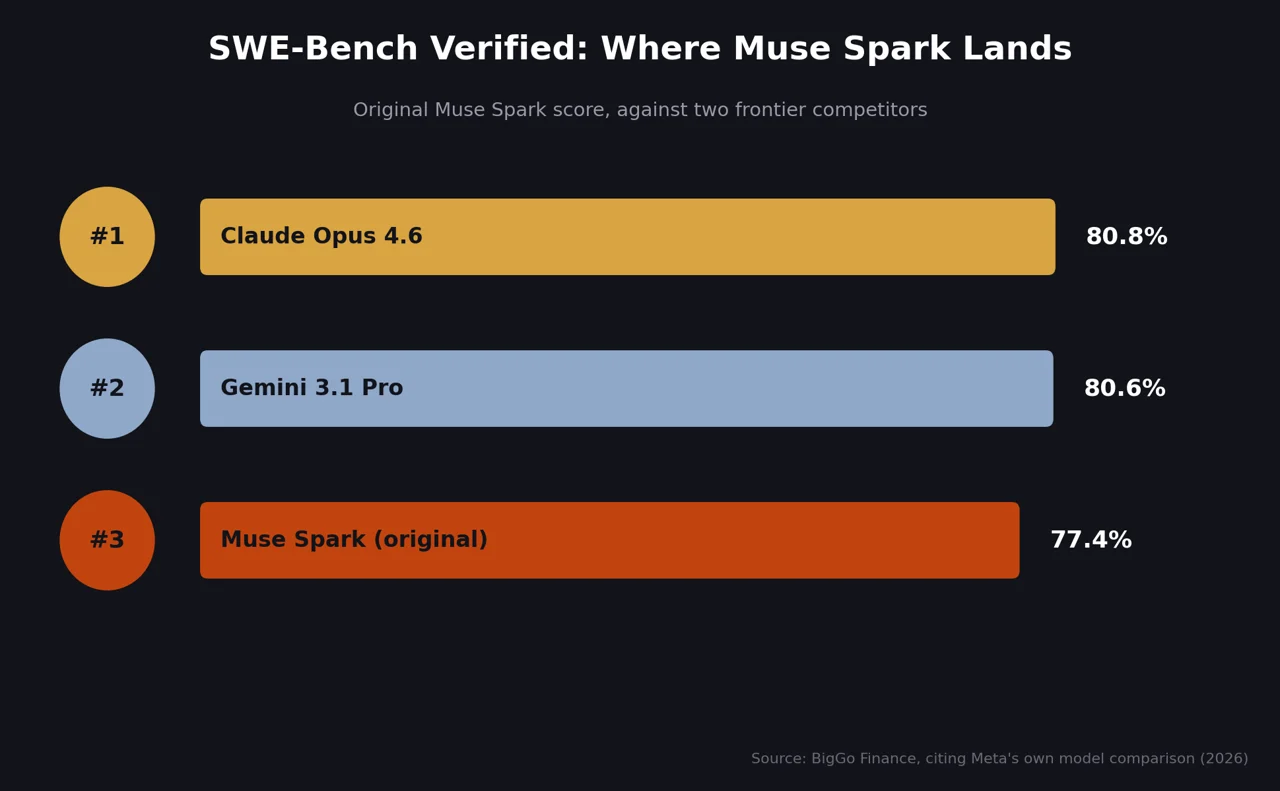
It's not all downside. Vals AI placed Muse Code 5th on its Vals Index at 71.88% as of August 12, with the lowest cost-per-test of any model in the top five, a genuinely strong result once price enters the picture. For context on the broader Muse Spark lineage, the original Muse Spark scored 77.4% on SWE-Bench Verified, against Claude Opus 4.6's 80.8% and Gemini 3.1 Pro's 80.6%, competitive, if not category-leading.
Who Should Actually Consider This
The Clear Fit
- High-volume, non-sensitive workloads. CI-adjacent code review, test generation, and routine refactors are exactly where the contributor tier's savings compound fastest
- Open-source projects and side projects, where the data-sharing trade-off carries little real risk
- Teams already using OpenRouter, since testing Muse Code alongside existing Claude- or GPT-based agents requires no new procurement step
Where to Stay Cautious
- Anything touching proprietary code, client data, or regulated information belongs on the standard tier at most, not the contributor tier
- Teams that need Windows support, which doesn't exist yet
- Anyone treating Meta's launch benchmarks as independently confirmed, given the gap between the claimed and verified Terminal-Bench score
How the Coverage Split
Wide Attention, Mixed Reception
TechCrunch, Reuters, CNBC, and Bloomberg all covered the launch the same week, a level of simultaneous major-outlet attention most coding-tool launches don't get. The tone of that coverage skewed more skeptical than celebratory once reporters got past the headline pricing.
What Independent Voices Actually Said
- One independent developer reference put it plainly: "Lower token pricing may attract developers, but cost is only part of the evaluation"
- Coverage repeatedly circled back to the same open questions: whether Spark 1.2 actually matches Claude- and GPT-class models on real repositories, whether developers trust Meta with their code, and whether the discount is steep enough to override that hesitation
Quick FAQ
Is Muse Code free? No. Both tiers are paid, per-token pricing. The contributor tier is heavily discounted, not free, and comes with a real data-use trade-off.
Can I use Muse Code on Windows? Not at launch. It's macOS and Linux only.
Does the standard tier use my code to train Meta's models? No. Meta states standard-tier prompts and completions are not used for training. Only the contributor tier carries that trade.
Is Muse Spark 1.2 actually better than Muse Spark 1.1? Mixed. It's untested on some major independent leaderboards, and on the one benchmark where a direct before-and-after figure exists, LiveBench's agentic coding score, it scored slightly lower than 1.1.
Common Mistakes to Avoid
- Assuming "contributor tier" is a free trial rather than a permanent data-sharing agreement
- Comparing Meta's launch-day benchmark claims directly to independently verified competitor scores without checking whether both were run on the same harness
- Putting proprietary or client codebases on the contributor tier for the discount alone
- Treating a single 24-hour autonomous-run demo as proof the plateau-and-drift problem is fully solved
The Honest Verdict
Muse Code's real innovation isn't the model underneath it, independent benchmarks suggest Spark 1.2 is competitive but not clearly ahead of Claude- or GPT-class coding agents. The real innovation is the pricing structure itself: a direct, explicit trade of cheaper tokens for training data, offered with unusual transparency about what's actually happening to your prompts. Early reaction from independent analysts has run more skeptical than celebratory, and Meta's bigger test now isn't benchmark scores, it's whether developers are willing to hand over their code for the discount.
Figures and quotes in this piece are drawn from Meta's own launch materials alongside independent reporting from Forbes, CNBC, eWeek, and independent benchmark trackers including tbench.ai, LiveBench, and Vals AI, current as of mid-August 2026. Muse Code remains in beta; pricing, availability, and country restrictions on the contributor tier may change. Confirm current terms directly with Meta's developer documentation before making a procurement decision.