In San Antonio, you can open the Waymo app and hail a car with nobody in the driver's seat. This month Tesla said its robotaxis would start rolling there too, which could turn Waymo vs Tesla into a real choice. Waymo sees with lidar (lasers that measure shape), radar, cameras and detailed maps, and already runs cars with nobody at the wheel across 10+ major cities. Tesla bets on cameras and AI: it has pulled safety monitors from its Austin robotaxis, but the driving software in customers' cars still needs a fully attentive driver.
Is Waymo better than Tesla? The short verdict
For a rider today, Waymo is ahead: it runs cars with nobody at the wheel in more places, and it publishes detailed safety data for those driverless miles. Here is the whole verdict in four lines.
How they see: Waymo combines lidar, radar, cameras and HD maps (very detailed street maps). Tesla relies on cameras and neural networks, a kind of AI that learns patterns from examples.
Where they drive alone: Waymo runs fully autonomous cars across 10+ major cities, and anyone in San Antonio, San Diego and Tampa can hail one. Tesla removed safety monitors from its Austin robotaxis, runs robotaxis in limited areas of Miami and Orlando, and lacks the permits for driverless ride-hailing in California.
The Tesla in your driveway: Full Self-Driving (Supervised), or FSD, is a driver assistance system. Tesla says it is meant only for a fully attentive driver and does not make the car autonomous.
Safety: Waymo reports crash data for cars with no driver. Tesla's headline number is for cars with a human supervising. Nobody can rank them head to head yet.
Is Waymo lidar or camera? It uses both, plus radar and a map
Waymo uses lidar and cameras, plus radar and a stored map, so each sense can cover for the others. Think of each sensor as a witness at a busy crossing. Waymo puts three very different witnesses on the case and checks their stories against each other.
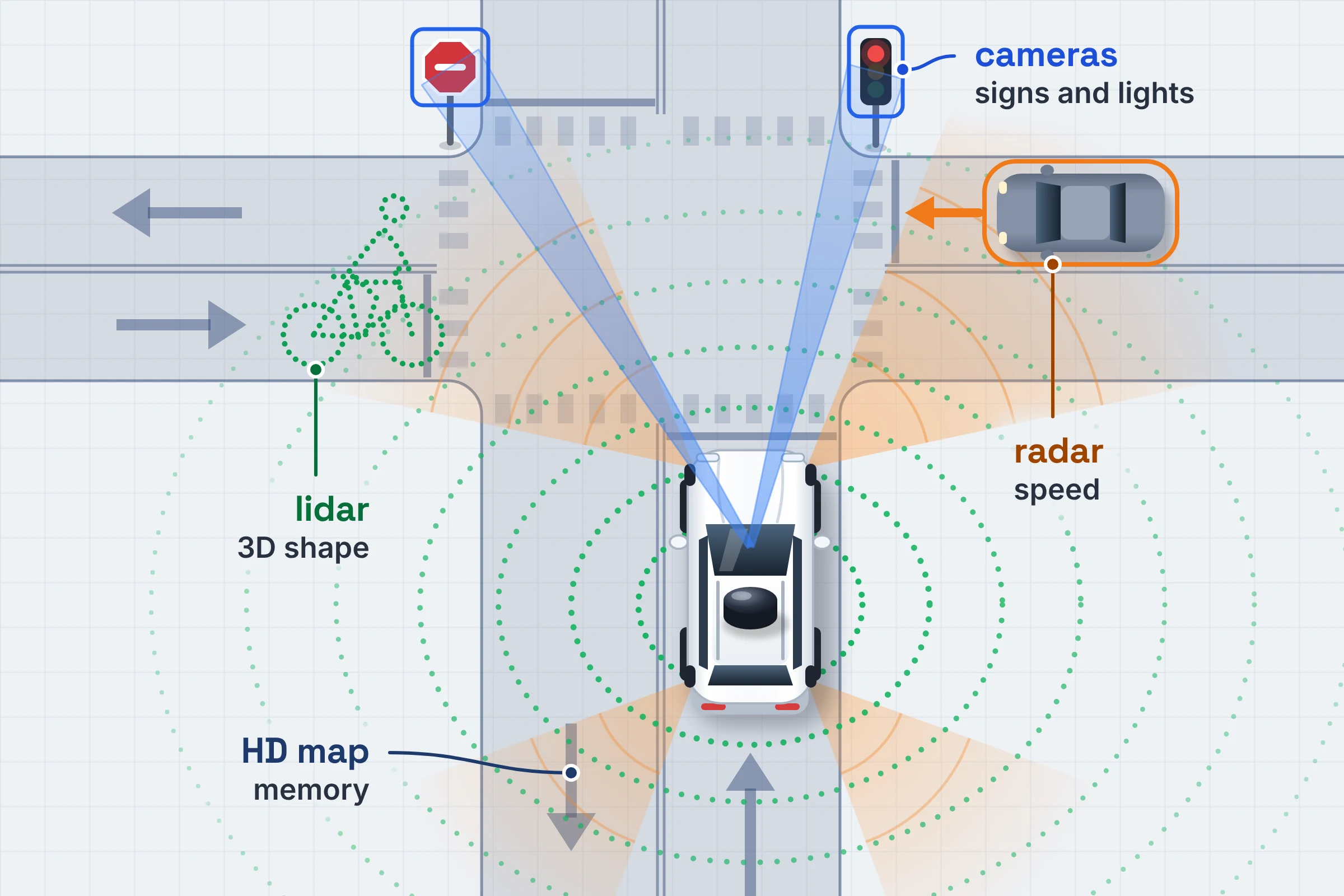
When Waymo unveiled the 6th-generation Waymo Driver (the sensors and software that do the driving), it listed 13 cameras, 4 lidar units and 6 radar units. It added outside microphones it calls external audio receivers. Waymo says together they give overlapping views all around the car, up to 500 meters (about a third of a mile) away, day and night.
Each witness has a specialty.
Lidar brings its own light. It uses laser beams to paint a 3D picture called a point cloud: a cloud of dots tracing the shape of everything nearby. Waymo says lidar captures that shape with millimeter precision.
Radar tracks speed. It follows how fast things are moving, and Waymo says it can pick things out through heavy rain, fog or dust that hide them from cameras.
Cameras do the reading. They read street signs and spot the color of traffic lights.
The witnesses back each other up. When a camera's view is limited, Waymo says its lidar and radar keep the car's sense of its surroundings working.
Then there's memory. Waymo uses HD maps (highly detailed maps of the streets it serves) and treats them as one more input, like a sensor that remembers. It says maps are especially helpful in poor visibility and on complicated roads, and they give its safety testing a head start.
The sensor feeds flow into one AI. Part of the Waymo Foundation Model blends camera, lidar and radar inputs over time.
Waymo's driving vision-language model (an AI that understands both pictures and words) was trained using Gemini. That lets it draw on Gemini's broad knowledge of the world. It's the same idea of one general brain that shows up in our explainer on how humanoid robots learn.
For you, the payoff is backup: if one witness is fooled, two others are still watching.
Is Tesla lidar or camera? Cameras and neural networks
Tesla's approach is built on cameras, with neural networks working out what the cameras see. In witness terms, Tesla has one kind of witness, eyes, but many of them and very well trained. Tesla's FSD support page says on-board cameras with 360-degree visibility check the car's blind spots.
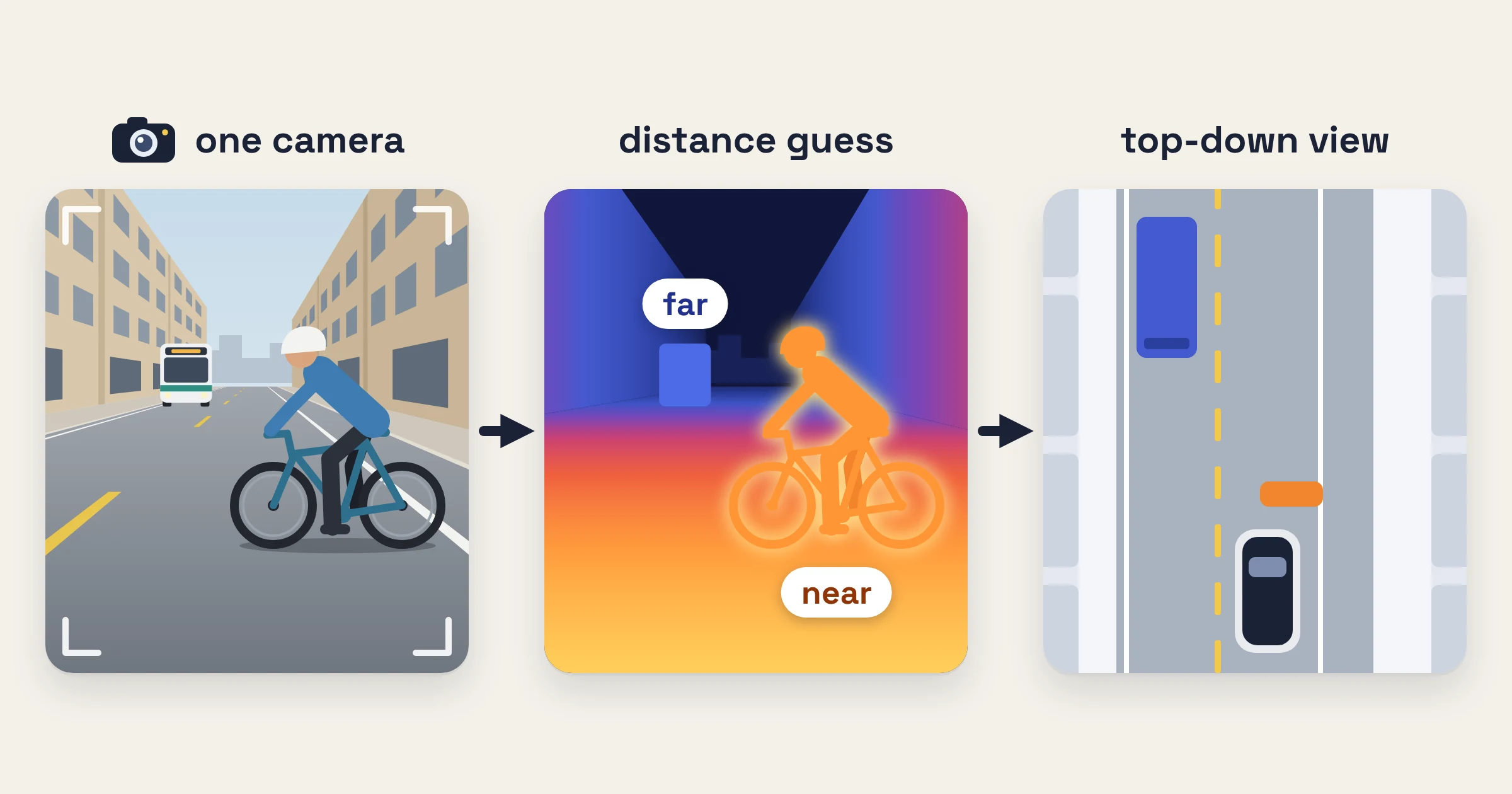
So how do flat pictures turn into distance? Tesla's AI page, which carries no date, says networks for each camera find objects and do monocular depth estimation, which means judging distance from a single camera. Try it yourself: close one eye, and you can still tell the bus is farther away than the bike.
Other networks take video from all the cameras at once. They draw the road layout, the things that don't move and the 3D objects around the car. The result is a top-down view, like a map seen from above.
Training all that is heavy lifting. Tesla says a full build involves 48 networks that take 70,000 GPU hours to train. A GPU is a chip built for AI math, and 70,000 hours is roughly eight years for one chip running nonstop.
Tesla didn't always lean on cameras alone. In 2021, IEEE Spectrum (an engineering magazine) reported that an FSD update dropped radar input and relied only on the car's cameras. The magazine noted that Elon Musk pointed to lidar's high cost and pushed a "pure vision" approach instead.
When Tesla began robotaxi rides in Austin, TechCrunch framed them as a test of whether self-driving cars could be safely deployed "using just cameras and end-to-end AI." Waymo describes pure end-to-end systems as ones where a model "takes in raw pixels and directly outputs steering commands." In plain words: the dots of a camera image go in, steering comes out, and one learned system sits in between.
If the bet works, the car needs nothing extra on the roof. If a camera gets fooled, though, there's no different kind of witness to catch it.
Lidar vs camera: round by round
Lidar vs camera comes down to one trade. Waymo pays for extra senses that back each other up, while Tesla saves on hardware and asks cameras and AI to do it all.
| Round | Waymo: lidar, radar, cameras | Tesla: cameras |
|---|---|---|
| Judging distance | Lidar measures 3D shape directly | Networks estimate distance from images; NODAR CEO Leaf Jiang told IEEE Spectrum that inferring distance is more open to mistakes in unclear scenes |
| Reading signs and lights | Cameras do this job | Cameras do this job |
| Rain, fog and dust | Radar sees through what blocks cameras, Waymo says | Relies on cameras, the sensor Waymo says these conditions can block |
| Cost | Lidar costs fell sharply across the industry over five years, and Waymo's 6th-generation system uses less than half as many cameras as the 5th | Cameras are "dirt cheap compared to lidar", Cornell's Kilian Weinberger told IEEE Spectrum |
| Backup if one sensor is fooled | Lidar and radar step in when cameras can't see well | Relying on one kind of sensor means less backup, IEEE Spectrum notes |
Waymo points out that people have argued for years over whether cameras alone could deliver full self-driving. After more than 200 million real-world miles, it says "the data is clear." Its verdict: "Cameras are incredible, but they aren't enough."
Part of Tesla's case, as IEEE Spectrum reported it, is cost. Cameras are cheap, and its networks estimate depth from pictures instead of measuring it.
IEEE Spectrum backs the witness idea. Citing ETH Zurich's Marc Pollefeys, it wrote that the chance of "three different sensors making the same mistake simultaneously" is vanishingly small.
Here's where the analogy breaks, though. All the witnesses report to the same driving AI, so a bad decision can still happen after every sensor got it right. Waymo adds a separate AI safety system that checks every path the car proposes against physics and traffic laws.
In one sentence: Waymo spends on hardware so its senses can back each other up, and Tesla saves on hardware and trusts its cameras and AI.
Where can you ride with nobody behind the wheel?
As of late November 2026, Waymo offers rides with nobody at the wheel to the public in several cities. For Tesla, Austin is the one city where TechCrunch reports the safety monitors are gone.
| Service and place | Anyone at the wheel? | What's known |
|---|---|---|
| Waymo: San Antonio, San Diego, Tampa | No | Fully autonomous rides open to anyone in the Waymo app since October |
| Waymo: San Francisco Bay Area | Rides paused, now resuming | Paused from Monday, November 23; Waymo says it is gradually resuming |
| Tesla: Austin | No safety monitor on board | Started with human safety operators on board, later removed them; more than 400 autonomous cars registered |
| Tesla: Miami and Orlando | Unclear | Robotaxis in limited areas |
| Tesla: San Antonio | Unclear | Tesla said rides would start at 5 a.m. on a Monday; it gave no other details |
| Tesla: San Francisco Bay Area | Yes, a human driver | No permit for driverless ride-hailing in California |
Two details the table can't show. TechCrunch reports that Tesla's fleets outside Austin have numbered between a handful and a few dozen cars. It also reports that Tesla's robotaxi network drove fewer miles with paying customers in the second quarter than in the first.
Waymo, meanwhile, said in late October it was scaling in five cities and adding nearly 250 square miles of territory. If an empty driver's seat is what you want, check the city, not just the brand.
What's safer, Waymo or Tesla? What the numbers can and can't say
Nobody can say yet which is safer, because the two companies publish numbers that measure different things.
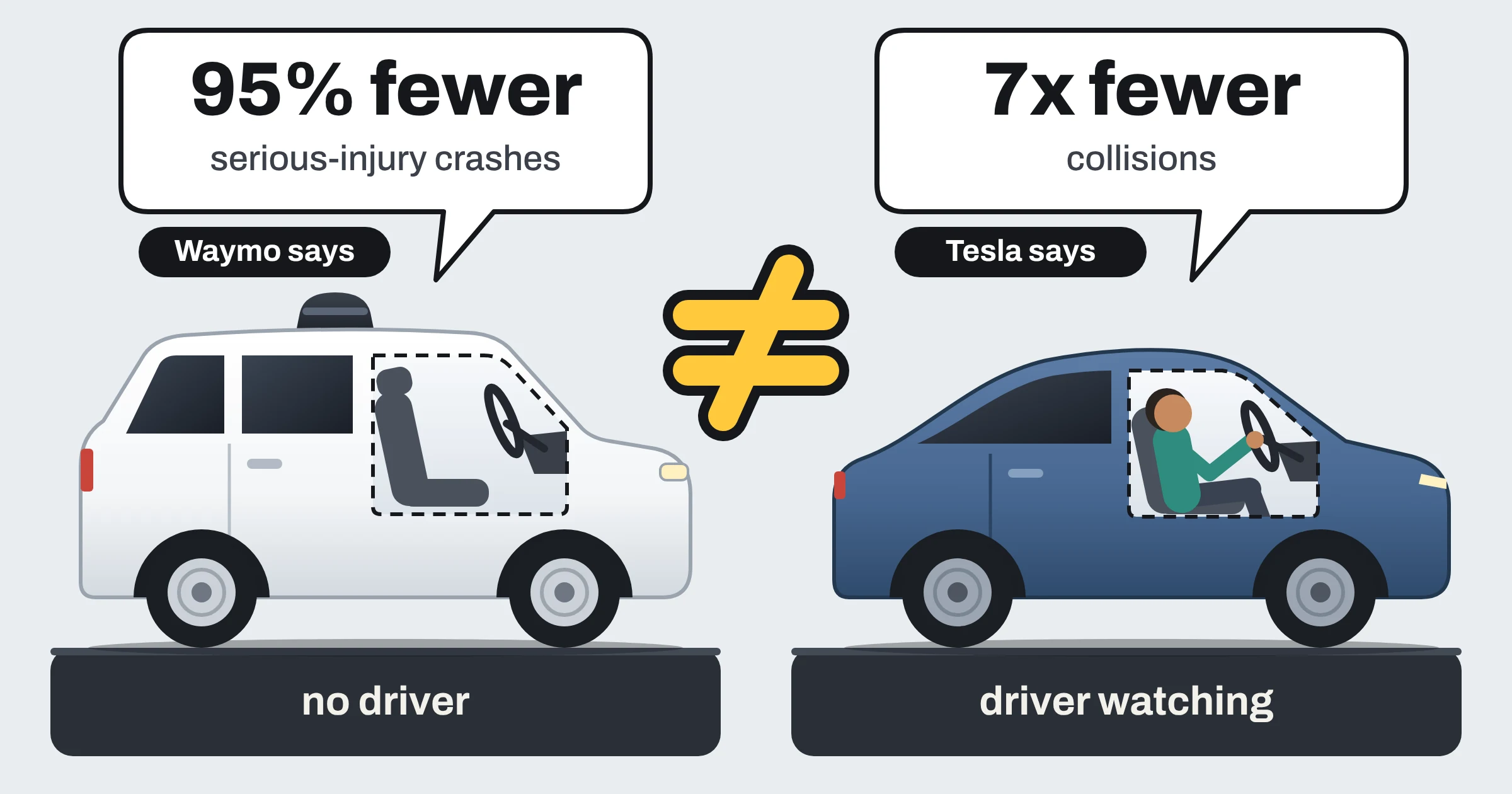
Waymo's Safety Impact page says that through June 2026 its cars had driven 271.3 million miles without a human driver. Compared with a human benchmark, Waymo reports 95% fewer crashes causing serious injury or worse. It also reports 82% fewer crashes that caused an injury (841 fewer) and 93% fewer pedestrian crashes with injuries (87 fewer).
The counts give those percentages scale. The 95% drop means 55 fewer serious crashes across all those miles.
Waymo lists the catches itself. Its human benchmark comes from state police crash reports and data on miles driven, and robotaxi data and human data define a crash differently. Waymo says there is no perfect apples-to-apples comparison between the two today.
Tesla's FSD page claims 7x fewer major and minor collisions and 5x fewer off-highway collisions. But that claim is for FSD (Supervised), which Tesla says is meant only for a fully attentive driver.
So Tesla's number describes a car and a watching human as a team, not a car alone. It can't be lined up against Waymo's driverless miles. The research behind this post found no matching Tesla figure for rides with nobody at the wheel.
It's the same trap as comparing AI energy use per prompt across vendors: each company measures in its own way. Back to our witnesses: every number here is a company testifying about itself.
Lidar vs camera in rain and fog: one night, two cars
In fog and rain, Waymo leans on radar and its map when cameras struggle. When weather turns truly bad, it slows down or stops giving rides.
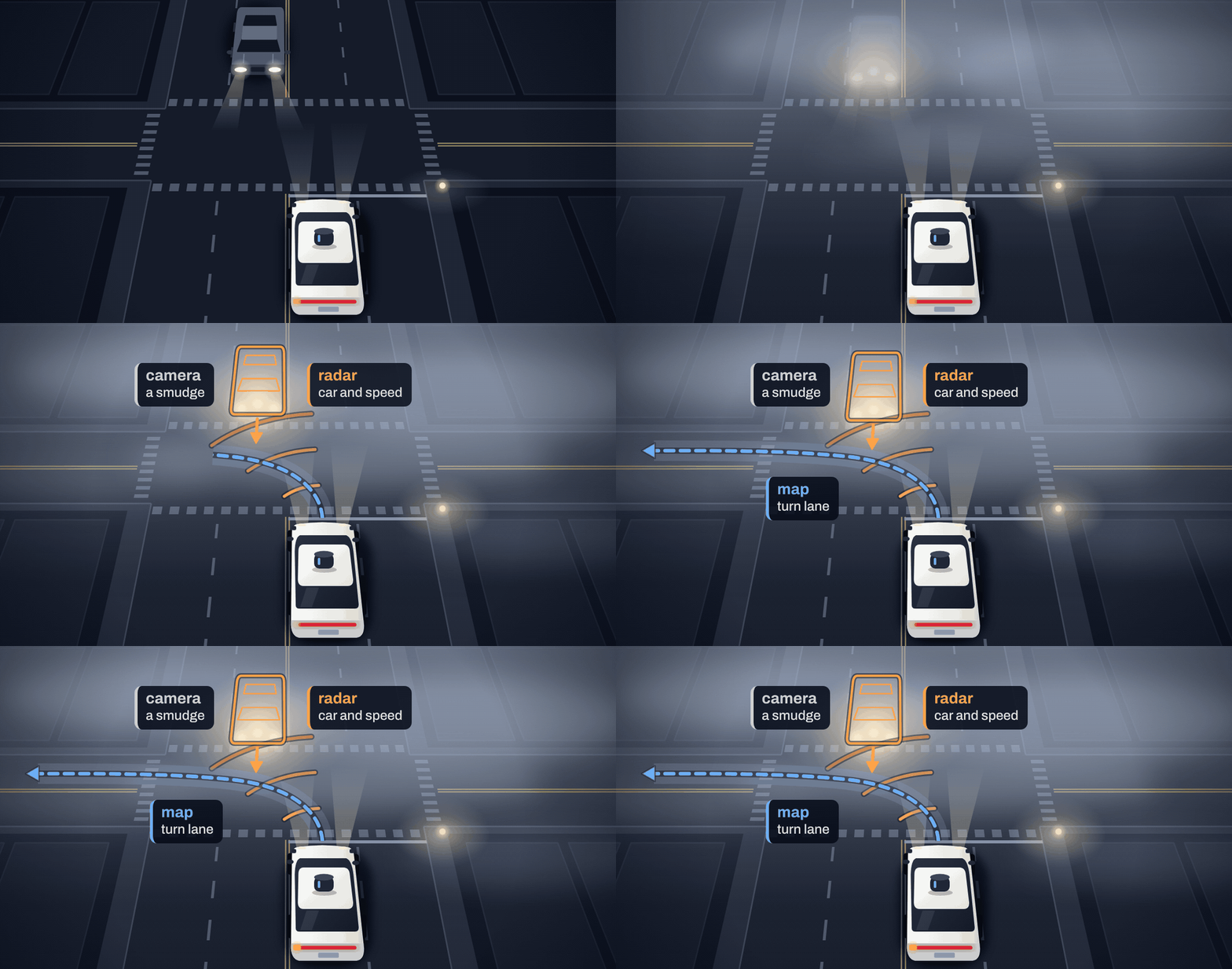
Picture this made-up scene. It's a foggy, drizzly night, and your robotaxi needs to turn left across oncoming traffic. The headlights of an approaching car are just a smudge in the mist.
In the Waymo, the cameras see that smudge. Radar can still follow the car and its speed, since Waymo says radar sees through fog and rain that hide things from cameras. Lidar and radar keep the car's picture of the road going.
The map remembers where the turn lane is, even if the paint is hard to spot.
In the Tesla, everything rides on the cameras. The networks have to judge how far away that smudge is from the images alone. As NODAR CEO Leaf Jiang told IEEE Spectrum, guessing distance is more open to mistakes in murky moments like this.
Tesla hasn't laid out a bad-weather plan in the sources behind this post, so this half stays a question mark.
Here's what Waymo actually does when weather turns. In its winter weather post, Waymo says it may slow down, limit service or pause rides altogether. Those pauses can last hours or even days.
Built-in heaters and tiny wipers keep its sensors clear in icy conditions. This season, it plans closed-course tests in Alaska and will gather heavy-snow data there.
So even three kinds of witness can't beat every storm. Sometimes the safest robotaxi is the one that stays parked.
Who should pick which
Pick by what you need today: a ride with nobody at the wheel, help with your own driving, or a race to follow.
- You live where Waymo runs and Tesla has announced rides, like San Antonio. Waymo's rides there are fully autonomous and open to anyone in its app. Tesla hasn't shared details of its San Antonio service, so check who's on board before you count it as driverless.
- You own a Tesla with FSD. You are still the driver. Tesla says the features on customer cars need active supervision and don't make the car autonomous, so stay ready to take over.
- You ride in California. Tesla doesn't have permits for driverless ride-hailing there, so its Bay Area cars come with a human behind the wheel.
- You're just following the race. Watch whether Tesla pulls safety monitors outside Austin, and whether it starts publishing crash data for rides with nobody at the wheel.
Waymo's lasers, radar, cameras and maps already carry riders with nobody at the wheel in several cities. Tesla's camera bet is cheaper on sensors and still being proven in a few cities, and its customer cars still need you watching.
Before you ride, check which service runs with nobody at the wheel in your city. And read every safety number as the company's own claim, with its own definitions.