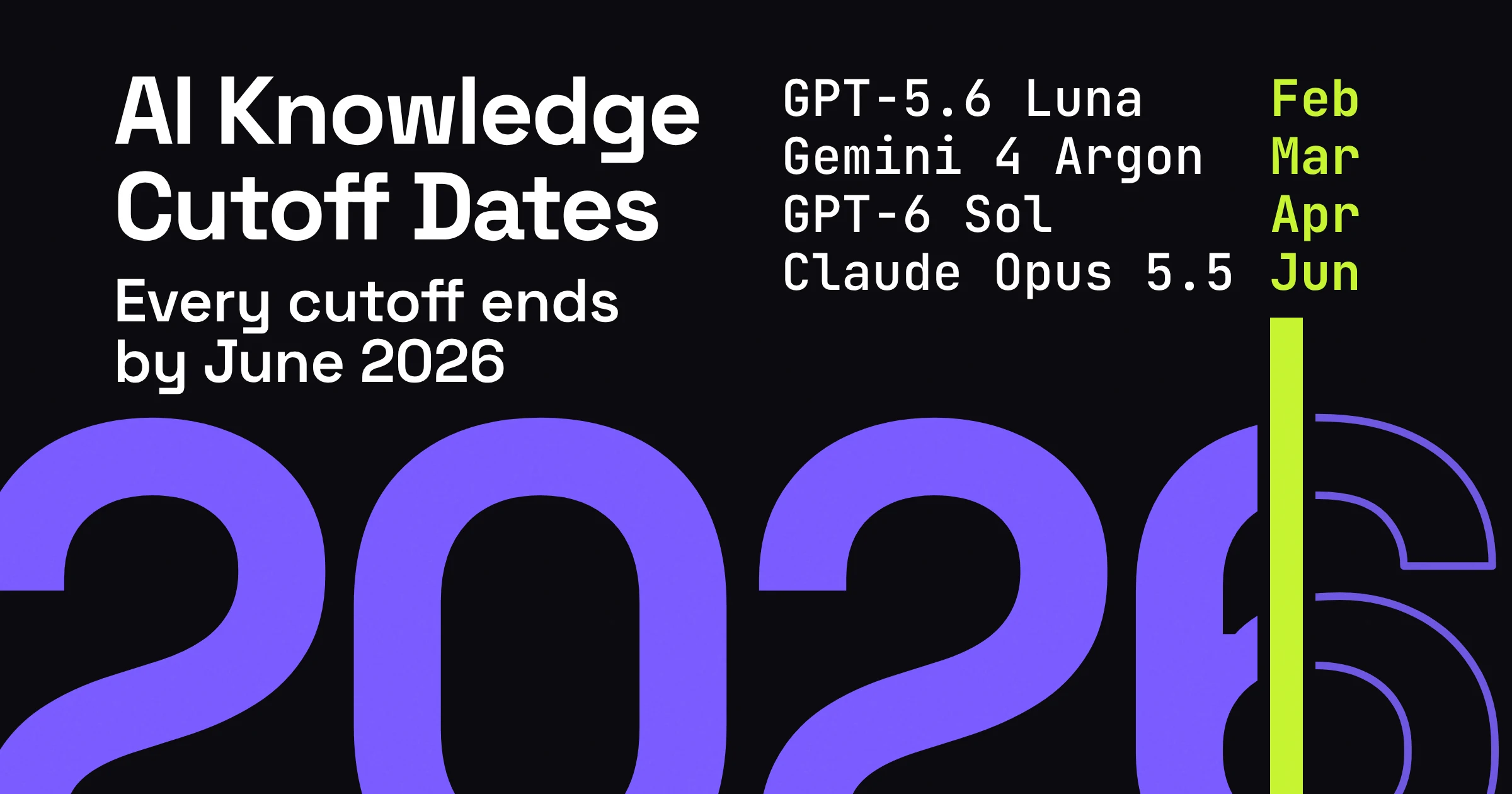
The knowledge cutoff date for ChatGPT, Claude and Gemini depends on which model answers you, not on the brand. As of November 2026, the vendors' own pages put the main models between February and June 2026:
- ChatGPT: it depends on your plan. GPT-5.6 Luna, the Free and Go default, has an API page listing Feb 16, 2026. GPT-6 Sol, which powers most GPT-6 settings for eligible Plus, Pro, Business and Enterprise users, lists Apr 20, 2026 on its API page.
- Claude: Anthropic says its four current models were trained on data up until June 2026.
- Gemini: Google gives March 2026 for Gemini 4 Argon and Gemini 3.8 Flash.
For anything newer than your model's date, switch on web search instead of trusting its memory.
What is the knowledge cutoff date for each ChatGPT, Claude and Gemini model?
As of November 2026, the latest published dates in this table fall in June 2026, for Claude's four current models and OpenAI's GPT-6.2 Sol. Every date comes from the vendor's own pages (model pages, help centers or Anthropic's Transparency Hub), not from asking the chatbot.
Start with the Where you'll meet it column. It matches each model to the app and plan you actually use.
| Model | Published cutoff | Where you'll meet it | Best for |
|---|---|---|---|
| GPT-5.6 Luna | Feb 16, 2026 (OpenAI API page) | ChatGPT Free and Go default; also powers Think | Free and Go plan chats |
| GPT-6 Sol | Apr 20, 2026 (OpenAI API page) | ChatGPT with GPT-6 selected: Instant, Medium, High and Extra High | Eligible Plus, Pro, Business and Enterprise users |
| GPT-6 Astra | Apr 30, 2026 (OpenAI API page) | Powers GPT-6 Pro in ChatGPT | The Pro setting in ChatGPT |
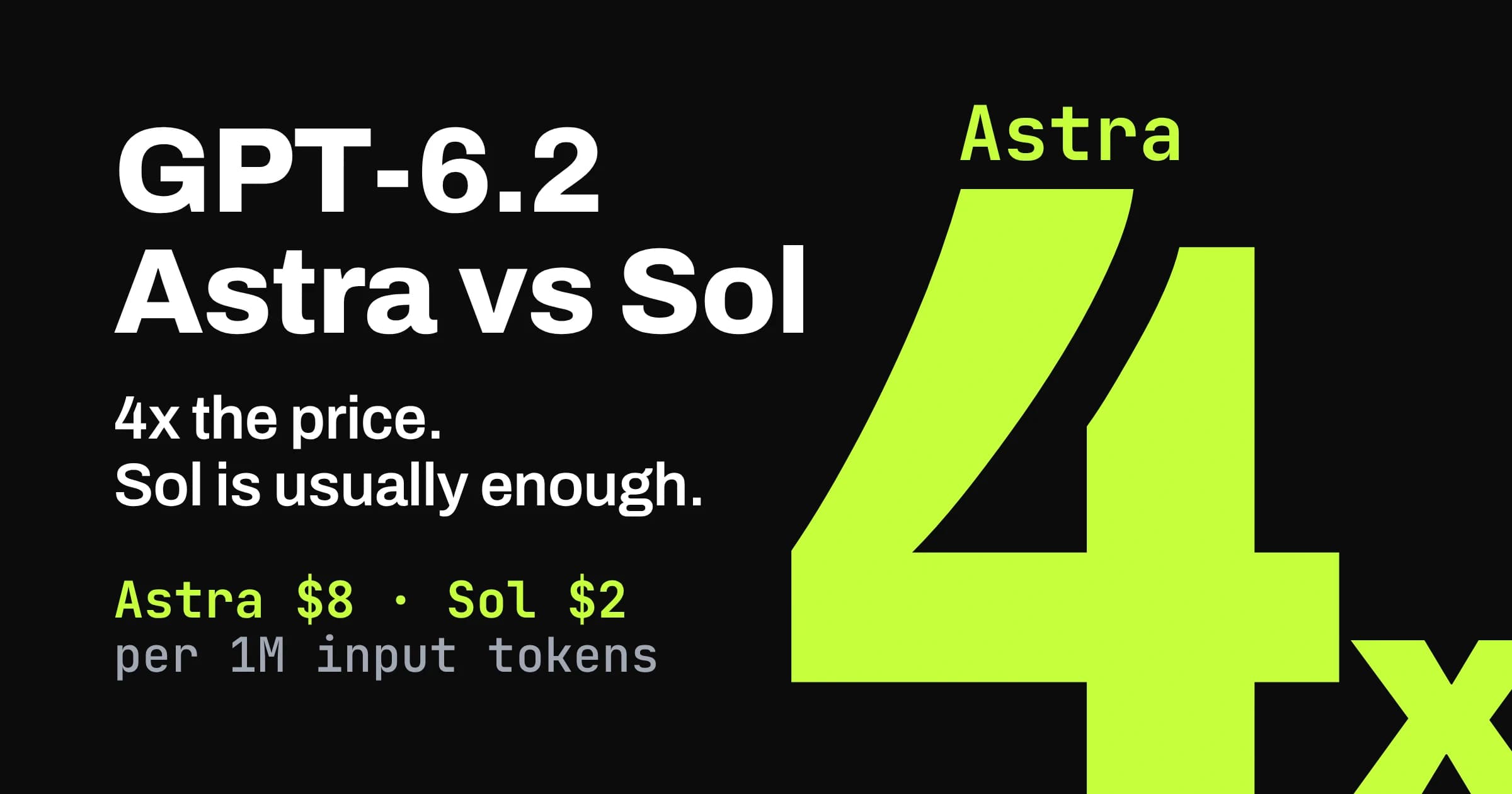
| GPT-6.2 Sol | Jun 01, 2026 (OpenAI API page) | OpenAI API; not on the ChatGPT help page | Everyday work and agents, per OpenAI |
| GPT-6.2 Astra | May 18, 2026 (OpenAI API page) | OpenAI API; not on the ChatGPT help page | Hardest projects, per OpenAI |
| Claude Opus 5.5 | Trained on data up until June 2026 | Anthropic's suggested starting model | Most workloads, per Anthropic |
| Claude Fable 5.2 | Trained on data up until June 2026 | Current Claude lineup | Demanding reasoning and long agentic work, per Anthropic |
| Claude Sonnet 5.5 and Claude Haiku 5.5 | Trained on data up until June 2026 | Current Claude lineup | Same date as Opus 5.5, so pick on other grounds |
| Claude Opus 5 | May 2026 (reliable knowledge and training data) | Older Claude model | Questions about events up to May 2026 |
| Claude Sonnet 4.6 | Reliable to May 2025; training data up until August 2025 | Older Claude model | Questions about events up to May 2025 |
| Gemini 4 Argon | March 2026; some domains less up to date (model card) | Gemini app for Google AI Pro and Ultra; Gemini API | Google AI Pro and Ultra subscribers |
| Gemini 3.8 Flash | March 2026; some domains only to January 2025 (model card) | Gemini API | Developers, with search turned on |
No date in the table goes past June 2026. So anything from July 2026 on is outside every model's published cutoff, and those questions need search.
What is a knowledge cutoff in AI?
A knowledge cutoff is the point where a model's training data ends, so the model knows little or nothing about what happened after it. Anthropic puts it plainly: its models "may not be aware of events or information that occurred after their respective cutoff dates."
Think of it like the print date on a travel guide. The museum hours are probably still right, but the guide has no clue about this week's train strike or the cafe that opened last month.
Each model has its own date. OpenAI says how much one of its API models knows about current events "depends on the specific model." So there is no single cutoff for ChatGPT, Claude or Gemini as a brand.
A cutoff is also not the memory feature that stores facts about you between chats. That is a separate setting, covered in our guide to deleting what ChatGPT, Claude and Gemini remember.
What is the knowledge cutoff date for ChatGPT?
As of November 2026, ChatGPT has no single published cutoff: OpenAI's help page names the models ChatGPT uses but lists no dates. The API pages for the models with the same names list Feb 16, 2026 for GPT-5.6 Luna, Apr 20, 2026 for GPT-6 Sol and Apr 30, 2026 for GPT-6 Astra.
Which one answers you depends on your plan, according to OpenAI's help page on GPT-6 in ChatGPT:
- Free and Go: the default is GPT-5.6 Luna, which also powers Think.
- Plus, Pro, Business and Enterprise: GPT-6 is rolling out as the default for eligible users. With GPT-6 selected, GPT-6 Sol powers Instant, Medium, High and Extra High.
- The Pro setting: uses GPT-6 Pro, which is powered by GPT-6 Astra.
So a Free user asking about something announced in March 2026 is asking a model whose API page stops at Feb 16, 2026. Treat that answer as a guess and switch on search.
Two traps catch people reading OpenAI's dates:
- Newer doesn't mean it's in ChatGPT. OpenAI's API also lists GPT-6.2 Sol with a Jun 01, 2026 cutoff and GPT-6.2 Astra with May 18, 2026, but the ChatGPT help page doesn't say either one runs in ChatGPT.
- More capable isn't newer. OpenAI calls GPT-6.2 Astra "Our most capable model for your hardest projects," yet its cutoff is earlier than the everyday GPT-6.2 Sol. In the GPT-6 pair it flips: GPT-6 Astra's date is ten days later than GPT-6 Sol's. Check the row, not the model's reputation.
One gap remains. OpenAI's model pages show no release dates, so you can't tell from them how stale a model's knowledge was on the day it arrived.
Does Claude have a knowledge cutoff?
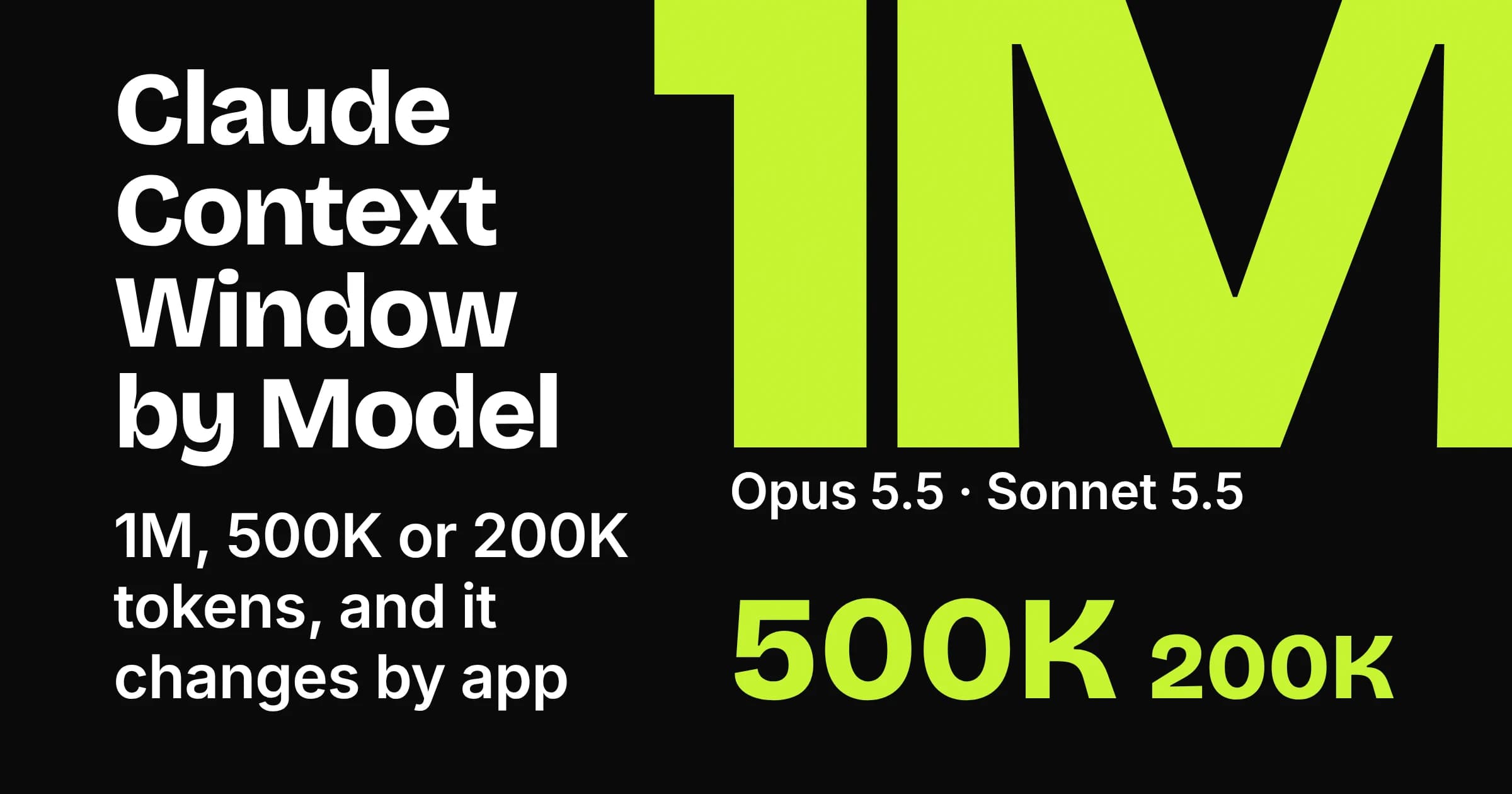
Yes. As of November 2026, Anthropic's help center says Claude Opus 5.5, Claude Sonnet 5.5, Claude Haiku 5.5 and Claude Fable 5.2 were each trained on data up until June 2026. It gives May 2026 for the older Claude Opus 5.
Anthropic's models overview suggests starting with Claude Opus 5.5 for most workloads and Claude Fable 5.2 for demanding reasoning and long agentic work. Both share the same June 2026 date in Anthropic's help article on Claude's training data, so the cutoff won't help you choose between them.
Older models trail behind: the same article says Claude Sonnet 4.6 was trained on data up until August 2025. Anthropic also warns: "If you ask about more recent events, the model may not have accurate information." Asking Claude Sonnet 4.6 about this year's phone launches is like asking last year's catalogue.
What does the knowledge cutoff mean for Claude?
For Claude, a knowledge cutoff can mean two dates: the reliable knowledge cutoff, up to which its knowledge is most complete, and the training data cutoff, the latest data it learned from. As of November 2026 the two differ for some models, such as Claude Sonnet 4.6.
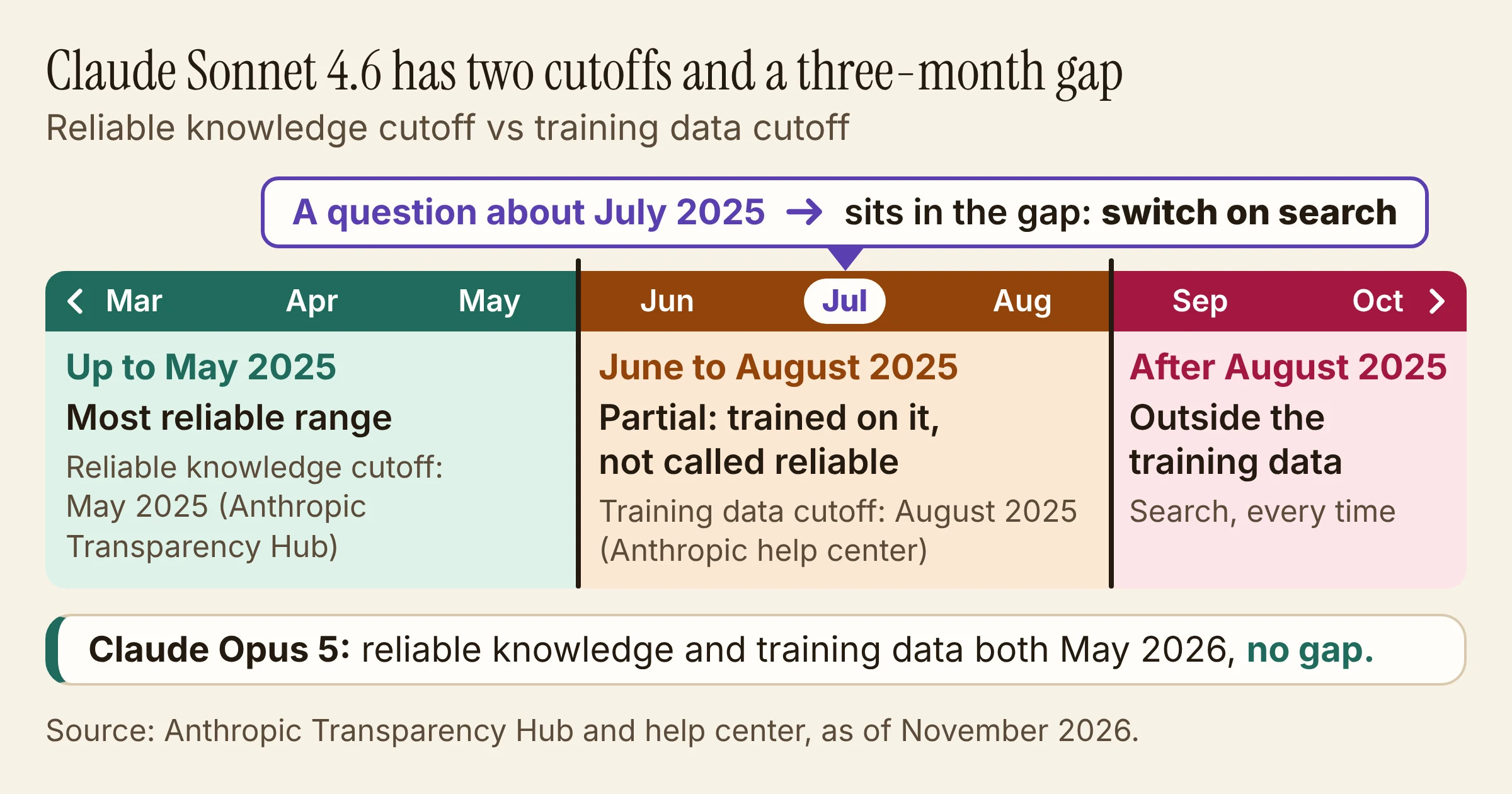
Anthropic's models overview sends you to the Transparency Hub for both dates. Here is the gap for Claude Sonnet 4.6, month by month:
- Up to May 2025: Anthropic's Transparency Hub says the model's knowledge is "most extensive and reliable on information and events up to May 2025." This is its most reliable range.
- June to August 2025: the help center says the model was still trained on data from this stretch, but Anthropic doesn't call it reliable. Treat answers about these three months as partial.
- After August 2025: outside the training data entirely. Search, every time.
For Claude Opus 5 the two dates match: May 2026 on both pages. For the four current models, the help center gives June 2026 as the training data date. As of November 2026, the Transparency Hub has no separate cutoff sentence for them.
The rule: when a vendor gives you two dates, plan around the earlier one. On Claude Sonnet 4.6, a question about July 2025 sits in the gap, so switch on search.
What is the knowledge cutoff date for Gemini?
As of November 2026, Google's DeepMind model cards put the knowledge cutoff for both Gemini 4 Argon and Gemini 3.8 Flash at March 2026, with a catch. Google says knowledge in some subject areas may be less up to date, and for Gemini 3.8 Flash some only reach January 2025.
Look in the model cards, not the Gemini API models page. That page lists no cutoff at all, so don't read any date on it as one.
The fine print differs by model:
- Gemini 4 Argon: the Gemini 4 Argon model card gives March 2026, but adds that "in some domains the model's knowledge may be less up to date."
- Gemini 3.8 Flash: its card also gives March 2026, but says users in some domains "may experience the model's knowledge is limited to January 2025." Google doesn't name those domains, so you can't tell in advance which questions hit the older date.
Who gets which model is only partly clear. Google says Google AI Pro and Ultra subscribers can access Gemini 4 Argon in the Gemini app. Its post doesn't say which model free users get or whether Argon is the default.
Cutoffs can also be months older than a model card's publication date. Google published the Gemini 4 Argon card on 13 October 2026, about seven months after its March 2026 cutoff. The Gemini 3.8 Flash card went up on 2 September 2026 with the same March cutoff.
Can you just ask the chatbot for its cutoff date?
Asking a chatbot for its own cutoff date is not a reliable check: as of November 2026, threads on OpenAI's community forum and the Cursor forum report models naming older dates than their vendors list. None of the official pages behind this guide explains why, so the vendor's page is the reference, not the chatbot's answer.
Putting What's your knowledge cutoff date? to a model is a bit like asking a novel's narrator what year the book was printed. Check the copyright page instead.
Here is where each vendor keeps its copyright page:
- OpenAI: the model's API page. OpenAI says its models overview page lists the cutoff for each model, and the GPT-5.6 Luna page gives Feb 16, 2026 even if the chatbot tells you something older.
- Anthropic: the help center article on Claude's training data, plus the Transparency Hub for reliable knowledge dates.
- Google: the DeepMind model card for the specific model.
Wondering about Microsoft Copilot? Its dates weren't part of the research for this guide, and guessing would defeat the point, so it isn't in the table. The same method applies: look for Microsoft's own published date, if it gives one, rather than asking the assistant.
When should you turn on web search instead?
Turn on web search whenever your answer depends on something after the model's published cutoff, or after the earlier of two dates for Claude. As of November 2026, Anthropic says Claude can search the web with citations, OpenAI's launch post describes the same for ChatGPT, and Google offers Grounding with Google Search for Gemini through its API.
Use this quick sort before you hit enter:
| Your question needs | Everyday example | Do this |
|---|---|---|
| Skills that don't change | Rewrite an email so it sounds friendlier | Memory is fine |
| Background well before the cutoff | Explain what a balance sheet shows | Memory is fine |
| Anything after the cutoff | Summarise this month's product launch | Search |
| Prices, plans, limits or version numbers | What a subscription costs today | Search, because these change often |
| The gap between two Claude dates | An event from July 2025 on Claude Sonnet 4.6 | Search |
| Anything after January 2025 on Gemini 3.8 Flash | A rule that may have changed since January 2025 | Search |
How each assistant handles search, according to its vendor:
| Assistant | How search starts | How you check sources | Best for |
|---|---|---|---|
| ChatGPT | Chooses to search based on what you ask, or you click the web search icon (OpenAI's launch post) | Sources button below the response | Letting the app decide when to look things up |
| Claude | Searches when it helps in the new Claude experience, with no toggle; Team and Enterprise need an Owner to enable it first | Citations in every search response | Checking each claim against its citation |
| Gemini API | Developers turn on Grounding with Google Search | Cited sources in the answer | Developers building current answers into their own apps |
The fine print:
- ChatGPT: OpenAI's launch post describes ChatGPT search as giving "fast, timely answers with links to relevant web sources," with the references listed in a sidebar.
- Claude: on Team or Enterprise plans, an Owner or Primary Owner must first enable web search for the workspace in Organization settings, then Capabilities. Anthropic notes that web search and web fetch count toward your usage limits.
- Gemini: Google says grounding lets Gemini "cite verifiable sources beyond its knowledge cutoff." For developers on Gemini 3 and newer, it includes 5,000 free search requests per month, shared across those models, then costs $14 per 1,000 search requests. The pages behind this guide don't cover how search works in the consumer Gemini app.
- Your own documents: OpenAI says developers can add to what its API models know with retrieval augmented generation (RAG), which means letting the AI look things up in your own documents first. A shop could feed in this month's price list instead of hoping the model remembers it.
For questions that need many sources at once, see how deep research compares across ChatGPT, Gemini, Perplexity and Claude.
Do this next: a three-step cutoff check
Before you act on an answer about anything recent, run this check. It takes about as long as the kettle does to boil.
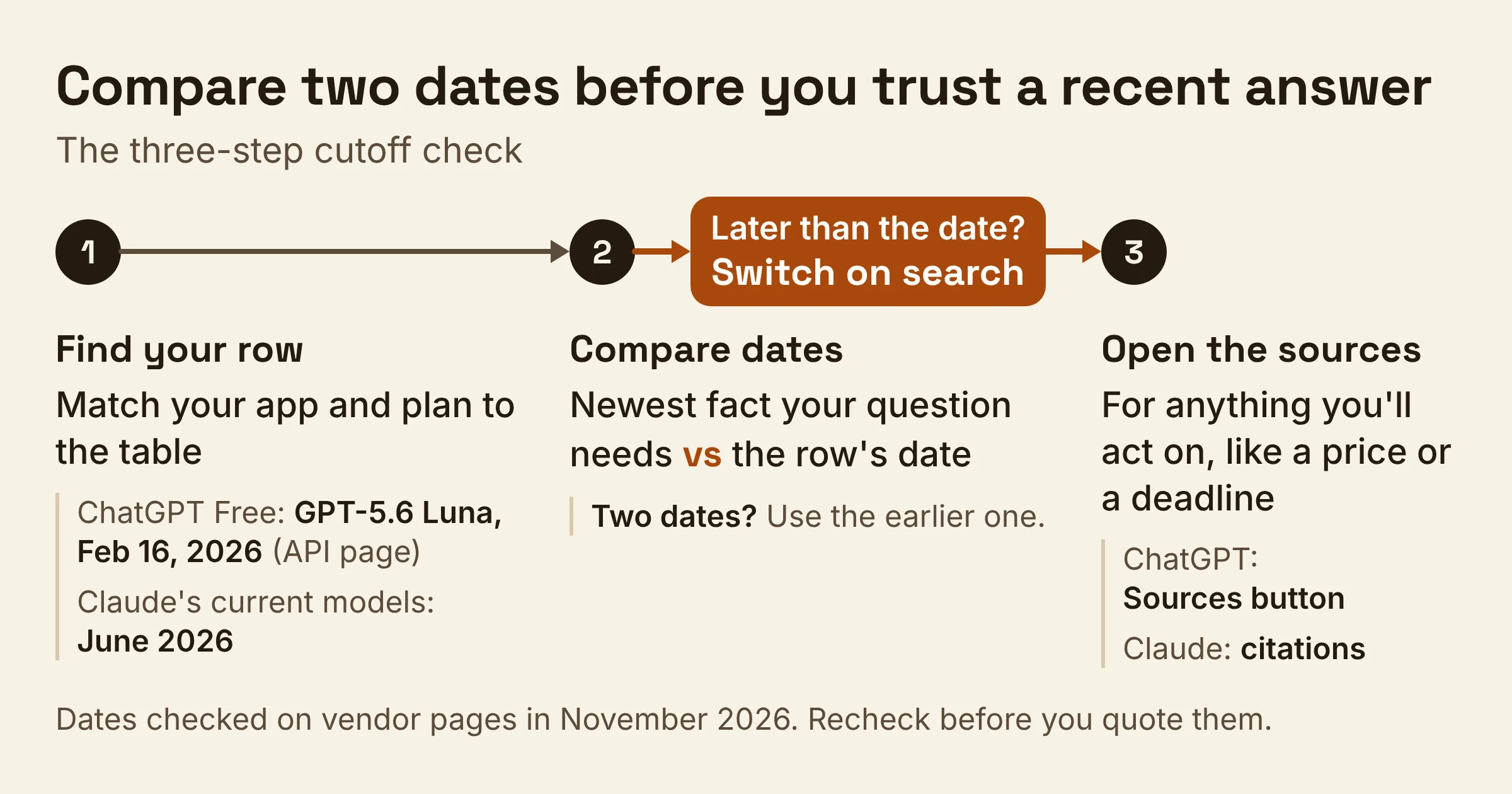
- Find your row. Match your app and plan to the table at the top. On ChatGPT Free that's GPT-5.6 Luna, whose API page lists Feb 16, 2026; on Claude's current models it's June 2026.
- Compare dates. Name the newest fact your question depends on. If it's later than the row's date (or the earlier date, when there are two), switch on search.
- Open the sources. Click ChatGPT's Sources button or Claude's citations for anything you'll act on, like a price or a deadline.
Cutoff dates, plan details and Google's grounding price were checked on the vendors' own pages in November 2026. They change often, so recheck before you quote them.