StepFun's Step 5 Preview is a genuinely cheap, genuinely capable agentic coding model - but as of today it is a rental with a promise attached. Artificial Analysis, the independent LLM benchmarking service, measures it at an Intelligence Index of 44, rank #26 of 202 models, at $1.00 per million input tokens and $2.70 per million output tokens. That mix of mid-tier capability and rock-bottom price is real and independently verified, which is more than you can say for most of what circulated during launch week.
Because the launch coverage glossed over four things. The headline coding benchmarks are self-reported, run on StepFun's own harnesses. The October 15 "open weights" promise names no license. The official Hugging Face repo is unavailable (removed or gated). And the maximum output is 64k tokens, not the 1M number the headlines ran with.
The context matters too: StepFun, the Shanghai AI lab behind the Step model series, launched this into the middle of a Chinese open-weight price war, where Xiaomi's MiMo-V2.6-Pro already undercuts Step 5 on both price and measured intelligence - more on that below.
So split your decisions in two. The pilot decision is today, and it rests on price plus the verified Artificial Analysis rank. The deployability decision is October 15, when we find out whether the weights actually land and under what license.
In short:
- $1.00/M input, $2.70/M output, $0.05 cached input (a 95% cache discount) - vendor-confirmed platform docs.
- Independent score: Artificial Analysis Intelligence Index 44, #26 of 202 overall; ties Kimi K3 at #3 among open-weight-class models - but it is API-only while those rivals are downloadable today.
- The headline coding numbers (DeepSWE v1.1 67.7%, StepCodeBench 49.0) are vendor-reported, measured on StepFun's own harnesses.
- The "1/8 of Claude Opus 5's per-task cost" claim is vendor-reported with an undisclosed methodology; straightforward token-price math gives about 5.9x, not 8x.
- The API and StepFun AI Studio work today; weights are promised October 15 in BF16 with no license named - and the official Hugging Face repo is unavailable (removed or gated) as of September 22.
All pricing in this post is StepFun's published vendor pricing as of September 22, 2026, subject to change - and "Preview" pricing may not survive the preview phase.
What actually shipped on September 20
What shipped on day one - and what is still just a promise?
Confirmed and shipping right now, per the StepFun announcement and platform docs: the step-5-preview API and StepFun AI Studio access were both live from day one. The model takes text and image input (up to 60 images per request) plus video input, and it supports tool calling, structured output and streaming. Reasoning effort is selectable per request - low, medium or high - which matters for cost control on an output-priced API. There is also a documented Claude Code integration ("Configure Step Plan and enable 1M context"), so teams already running agentic coding workflows can wire it in without leaving their toolchain. On the input side it is genuinely multimodal: JPG, PNG, WebP and static GIF images, plus MP4, QuickTime and Matroska video under 128MB with five minutes recommended as the practical limit.
The spec nuance almost nobody covered: the 1M-token window is maximum input, while maximum output is 64k tokens, per the "At a glance" table in the docs. That is not a defect, but it changes the math for long-form code generation jobs that expect huge completions in one shot.
Everything else is promise-only for now. The 600B total / 27B active sparse mixture-of-experts (MoE) architecture is a vendor figure; the config cannot be independently checked until weights exist. Open weights are promised for October 15 in BF16 - with no license named. And the official stepfun-ai/Step-5-Preview-BF16 Hugging Face repo is unavailable (removed or gated) as of September 22; it was a placeholder at launch, and the stepfun-ai org has published nothing new since Step-3.7-Flash-GGUF in May. A third-party 1.21TB shard repo with the same model name exists, tagged license:other with unproven provenance - do not treat it as official weights. For what it is worth, the Wall Street Journal has reported StepFun is preparing a Hong Kong IPO of roughly $500M at up to a $12B valuation; that is press-reported, not company-confirmed. StepFun's Step-3.5 and Step-3.7-Flash were both Apache-2.0, which is a reasonable basis for license expectations - but Step 5's license remains unresolved.
Verified vs vendor-reported: which numbers you can trust
Which benchmark numbers are independent, and which are StepFun grading its own homework?
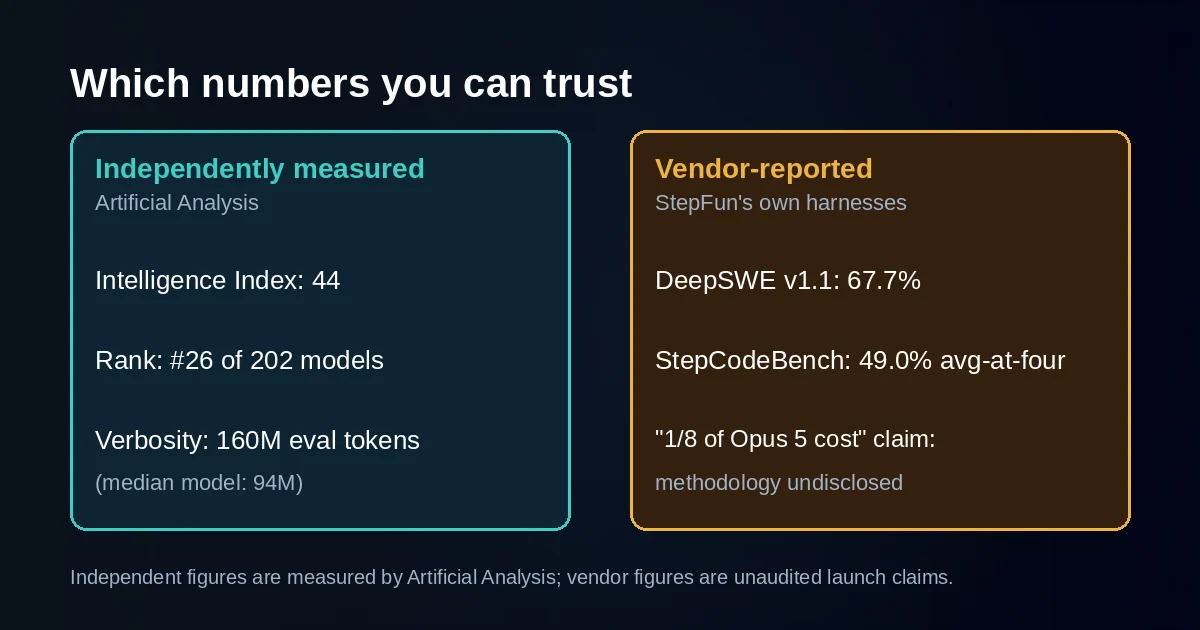
Only one measurement of this model is genuinely independent: Artificial Analysis, on its v4.3.2 index, puts Step 5 Preview at Intelligence Index 44 - rank #26 of 202 models overall, accepting text and image input and returning text output, classed as a reasoning model. AA also measured something the announcement did not mention: the model is very verbose, generating 160M tokens during evaluation against a 94M median across models. On an API you pay per output token, verbosity is a direct cost multiplier, not trivia.
Sort every number you have seen about this launch into three buckets:
- Independently measured (AA): Intelligence Index 44, rank #26 of 202, and the 160M-token verbosity figure. AA's page dates the model to September 18 - a test-tag leak two days before the September 20 announcement.
- Vendor-reported (StepFun's own harnesses): DeepSWE v1.1 67.7%, StepCodeBench 49.0% average-at-four, GPQA Diamond 93.5%, Terminal-Bench v2.1 85.0%, and BrowseComp 88.7%. None of these has independent confirmation yet.
- Unresolved: the "1/8 of Claude Opus 5's per-task cost" claim - methodology undisclosed, including task count, difficulty mix and the prices used.
One honesty gap worth noting: StepFun's announcement cites Terminal-Bench v2.1 at 85.0%, while the independently derived Terminal-Bench 4.0 figure reported from AA data is 33.3%. Different benchmark versions, but the version gap is part of the story - the numbers you can check are more modest than the numbers in the announcement.
The real cost math: $1/M tokens, cache hits, and that 1/8 claim
What does it actually cost for a coding-agent workload - and is "1/8 of Opus 5" real?
Run the token prices against the published pricing table and the 1/8 claim does not reproduce. Take a workload of 1M input tokens plus 0.1M output tokens, cache miss: Step 5 Preview costs $1.00 + $0.27 = $1.27. The same workload on Claude Opus 5 costs $5.00 + $2.50 = $7.50. That is about 5.9x, not 8x. StepFun may be factoring verbosity differences on specific tasks, but with the methodology undisclosed - task count, difficulty mix, prices all unspecified - treat 1/8 as a marketing number, not a fact.
For agentic coding loops, the real story is the cache. Prompt caching is priced at $0.05 per M cached input tokens - a 95% discount. An agent that re-reads a 1M-token repository ten times pays $1.00 for the first read plus 9 x $0.05 = $1.45 in input, versus $10.00 uncached. That cache pricing is what makes long agent loops genuinely cheap on this API.
Two friction points the launch coverage skipped. First, the verbosity tax: at $2.70/M output, AA's 160M-token verbosity inflates real per-task spend compared with a terser model at the same index - a model that writes 70% more tokens than the median eats much of its own price advantage. Second, rate limits: the free V0 tier allows 5 concurrent requests at 10 requests per minute; reaching 10,000 concurrent requires a $1,500 cumulative top-up, with tiers scaling in between. All pricing here is vendor-confirmed docs, not independent verification.
Where Step 5 Preview sits in the open-weight price war
How does it compare with MiMo-V2.6, GLM-5.3, Kimi K3, Opus 5, and GPT-6 Astra?
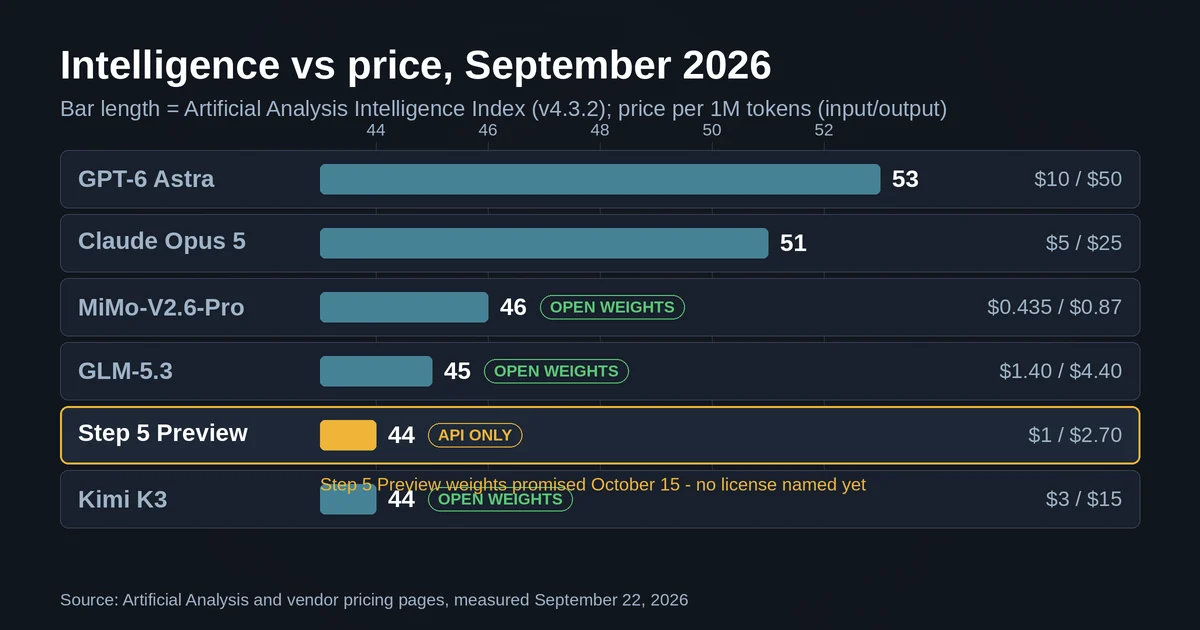
All figures below are Artificial Analysis-measured, live on September 22, 2026:
| Model | AA Intelligence Index | Rank | In $/M | Out $/M |
|---|---|---|---|---|
| Step 5 Preview | 44 | #26/202 | 1.00 (0.05 hit) | 2.70 |
| GPT-6 Astra | 53 | #3/202 | 10.00 | 50.00 |
| Claude Opus 5 | 51 | #7/202 | 5.00 | 25.00 |
| MiMo-V2.6-Pro (open) | 46 | #1/114 open | 0.435 | 0.87 |
| GLM-5.3 (open) | 45 | #2/114 open | 1.40 | 4.40 |
| Kimi K3 (open) | 44 | #3/114 open | 3.00 | 15.00 |
The uncomfortable fact first: Xiaomi's MiMo-V2.6-Pro is both cheaper and higher-indexed than Step 5 Preview on AA - $0.435/$0.87 per M tokens against an index of 46, versus Step 5's $1.00/$2.70 at 44. Step 5's actual differentiation is not raw price-performance in the open class; it is the finance-and-coding agentic positioning, the vision and video input support, and the day-one Claude Code integration.
There is a standing caveat on the "open-weight class" numbers too. Step 5 Preview's 44 ties Kimi K3 for #3 among open-class models, behind MiMo-V2.6-Pro (46) and GLM-5.3 (45). But those three rivals are downloadable today, and Step 5 Preview is not - its open-class standing is not backed by actual weights yet. AA's own comparison notes describe Opus 5 and GPT-6 Astra as "particularly expensive" and GLM-5.3 as "very verbose", while MiMo-V2.6-Pro is flagged as notably fast.
For context, we have previously covered GLM-5.3's position in this same Chinese open-weight wave and the broader slide in inference costs that this launch continues. Nobody has covered StepFun here before - this is the first look.
Pilot now or wait for the checkpoint?
Should you build on Step 5 Preview today?
The pilot-today case is straightforward: the API is cheap, the mid-tier intelligence is independently verified rather than promised, and the agentic feature set - tool calling, structured output, a documented Claude Code integration - is all live. At rank #26 of 202, $1/$2.70 is among the best dollars-per-index you will find on a preview API, and the 95% cache discount makes agent loops genuinely inexpensive to run. If you have a Claude Code-based workflow, wiring step-5-preview in for a week of real tasks is a cheap experiment, and the selectable reasoning-effort setting lets you dial output cost down on simple jobs.
The wait-for-checkpoint case is just as real. It is a preview - pricing may not survive the suffix dropping. No license is named for the October 15 weights, so there is no self-host exit yet. The official HF repo is unavailable. The headline coding numbers are self-reported. Output is capped at 64k tokens. And preview models can change or vanish - the HF repo already did.
The decision rule we would apply: wire it into a non-production pilot this week - the capability is real and the cost is trivial. Do not build a product on it until October 15 brings both weights and a named license. Hold StepFun to its own precedent: Step-3.5 and Step-3.7-Flash shipped Apache-2.0, and anything more restrictive than that deserves scrutiny. On October 15, check three things: whether the weights are actually live, what the license is, and whether the released config matches the announced 600B/27B sparse MoE spec. Until then, treat Step 5 Preview as what it is today: a cheap, capable rental with a dated promise attached.
Frequently asked questions
Three questions keep coming up around this launch. Each is answered strictly from what this post has already established above.
Can I self-host Step 5 Preview today? No. The API and StepFun AI Studio are the only access. The official Hugging Face repo is unavailable (removed or gated) as of September 22, and the October 15 BF16 weights promise names no license. A third-party 1.21TB shard repo exists, but its provenance is unproven - treat it as unofficial.
Is the "1/8 of Claude Opus 5's cost" claim verifiable? No. It is vendor-reported with undisclosed methodology - task count, difficulty mix, and prices are all unspecified. Token-price math on a 1M-input/0.1M-output workload gives about 5.9x, not 8x. StepFun may be factoring verbosity differences on specific tasks, but nothing independent reproduces the figure.
What changes on October 15 if the license is restrictive? Everything, for product builders. The weights ship in BF16, but without a permissive license - StepFun's Step-3.5/3.7-Flash precedent is Apache-2.0 - you are locked into the preview-priced API with no self-host exit. A restrictive license would leave MiMo-V2.6-Pro and GLM-5.3 as the deployable open-weight alternatives.
Pricing and plan details are as published by the vendor around September 22, 2026 and can change - confirm on the official site.